Question
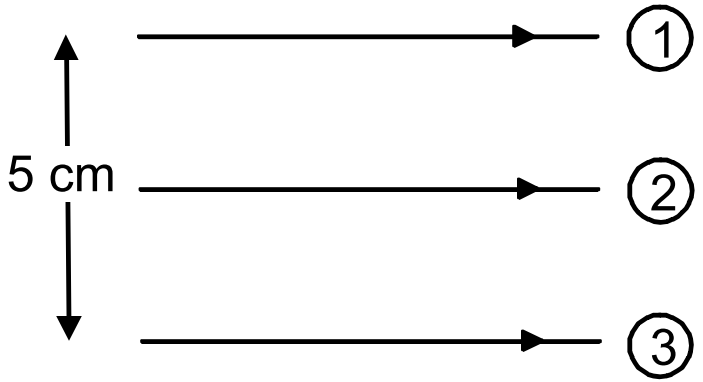
Three coplanar parallel wires, each carrying a current of 10A along the same direction, are placed with a separation 5.0cm between the consecutive ones. Find the matnitude ol the magnetic force per unit lenght acting on the wires.
Answer

i = 10A

Magnetic force due to two parallel Current Carrying wires.

$\text{F}=\frac{\mu_0\text{I}_1\text{I}_2}{2\pi\text{r}}$

So, $\overrightarrow{\text{F}}\ \text{or}\ 1=\overrightarrow{\text{F}}\ \text{or}\ 2+\overrightarrow{\text{F}}\ \text{by}\ 3$

$=\frac{\mu_0\times10\times10}{2\pi\times5\times10^{-2}}+\frac{\mu_0\times10\times10}{2\pi\times10\times10^{-2}}$

$=\frac{4\pi\times10^{-7}\times10\times10}{2\pi\times5\times10^{-2}}+=\frac{4\pi\times10^{-7}\times10\times10}{2\pi\times10\times10^{-2}}$

$=\frac{2\times10^{-3}}{5}+\frac{10^{-3}}{5}=\frac{3\times10^{-3}}{5}=6\times10^{-4}\text{N}$ towards middle wire

Need a full question paper?

Generate a complete, print-ready paper with questions like this in minutes — across 16+ boards, with answer keys.
Start Generating Free

Similar questions

A sound source, fixed at the origin, is continuously emitting sound at a frequency of 660Hz. The sound travels in air at a speed of 330m/s. A listener is moving along the line x = 336m at a constant speed of 26m/s. Find the frequency of the sound as observed by the listener when he is:
  1. At y = - 140m.
  2. At y = 0.
  3. At y = 140m.
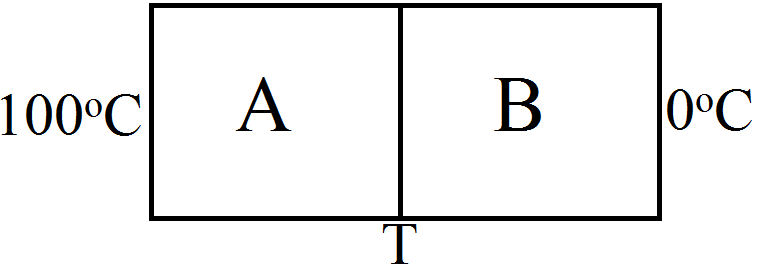
Two metal cubes A and B of same size are arranged as shown in figure. The extreme ends of the combination are maintained at the indicated temperatures. The arrangement is thermally insulated. The coefficient of thermal conductivity of A and B are 300 W/moC and 200 W/m°C respectively. After steady state is reached, what will be the temperature T of the interface?

State parallelogram law of vector addition and find the magnitude and direction of resultant of two vectors $\vec{\text{A}}$ and $\vec{\text{B}}$ in terms of their magnitude and angle between them.
A player throws a ball upwards with an initial speed of $29.4$ $m s ^{-1}$.
(a) What is the direction of acceleration during the upward motion of the ball?
(b) What are the velocity and acceleration of the ball at the highest point of its motion?
(c) Choose the $x = 0 ~ m$ and $t = 0 ~ s$ to be the location and time of the ball at its highest point, vertically downward direction to be the positive direction of $x$-axis, and give the signs of position, velocity and acceleration of the ball during its upward, and downward motion.
(d) To what height does the ball rise and after how long does the ball return to the player's hands?
(Take $g =9.8 ms^{-2}$ and neglect air resistance.)
Prove that :
(i) Inside the liquid the pressure is higher than on the open surface of the liquid.
(ii) The pressure difference between any two points in a vertical line inside the liquid occurs only due to the effect of gravity.
One end of a 10cm long silk thread is fixed to a large vertical surface of a charged nonconducting plate and the other end is fastened to a small ball having a mass of 10g and a charge of 4.0 × 10⁻⁵C. In equilibrium, the thread makes an angle of 60° with the vertical. Find the surface charge density on the plate.
36. You are given, the following data about a group of particles, where n represents the number of molecules with speed vi
ni
2
4
8
6
3
vi(ms-1)
1.0
2.0
3.0
4.0
5.0
Calculate:
  1. Average speed.
  2. Rms speed.
  3. Most probable speed.
Answer the following:
What is the temperature of the triple-point of water on an absolute scale whose unit interval size is equal to that of the Fahrenheit scale?
A body of mass 0.3kg is taken up an inclined plane length 10m and height 5m and then allowed to slide down the bottom again. The coefficient of friction between the body and the plane is 0.15. What is the

  1. Work done by gravitational force over the round trip?
  2. Work done by the applied force over the upward journey?
  3. Work done by the frictional force over the round trip?
  4. Kinetic energy of the body at the end of trip? (g = 10ms-2)

Doubly-ionised helium ions are projected with a speed of 10km/s-1 in a direction perpendicular to a uniform magnetic field of magnitude 1.0T. Find
  1. The force acting on an ion.
  2. The radius of the circle in which it circulates.
  3. The time taken by an ion to complete the circle.