Three copper rods are subjected to different potential difference. Compare the drift speed of electrons through them. Assume that all $3$ are at the same temperature.
| Length | Diameter | Potential difference | |
| $(A)$ | $L$ | $3d$ | $V$ |
| $(B)$ | $2L$ | $d$ | $2V$ |
| $(C)$ | $3L$ | $2d$ | $2V$ |
Medium


Download our appand get started for free
Experience the future of education. Simply download our apps or reach out to us for more information. Let's shape the future of learning together!No signup needed.*
Similar Questions
- 1Masses of $3$ wires of same metal are in the ratio $1 : 2 : 3$ and their lengths are in the ratio $3 : 2 : 1$. The electrical resistances are in ratioView Solution
- 2View SolutionThe temperature at which thermal electric power of a thermo couple becomes zero is called
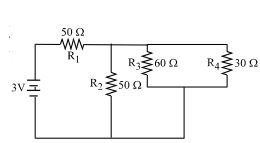
- 3In the circuit shown, the resistances are given in ohms and the battery is assumed ideal with $\mathrm{emf}$ equal to $3.0$ $\mathrm{volts}.$ The resistor that dissipates the most power isView Solution
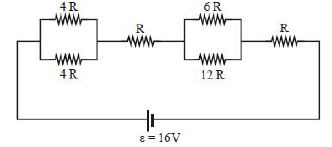
- 4The resistive network shown below is connected to a $D.C.$ source of $16\, V$. The power consumed by the network is $4\, Watt$. The value of $R$ is ............. $\Omega$View Solution
- 5A $10\, ohm$ electric heater operates on a $110\, V$ line. Calculate the rate at which it develops heat in ............... $watts$View Solution
- 6Two identical batteries, each of $e.m.f.$ $2\, volt$ and internal resistance $1.0\, ohm$ are available to produce heat in an external resistance $R = 0.5\,ohm$ by passing a current through it. The maximum Joulean power that can be developed across $R$ using these batteries is ............. $watt$View Solution
- 7$STATEMENT-1$ In a Meter Bridge experiment, null point for an unknown resistance is measured. Now, the unknown resistance is put inside an enclosure maintained at a higher temperature. The null point can be obtained at the same point as before by decreasing the value of the standard resistance. andView Solution
$STATEMENT-2$ Resistance of a metal increases with increase in temperature.
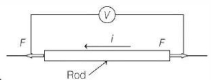
- 8As shown in the schematic below, a rod of uniform cross-sectional area $A$ and length $l$ is carrying a constant current $i$ through it and voltage across the rod is measured using an ideal voltmeter. The rod is stretched by the application of a force $F$. Which of the following graphs would show the variation in the voltage across the rod as function of the strain $\varepsilon$ when the strain is small. Neglect Joule heating.View Solution
- 9The internal resistance of a primary cell is $4\, ohm$. It generates a current of $0.2\, amp$ in an external resistance of $21\, ohm$. The rate at which chemical energy is consumed in providing the current is .............. $J/s$View Solution
- 10$A\,\,{5\,^o}C$ rise in the temperature is observed in a conductor by passing some current. When the current is doubled, then rise in temperature will be equal to ............. $^oC$View Solution