Three copper rods are subjected to different potential difference. Compare the drift speed of electrons through them. Assume that all $3$ are at the same temperature.
| Length | Diameter | Potential difference | |
| $(A)$ | $L$ | $3d$ | $V$ |
| $(B)$ | $2L$ | $d$ | $2V$ |
| $(C)$ | $3L$ | $2d$ | $2V$ |
Medium
Download our app for free and get started
$\mathrm{i}=\mathrm{neAV}_{\mathrm{drift}}=\frac{\mathrm{V}}{\mathrm{R}}$
$\mathrm{R}=\frac{\rho \ell}{\mathrm{A}}=\frac{4 \rho \ell}{\pi \mathrm{d}^{2}}$
$\therefore {{\rm{V}}_{{\rm{drift}}}} = \frac{{\rm{V}}}{{{\rm{RneA}}}} = \frac{{\rm{V}}}{{\frac{{\rho \ell }}{{\rm{A}}} \times {\rm{neA}}}} = \frac{{\rm{V}}}{{\rho \ell {\rm{ne}}}} \propto \frac{{\rm{V}}}{\ell }$

Download our appand get started for free
Experience the future of education. Simply download our apps or reach out to us for more information. Let's shape the future of learning together!No signup needed.*
Similar Questions
- 1Two electric bulbs whose resistance are in the ratio of $1: 2$, are connected in parallel to a constant voltage source. The power dissipated in them has the ratioView Solution
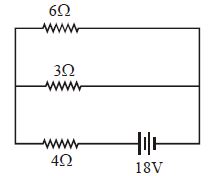
- 2The total power dissipated in watts in the circuit shown is ............. $W$View Solution
- 3A coil develops heat of $800\, cal/sec$. When $20\, volts$ is applied across its ends. The resistance of the coil is .............. $\Omega$ ($1$ $cal$ = $4.2$ $joule$)View Solution
- 4A potentiometer wire has length $10\, m$ and resistance $20\,\Omega $. A $2. 5\, V$ battery of negligible internal resistance is connected across the wire with an $80\,\Omega $ series resistance. The potential gradient on the wire will beView Solution
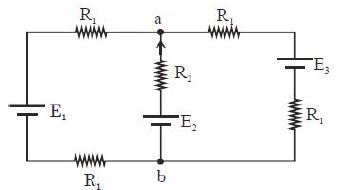
- 5For the circuit shown, with ${R_1} = 1.0\,\Omega $, ${R_2} = 2.0\,\Omega $, ${E_1} = 2\,V$ and ${E_2} = {E_3} = 4\,V$, the potential difference between the points $‘a’$ and $‘b’$ is approximately (in $V$)View Solution
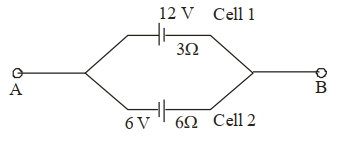
- 6Two cells are connected between points $A$ and $B$ as shown. Cell $1$ has emf of $12\,V$ and internal resistance of $3\,\Omega$. Cell $2$ has emf of $6\,V$ and internal resistance of $6\,\Omega$. An external resistor $R$ of $4\,\Omega$ is connected across $A$ and $B$. The current flowing through $R$ will be $.............A$.View Solution
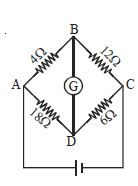
- 7View SolutionIn the following diagram the wheat stone bridge is balanced when we interchange the resistances of
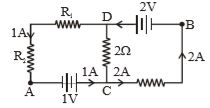
- 8In the circuit shown below, if the potential at point $A$ is taken to be zero, the potential at point $B$ is .............. $V$View Solution
- 9Heater of electric kettle is made of a wire of length $L$ and diameter $d$. It takes $4$ minutes to raise the temperature of $0.5 \ kg$ water by $40\ K$. This heater is replaced by a new heater having two wires of the same material, each of length $L$ and diameter $2 d$. The way these wires are connected is given in the options. How much time in minutes will it take to raise the temperature of the same amount of water by $40K$ ?View Solution
$(A)$ $4$ if wires are in parallel
$(B)$ $2$ if wires are in series
$(C)$ $1$ if wires are in series
$(D)$ $0.5$ if wires are in parallel.
- 10Power dissipated across the $8\,\Omega $ resistor in the circuit shown here is $2\, watt$. The power dissipated in watt units across the $3\,\Omega $ resistor isView Solution