Question
Three elements ‘X’, ‘Y’ and ‘Z’ have atomic numbers 7, 8 and 9 respectively.
  1. State their positions (Croup number and period number both) in the Modern Periodic Table.
  2. Arrange these elements in the decreasing order of their atomic radii.
  3. Write the formula of the compound formed when ‘X’ combines with ‘Z’.
Answer


The electronic configuration of the elements X, Y and Z can be written as: (X - 2, 5) (Y - 2, 6) (Z - 2, 7)
  1. Since all the elements consists two valence shells, therefore all will belong to period $2^{nd}$ Group to which X belongs = 10 + 5 = 15
Group to which Y belongs = 10 + 6 = 16
Group to which Z belongs = 10 + 7 = 17
  1. The elements can be arranged according to the decreasing order of atomic radii as follows: X > Y > Z this is because size of the atom decreases when moving from left to right in a period.
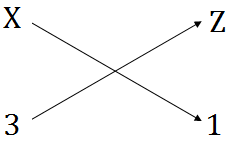
  2. When X combines with Z
Valency of X = 3
Valency of Z = 1
Cross multiplying the valences.

The compound formed is $XZ_3$.

Need a full question paper?

Generate a complete, print-ready paper with questions like this in minutes — across 16+ boards, with answer keys.

Start Generating Free

Similar questions

What is the effect of DNA copying, which is not perfectly accurate, on the reproduction process? How does the amount of DNA remain constant though each new generation is a combination of DNA copies of two individuals?
An electric heater is connected to the 230V mains supply. A current of 8A flows through the heater.
  1. How much charge flows around the circuit each second?
  2. How much energy is transferred to the heater each second?
How are contributions of Darwin different from that of Mendel?
Leaves of a healthy potted plant were coated with vaseline. Will this plant remain healthy for long? Give reason for your answer.
What is meant by ‘group’ in the modern periodic table? How do the following change on moving from top to bottom in a group?
  1. Number of valence electrons.
  2. Number of occupied shells.
  3. Size of atoms.
  4. Metallic character of elements.
  5. Effective nuclear charge experienced by valence electrons.
What steps would you suggest to reduce energy consumption?
The magnification of an image formed by a lens is – 1. If the distance of the image from the optical centre of the lens is 35 cm, where is the object placed ? What is the nature and focal length of the lens? If the object is displaced 20 cm towards the optical centre of the lens, where would the image be formed and what will be its nature? Draw a ray diagram to justify your answer.
  1. Which parts of the eye cause rays of light to converge on the retina?
  2. Which part causes the greatest convergence?
  3. Which part brings the image into sharp focus on the retina? How does it do this?

Draw the following diagram, in which a ray of light is incident on a concave/convex mirror, on your answer sheet. Show the path of this ray, after reflection, in each case.
a. Mention one function each of the following organs in human male reproductive system:
i. Testis
ii. Scrotum
iii. Vas deferens
iv. Prostate gland
b. Name the type of germ cell which (i) is motile, and (ii) stores food.
