MCQ
Three forces start acting simultaneously on a particle moving with velocity $\vec{\text{v}.}$ These forces are represented in magnitude and direction by three sides of a triangle taken in the same order. The particle will now move with a velocity.
  • A
    Less then $\vec{\text{v}}$
  • B
    More than $\vec{\text{v}}$
  • $\vec{\text{v}}$ only
  • D
    None of these

Answer

Correct option: C.
$\vec{\text{v}}$ only
Resultant of three forces represented completely by three sides of a triangle taken in the same order is zero. Therefore, velocity of particle remains unaffected.

Need a full question paper?

Generate a complete, print-ready paper with questions like this in minutes — across 16+ boards, with answer keys.

Start Generating Free

Similar questions

If the heart pushes $1 cc$  of blood in one second under pressure $20000 N/m^2$ the power of heart is.......$ W$
Which of the following statement must always be true?
$I.$ If an objects acceleration is zero, then its speed must remain constant.
$II.$ If an objects acceleration is constant, then it must move in a straight line.
$III.$ If an objects speed remains constant, then its acceleration must be zero.
A particle of mass $M$ originally at rest is subjected to a force whose direction is constant but magnitude varies with time according to the relation

$F=F_{0}\left(1-\left(\frac{t-T}{T}\right)^{2}\right)$

Where $F_{0}$ and $T$ are constants. The force acts only for the time internal $2 T$. The velocity $v$ of the particle after time $2 {T}$ is -

If the displacement of a particle varies with time as $\sqrt{x}=t+7$, then
A particle is moving with speed $v= b\sqrt x$ along positive $x-$ axis. Calculate the speed of the particle at time $t = \tau$ (assume that the particle is at origin at $t = 0$ ).
A boat of mass $90\ kg$ is floating in still water. A boy of mass $30\ kg$ walks from the stem to the bow. The length of the boat is $3\ m$ . Distance through which the boat recoils is .......... $m$
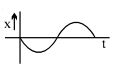
If position time graph of a particle is sine curve as shown, what will be its velocity-time graph.
A transverse wave travels along the Z-axis. The particles of the medium must move:
The focal length of a converging lens are $f_v$ and $f_r$ for violet and red light respectively:
Heat is being supplied at a constant rate to the sphere of ice which is melting at the rate of $0.1 \,gm / s$. It melts completely in $100 \,s$. The rate of rise of temperature thereafter will be ............ $^{\circ} C / s$