MCQ
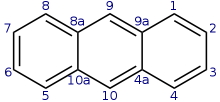
Three fused benzene rings are found in
  • A
    Naphthalene
  • Anthracene
  • C
    Phenanthroline
  • D
    Triphenyl methane

Answer

Correct option: B.
Anthracene
b
Anthracene is a solid polycyclic aromatic hydrocarbon ($PAH$) of formula $C _{14} H _{10}$ consisting of three fused benzene rings. It is a component of coal tar. 

Anthracene is used in the production of the red dye alizarin and other dyes.

Anthracene is colorless but exhibits a blue $(400-500\, nm$ peak) fluorescence under ultraviolet radiation
Need a full question paper?

Generate a complete, print-ready paper with questions like this in minutes — across 16+ boards, with answer keys.

Start Generating Free

Similar questions

Aluminium reacts with sulfuric acid to form aluminium sulfate and hydrogen. What is the volume of hydrogen gas in liters ($L$) produced at $300 K$ and $1.0 atm$ pressure, when $5.4 g$ of aluminium and $50.0 mL$ of $5.0 M$ sulfuric acid are combined for the reaction?

(Use molar mass of aluminium as $27.0 g mol ^{-1}, R =0.082 atm L mol { }^{-1} K ^{-1}$ )

Product $(D)$ in above sequence is
The incorrect stability order of $+3$ and $+1$ states of $13^{th}$ group elements (boron family) is
Phenyl magnesium bromide reacts with methanol to give
The standard reduction potentials at $298\,K$ for the following half reactions are given against each

$Z{n^{2 + }}\,(aq)\, + \,2e\, \rightleftharpoons \,Zn\,(s)\,;\, - \,0.762\,V$

$C{r^{3 + }}\,(aq)\, + \,3e\, \rightleftharpoons \,Cr(s)\,;\, - \,0.740\,\,V$

$2{H^ + }\,(aq)\, + \,2e\, \rightleftharpoons \,{H_2}(g)\,;\,\,\,0.00\,\,\,V$

$F{e^{3 + }}\,(aq)\, + \,e\, \rightleftharpoons \,F{e^{2 + }}(aq)\,;\,\,\,0.770\,\,\,V$

Which is the strongest reducing agent ?

If $‘a’ $ is the initial concentration and $ ‘n’ $ is the order of the reaction and the half life period is $ ‘T’,$  then
Product of the given reaction is
To obtain steel entirely free from sulphur and phosphorus, the process used is
If heat of neutralization is $-13.7\, KCal$ at $25\,^oC$ and $\Delta H_f^o (H_2O) = -68\, KCal$ then standard enthalpy of formation of $OH^-$ will be.....$KCal$
Which of the following shape can not be obtained from trigonal bipyramidal geometry