MCQ
Three harmonic waves having equal frequency $\mathrm{v}$ and same intensity $\mathrm{I}_{0}$, have phase angles $0 , \frac{\pi}{4}$ and $-\frac{\pi}{4}$ respectively. When they are superimposed the intensity of the resultant wave is close to
  • $5.8 \mathrm{I}_{0}$
  • B
    $0.2 \mathrm{I}_{0}$
  • C
    $\mathrm{I}_{0}$
  • D
    $3 \mathrm{I}_{0}$

Answer

Correct option: A.
$5.8 \mathrm{I}_{0}$
a
Let amplitude of each wave is $A.$

Resultant wave equation

$=A \sin \omega t+A \sin \left(\omega t-\frac{\pi}{4}\right)+A \sin \left(\omega t+\frac{\pi}{4}\right)$

$=\mathrm{A} \sin \omega \mathrm{t}+\sqrt{2} \mathrm{A} \sin \omega \mathrm{t}$

$=(\sqrt{2}+1) \mathrm{A} \sin \omega \mathrm{t}$

Resultant wave amplitude $=(\sqrt{2}+1) \mathrm{A}$

as $I \propto A ^{2}$

so $\frac{\mathrm{I}}{\mathrm{I}_{0}}=(\sqrt{2}+1)^{2}$

$I=5.8 \mathrm{I}_{0}$

Need a full question paper?

Generate a complete, print-ready paper with questions like this in minutes — across 16+ boards, with answer keys.

Start Generating Free

Similar questions

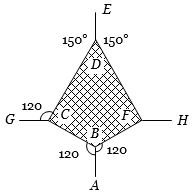
The adjacent figure is the part of a horizontally stretched net. section $AB$ is stretched with a force of $10 \,N$. The tensions in the sections $BC$ and $BF$ are
Considering the gases to be ideal, the value of $\gamma = \frac{{{C_P}}}{{{C_V}}}$ for a gaseous mixture consisting of $= 3$ moles of carbon dioxide and $2$ moles of oxygen will be $({\gamma _{{O_2}}} = 1.4,\,\,{\gamma _{C{O_2}}} = 1.3)$
Two simple harmonic motions $y_1 = A \sin \omega t$ and $y_2 =A \cos \omega t$ are superimposed on a particle of mass $m.$ The total mechanical energy of the particle is :
A uniform rope of mass $M$ and length $L$ is fixed at its upper end vertically from a rigid support. Then the tension in the rope at the distance $l$ from the rigid support is $x$
The dimensional formula for latent heat is:
Four spheres $A, B, C$ and $D$ are of same radius but made of different metals. Their densities are in ratio $6 : 3 : 4 : 5$ and specific heats are in ratio $2 : 5 : 4 : 6$ . These are initially kept at the same temperature and placed in the same surroundings. The sphere which has the slowest rate of cooling is
The potential energy of a simple harmonic oscillator when the particle is half way to its end point is (where $E$ is the total energy)
If mass is written as $\mathrm{m}=\mathrm{kc}^{\mathrm{p}} \mathrm{G}^{-1 / 2} \mathrm{~h}^{1 / 2}$ then the value of $P$ will be : (Constants have their usual meaning with $\mathrm{k}$ a dimensionless constant)
A man carries a load on his head through a distance of $5 \,m$. The maximum amount of work is done when he ..........
The expansion in volume of a substance due to increase in temperature does not depend :