MCQ
Three identical bodies of equal mass $M$ each are moving along a circle of radius $R$ under the action of their mutual gravitational attraction. The speed of each body is
  • A
    $\sqrt {\frac{GM}{R}}$
  • B
    $\sqrt {\frac{GM}{3R}}$
  • $\sqrt {\frac{GM}{\sqrt 3 R}}$
  • D
    $\sqrt {\frac{GM}{\sqrt 2 R}}$

Answer

Correct option: C.
$\sqrt {\frac{GM}{\sqrt 3 R}}$
c
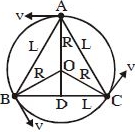
Consider the circle with centre at $\mathrm{O},$ and having radius $\mathrm{R}$. In it consider three bodies of masses $M$ each moving with velocity $v$ under the action of their gravitational attraction.

$\mathrm{R}=\frac{2}{3} \mathrm{AD}=\frac{2}{3} \times \mathrm{L} \sin 60^{\circ}=\frac{2 \mathrm{L}}{3} \times \frac{\sqrt{3}}{2}$

$=\frac{\mathrm{L}}{\sqrt{3}} \quad$ or $\quad \mathrm{L}=\sqrt{3} \mathrm{R}$

Centripetal force on any one mass $\mathrm{M}$ is

$=\frac{2 \mathrm{GM}^{2}}{\mathrm{L}^{2}} \cos \left(\frac{60^{\circ}}{2}\right)$

$\therefore \frac{\mathrm{Mv}^{2}}{\mathrm{R}}=\frac{2 \mathrm{GM}^{2}}{\mathrm{L}^{2}} \times \frac{\sqrt{3}}{2}$

or $\frac{\mathrm{GM}^{2}}{(\sqrt{3} \mathrm{R})^{2}} \sqrt{3}=\frac{\mathrm{Mv}^{2}}{\mathrm{R}}$

$\therefore v=\sqrt{\frac{\mathrm{GM}}{\sqrt{3} \mathrm{R}}}$
Need a full question paper?

Generate a complete, print-ready paper with questions like this in minutes — across 16+ boards, with answer keys.

Start Generating Free

Similar questions

The variation of potential energy $U$ of a system is shown in figure. The force acting on the system is best represented by
A small block is connected to one end of a massless spring of un-stretched length $4.9 \ m$. The other end of the spring (see the figure) is fixed. The system lies on a horizontal frictionless surface. The block is stretched by $0.2$ $m$ and released from rest at $t =0$. It then executes simple harmonic motion with angular frequency $\omega=\frac{\pi}{3} \ rad / s$.

Simultaneously at $t=0$, a small pebble is projected with speed $v$ from point $P$ at an angle of $45^{\circ}$ as shown in the figure. Point $P$ is at a horizontal distance of $10 \ cm$ from $O$. If the pebble hits the block at $t=1 \ s$, the value of $v$ is (take $g =10 \ m / s ^2$ )

The figure represents the instantaneous picture of a longitudinal harmonic wave travelling along the negative $x$-axis. Identify the correct statement $(s)$ related to the movement of the points shown in the figure. The points of maximum rarefaction are
A string fixed at both the ends is vibrating in two segments. The wavelength of the corresponding wave is
An object is projected at an angle of $45^°$ with the horizontal. The horizontal range and the maximum height reached will be in the ratio.
A bomb is released from a horizontal flying aeroplane. The trajectory of bomb is
A stone is thrown with an initial speed of $4.9 \,m/s$ from a bridge in vertically upward direction. It falls down in water after $2 \,sec$. The height of the bridge is..........$m$
Two particles $A$ and $B,$ initially at rest, move towards each other under a mutual force of attraction. At the instant when the speed of $A$ is $V$ and the speed of $B$ is $2V,$ the speed of the centre of mass of the system is:
Two trains travelling on the same track are approaching each other with equal speeds of $40\ m/s$ . The drivers of the trains begin to decelerate simultaneously when they are just $2.0\ km$ apart. Assuming the decelerations to be uniform and equal, the value of the deceleration to barely avoid collision should be..........$m/s^2$
The kinetic energy of one gm-mole of a gas at normal temperature and pressure is $(R = 8.31 J/Mole-K)$