Question
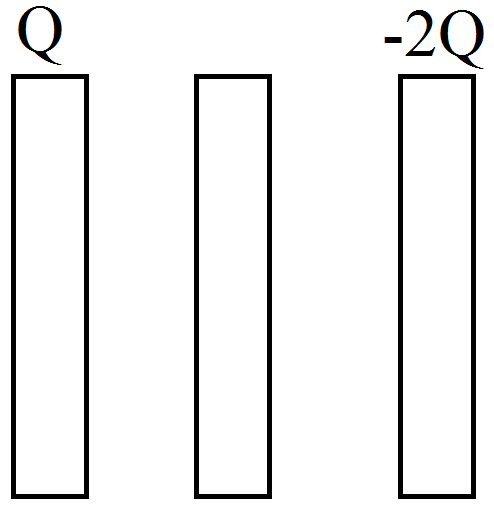
Three identical metal plates with large surface areas are kept parallel to each other as shown in figure. The leftmost plate is given a charge Q, the rightmost a charge -2Q and the middle one remains neutral. Find the charge appearing on the outer surface of the rightmost plate.

Answer


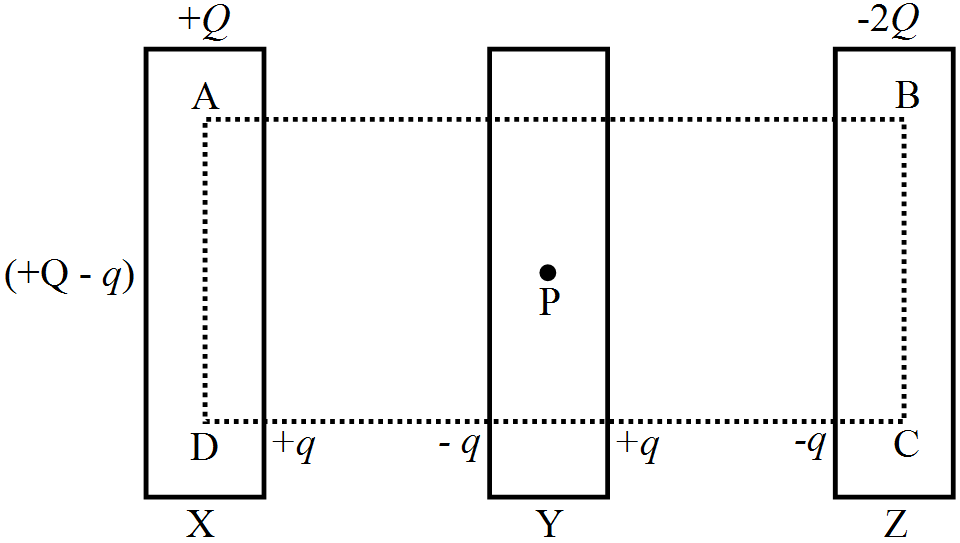
Consider the Gaussian surface as shown in the figure.

Let the charge on the outer surface of the left-most plate be q. Thus, the charges on the plates are distributed as shown in the diagram.

The net field at point P due to all the induced charges must be zero, as it is lying inside the metal surface.

Let the surface area of the plates be A.

Electric field at point P due to the charges on plate X:

Due to charge (+Q - q) is $\frac{\text{Q}-\text{q}}{2\text{A}\in_0}$ in the right direction

Due to charge (+q) is $\frac{\text{q}}{2\text{A}\in_0}$ in the right direction

Electric field at point P due to charges on plate Y:

Due to charge (-q) is $\frac{\text{q}}{2\text{A}\in_0}$ in the right direction

Due to charge (+q) is $\frac{\text{q}}{2\text{A}\in_0}$ in the left direction

Electric field at point P due to charges on plate Z:

Due to charge (-q) is $\frac{\text{q}}{2\text{A}\in_0}$ in the right direction

Due to charge (-2Q + q) is $\frac{\text{2Q}-\text{q}}{2\text{A}\in_0}$ in the right direction

The net electric field at point P:

$\frac{\text{Q}-\text{q}}{2\text{a}\in_0}+\frac{\text{q}}{2\text{A}\in_0}-\frac{\text{q}}{2\text{A}\in_0}-\frac{\text{q}}{2\text{A}\in_0}+\frac{\text{q}}{2\text{A}\in_0}+\frac{\text{2Q}-\text{q}}{2\text{A}\in_0}=0$

$\frac{\text{Q}-\text{q}}{2\text{A}\in_0}+\frac{\text{2Q}-\text{q}}{2\text{A}\in_0}=0$

$\text{Q}-\text{q}+\text{2Q}-\text{q}=0$

$\text{3Q}-2\text{q}=0$

$\text{q}=\frac{\text{3Q}}{2}$

Thus, the charge on the outer plate of the right-most plate

$-2\text{Q}+\text{q}=-2\text{Q}+\frac{3\text{Q}}{2}=-\frac{\text{Q}}{2}$
Need a full question paper?

Generate a complete, print-ready paper with questions like this in minutes — across 16+ boards, with answer keys.

Start Generating Free

Similar questions

Find the radius and energy of a He+ ion in the states (a) n = 1, (b) n = 4 and (c) n = 10.
A capacitor of capacitance $100\mu\text{F}$ is connected to a battery of 20 volts for a long time and then disconnected from it. It is now connected across a long solenoid having 4000 turns per metre. It is found that the potential difference across the capacitor drops to 90% of its maximum value in 2.0 seconds. Estimate the average magnetic field produced at the centre of the solenofd during this period.
What is space wave propagation? State the factors which limit its range of propagation. Derive an expression for the maximum line of sight distance between two antennas for space wave propagation.
A long, straight wire of radius r carries a current i and is placed horizontally in a uniform magnetic field B pointing vertically upward. The current is uniformly distributed over its cross-section.
  1. At what points will the resultant magnetic field have maximum magnitude? What will be the maximum magnitude?
  2. What will be the minimum magnitude of the resultant magnetic field?
A resistance of R $\Omega$ draws current from a potentiometer as shown in the figure. The potentiometer has a total resistance RoΩ. A voltage V is supplied to the potentiometer. Derive an expression for the voltage across R when the sliding contact is in the middle of the potentiometer.

A semiconducting material has a band gap of 1eV. Acceptor impurities are doped into it which create acceptor levels 1meV above the valence band. Assume that the transition from one energy level to the other is almost forbidden if kT is less than $\frac{1}{50}$ of the energy gap. Also, if kT is more than twice the gap, the upper levels have maximum population. The temperature of the semiconductor is increased from 0K. The concentration of the holes increases with temperature and after a certain temperature it becomes approximately constant. As the temperature is further increased, the hole concentration again starts increasing at a certain temperature. Find the order of the temperature range in which the hole concentration remains approximately constant.
The diameter of the sun is 1.4 × 10⁹m and its distance from the earth is 1.5 × 10¹¹m. Find the radius of the image of the sun formed by a lens of focal length 20cm.
A square loop of side 10 cm and resistance $0.5 \Omega$ is placed vertically in the east west plane. A uniform magnetic field of 0.10 T is set up across the plane in the north-east direction. The magnetic field is decreased to zero in 0.70 s at a steady rate. Determine the magnitudes of induced emf and current during this time interval.
What is reverse bias? Explain the change occuring in the junction under the effect of reverse bias.
What is the parallel and crossed arrangement of polaroid?