Question
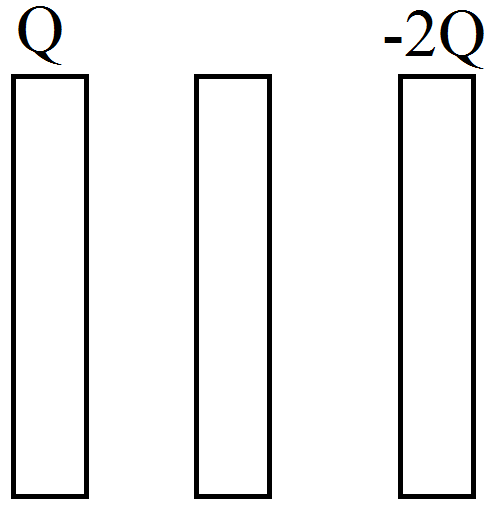
Three identical metal plates with large surface areas are kept parallel to each other as shown in figure. The leftmost plate is given a charge Q, the rightmost a charge -2Q and the middle one remains neutral. Find the charge appearing on the outer surface of the rightmost plate.

Answer


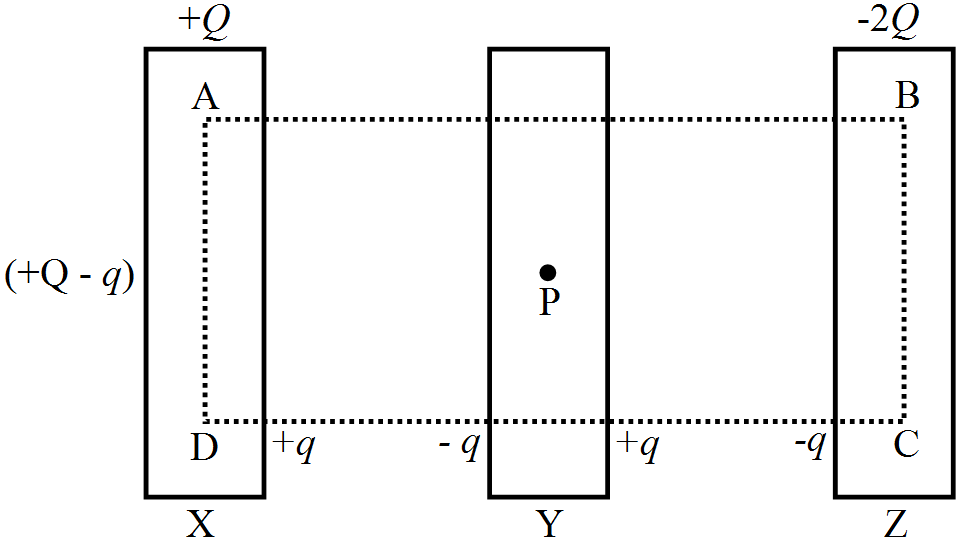
Consider the Gaussian surface as shown in the figure.

Let the charge on the outer surface of the left-most plate be q. Thus, the charges on the plates are distributed as shown in the diagram.

The net field at point P due to all the induced charges must be zero, as it is lying inside the metal surface.

Let the surface area of the plates be A.

Electric field at point P due to the charges on plate X:

Due to charge (+Q - q) is $\frac{\text{Q}-\text{q}}{2\text{A}\in_0}$ in the right direction

Due to charge (+q) is $\frac{\text{q}}{2\text{A}\in_0}$ in the right direction

Electric field at point P due to charges on plate Y:

Due to charge (-q) is $\frac{\text{q}}{2\text{A}\in_0}$ in the right direction

Due to charge (+q) is $\frac{\text{q}}{2\text{A}\in_0}$ in the left direction

Electric field at point P due to charges on plate Z:

Due to charge (-q) is $\frac{\text{q}}{2\text{A}\in_0}$ in the right direction

Due to charge (-2Q + q) is $\frac{\text{2Q}-\text{q}}{2\text{A}\in_0}$ in the right direction

The net electric field at point P:

$\frac{\text{Q}-\text{q}}{2\text{a}\in_0}+\frac{\text{q}}{2\text{A}\in_0}-\frac{\text{q}}{2\text{A}\in_0}-\frac{\text{q}}{2\text{A}\in_0}+\frac{\text{q}}{2\text{A}\in_0}+\frac{\text{2Q}-\text{q}}{2\text{A}\in_0}=0$

$\frac{\text{Q}-\text{q}}{2\text{A}\in_0}+\frac{\text{2Q}-\text{q}}{2\text{A}\in_0}=0$

$\text{Q}-\text{q}+\text{2Q}-\text{q}=0$

$\text{3Q}-2\text{q}=0$

$\text{q}=\frac{\text{3Q}}{2}$

Thus, the charge on the outer plate of the right-most plate

$-2\text{Q}+\text{q}=-2\text{Q}+\frac{3\text{Q}}{2}=-\frac{\text{Q}}{2}$
Need a full question paper?

Generate a complete, print-ready paper with questions like this in minutes — across 16+ boards, with answer keys.

Start Generating Free

Similar questions

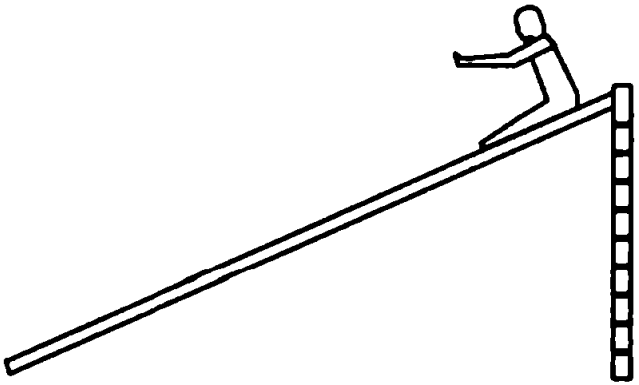
In a children's park, there is a slide which has a total length of 10m and a height of 8.0m (figure). Vertical ladder are provided to reach the top. A boy weighing 200N climbs up the ladder to the top of the slide and slides down to the ground. The average friction offered by the slide is three tenth of his weight. Find
  1. The work done by the ladder on the boy as he goes up.
  2. The work done by the slide on the boy as he comes down. Neglect any work done by forces inside the body of the boy.

A block of mass 30.0kg is being brought down by a chain. If the block acquires a speed of 40.0cm/s in dropping down 2.00m, find the work done by the chain during the process.
What are the basic requirements of a cooking utensil in respect of specific heat, thermal conductivity and coefficient of expansion?
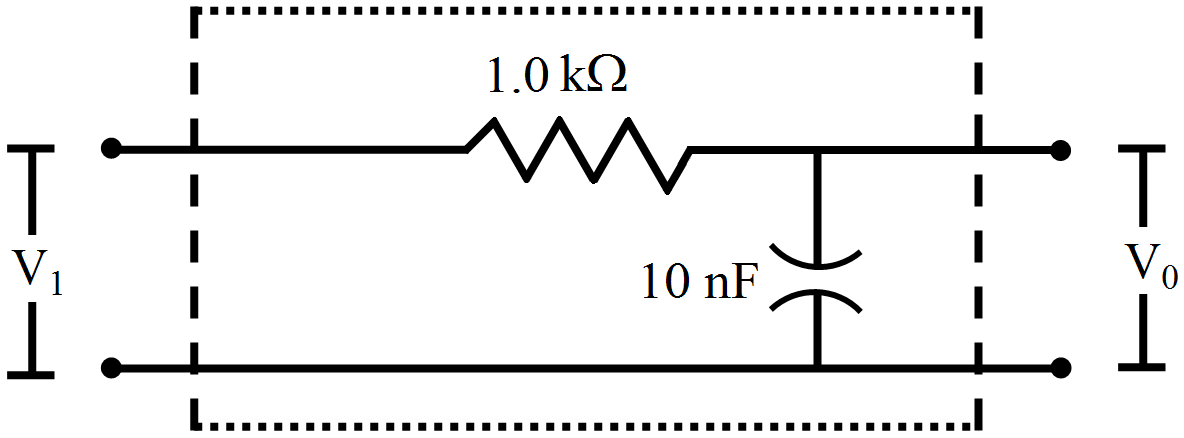
Figure shows a typical circuit for a low-pass filter. An AC input Vi = 10mV is applied at the left end and the output V0 is received at the right end. Find the output voltage for ν = 10kHz, 1.0MHz and 10.0MHz. Note that as the frequency is increased the output decreases and, hence, the name low-pass filter.

Calculate the radius of new bubble formed when two bubbles of radius $r_1$ and $r_2$ coalesce?
In a sonometer cord of length 24.7cm, resonance occurs with a tuning fork of frequency 256Hz. Deduce the velocity of the waves over the cord. At what length will resonance be observed with tuning fork of frequency 453Hz?
Find the dimensions of the following quantities
  1. Acceleration.
  2. Angle.
  3. Density.
  4. Kinetic energy.
  5. Gravitational constant.
  6. Permeability.
How is centripetal force provided in case of the following?
i. Motion of planet around the sun,
ii. Motion of moon around the earth.
iii. Motion of an electron around the nucleus in an atom.
In a photoelectric experiment, the collector plate is at 2.0V with respect to the emitter plate made of copper ($\phi$ - 4.5eV). The emitter is illuminated by a source of monochromatic light of wavelength 200 run. Find the minimum and maximum kinetic energy of the photoelectrons reaching the collector.
A parallel-plate capacitor with plate area 20cm2 and plate separation 1.0mm is connected to a battery. The resistance of the circuit is $10\text{k}\Omega.$ Find the time constant of the circuit.