Question
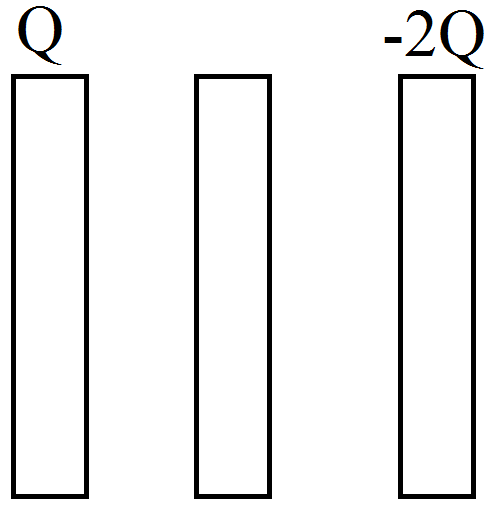
Three identical metal plates with large surface areas are kept parallel to each other as shown in figure. The leftmost plate is given a charge Q, the rightmost a charge -2Q and the middle one remains neutral. Find the charge appearing on the outer surface of the rightmost plate.

Answer


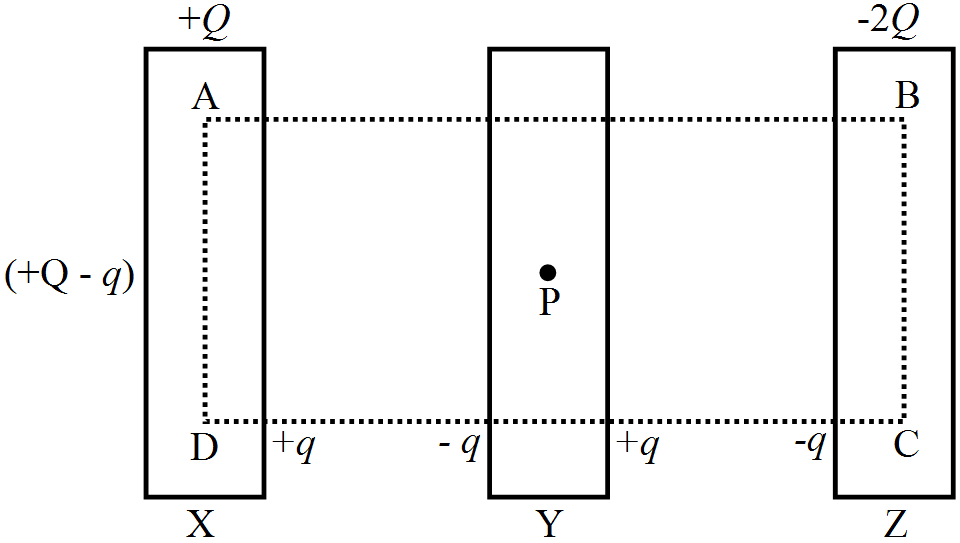
Consider the Gaussian surface as shown in the figure.

Let the charge on the outer surface of the left-most plate be q. Thus, the charges on the plates are distributed as shown in the diagram.

The net field at point P due to all the induced charges must be zero, as it is lying inside the metal surface.

Let the surface area of the plates be A.

Electric field at point P due to the charges on plate X:

Due to charge (+Q - q) is $\frac{\text{Q}-\text{q}}{2\text{A}\in_0}$ in the right direction

Due to charge (+q) is $\frac{\text{q}}{2\text{A}\in_0}$ in the right direction

Electric field at point P due to charges on plate Y:

Due to charge (-q) is $\frac{\text{q}}{2\text{A}\in_0}$ in the right direction

Due to charge (+q) is $\frac{\text{q}}{2\text{A}\in_0}$ in the left direction

Electric field at point P due to charges on plate Z:

Due to charge (-q) is $\frac{\text{q}}{2\text{A}\in_0}$ in the right direction

Due to charge (-2Q + q) is $\frac{\text{2Q}-\text{q}}{2\text{A}\in_0}$ in the right direction

The net electric field at point P:

$\frac{\text{Q}-\text{q}}{2\text{a}\in_0}+\frac{\text{q}}{2\text{A}\in_0}-\frac{\text{q}}{2\text{A}\in_0}-\frac{\text{q}}{2\text{A}\in_0}+\frac{\text{q}}{2\text{A}\in_0}+\frac{\text{2Q}-\text{q}}{2\text{A}\in_0}=0$

$\frac{\text{Q}-\text{q}}{2\text{A}\in_0}+\frac{\text{2Q}-\text{q}}{2\text{A}\in_0}=0$

$\text{Q}-\text{q}+\text{2Q}-\text{q}=0$

$\text{3Q}-2\text{q}=0$

$\text{q}=\frac{\text{3Q}}{2}$

Thus, the charge on the outer plate of the right-most plate

$-2\text{Q}+\text{q}=-2\text{Q}+\frac{3\text{Q}}{2}=-\frac{\text{Q}}{2}$
Need a full question paper?

Generate a complete, print-ready paper with questions like this in minutes — across 16+ boards, with answer keys.

Start Generating Free

Similar questions

A straight wire of length l can slide on two parallel plastic rails kept in a horizontal plane with a separation d. The coefficient of friction between the wire and the rails is $\mu.$ If the wire carries a current i, what minimum magnetic field should exist in the space in order to slide the wire on the rails?
Design a logical circuit using AND, OR and NOT gates to evaluate $\text{A}\overline{\text{BC}}+\text{B}\overline{\text{CA}}.$
In a p-n junction, the depletion region is 400nm wide and an electric field of 5 × 10⁵V/m exists in it.
  1. Find the height of the potential barrier.
  2. What should be the minimum kinetic energy of a conduction electron which can diffuse from the n-side to the p-side?
The number of electrons in an insulator is of the same order as the number of electrons in a conductor. What is then the basic difference between a conductor and an insulator?
(a) What happens if a bar magnet is cut into two pieces: (i) transverse to its length, (ii) along its length?
(b) A magnetised needle in a uniform magnetic field experiences a torque but no net force. An iron nail near a bar magnet, however, experiences a force of attraction in addition to a torque. Why?
(c) Must every magnetic configuration have a north pole and a south pole? What about the field due to a toroid?
(d) Two identical looking iron bars A and B are given, one of which is definitely known to be magnetised. (We do not know which one.) How would one ascertain whether or not both are magnetised? If only one is magnetised, how does one ascertain which one? [Use nothing else but the bars A and B.]
A converging lens and a diverging mirror are placed at a separation of 15cm. The focal length of the lens is 25cm and that of the mirror is 40cm. Where should a point source be placed between the lens and the mirror so that the light, after getting reflected by the mirror and then getting transmitted by the lens, comes out parallel to the principal axis?
A tank is filled with water to a height of 12.5 cm. The apparent depth of a needle lying at the bottom of the tank is measured by a microscope to be 9.4 cm. What is the refractive index of water? If water is replaced by a liquid of refractive index 1.63 up to the same height, by what distance would the microscope have to be moved to focus on the needle again?
In the circuit shown in the figure, identify the equivalent gate of the circuit and make its truth table.

Define relaxation time of the free electrons drifting in a conductor. How is it related to the drift velocity of free electrons? Use this relation to deduce the expression for the electrical resistivity of the material. 
Two particles, carrying charges -q and +q and having equal masses m each, are fixed at the ends of a light rod of length a to form a dipole. The rod is clamped at an end and is placed in a uniform electric field E with the axis of the dipole along the electric field. The rod is slightly tilted and then released. Neglecting gravity find the time period of small oscillations.