MCQ
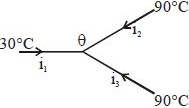
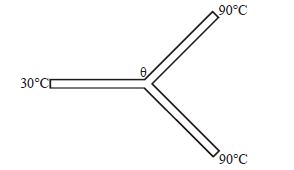
Three identical rods have been joined at a junction to make it a $Y$ shape structure. If two free ends are maintained at $90\,^oC$ and the third end is at $30\,^oC$ , then what is the junction temperature $\theta $ ?......... $^oC$
  • A
    $40$
  • B
    $50$
  • C
    $60$
  • $70$

Answer

Correct option: D.
$70$
d
Themal resistance $=\frac{\mathrm{L}}{\mathrm{KA}}=$ same for all $=\mathrm{R}(\mathrm{let})$ using kirchoff's law for heat current

$\mathrm{i}_{1}+\mathrm{i}_{2}+\mathrm{i}_{3}=0$

$\Rightarrow \frac{30-\theta}{R}+\frac{90-\theta}{R}+\frac{90-\theta}{R}=0$

$30-\theta+180-2 \theta=0 \Rightarrow 210=3 \theta \Rightarrow \theta=70^{\circ} \mathrm{C}$

Need a full question paper?

Generate a complete, print-ready paper with questions like this in minutes — across 16+ boards, with answer keys.

Start Generating Free

Similar questions

An object is propelled vertically to a maximum height of $4 R$ from the surface of a planet of radius $R$ and mass $M$. The speed of object when it returns to the surface of the planet is
A shell is fired vertically upwards with a velocity $v_1$ from a trolley moving horizontally with velocity $v_2$. A person on the ground observes the motion of the shell as a parabola, whose horizontal range is ....
If an object is projected vertically upwards with speed, half the escape speed of earth, then the maximum height attained by it is [ $R$ is radius of earth]
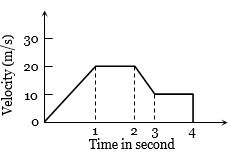
The variation of velocity of a particle with time moving along a straight line is illustrated in the following figure. The distance travelled by the particle in four seconds is.........$m$
A uniform rod of length $L$ has a mass per unit length $\lambda$ and area of cross-section $A$. If the Young's modulus of the rod is $Y$. Then elongation in the rod due to its own weight is ...........
If in a Vernier callipers $10 \,VSD$ coincides with $8 \,MSD$, then the least count of Vernier calliper is ............ $m$  [given $1 \,MSD =1 \,mm ]$
A river is flowing from west to east at a speed of $8\,m$ per min. A man on the south bank of the river, capable of swimming at $20\,m / min$ in still water, wants to swim across the river in the shortest time. He should swim in a direction
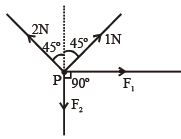
There are four forces acting at a point $P$ produced by strings as shown in figure, point $P$ is at rest. The forces $F_1$ and $F_2$ are respectively:-
Kepler's third law states that square of period of revolution $(T)$ of a planet around the sun, is proportional to third power of average distance $r$ between sun and planet i.e.

$\therefore \;{T^2} = k{r^3}$

here $K$ is constant.

If the masses of sun and planet are $M$ and $m$ respectively then as per Newton's law of gravitation force of attraction between them is $F = \frac{{GMm}}{{{r^2}}}$ , here $G$ gravitational constant . The relation between $G$ and $K$ is described as

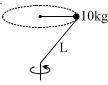
$A \,10\, kg$ ball attached to the end of a rigid massless rod of length $1\, m$ rotates at constant speed in a horizontal circle of radius $0.5\, m$ and period $1.57 \, sec$ as in fig. The force exerted by rod on the ball is ........ $N$.