Question
Three large identical plates are kept parallel to each other. The outer two plates are maintained at temperatures $T$ and $2 T$, respectively. The temperature of the middle plate in steady state will be close to ........... $T$
In steady state, heat gained by middle plate $=$ heat lost by it.
$\Rightarrow$ Heat radiations from plate $A+$ Heat radiations from plate $B=$ Heat radiations emitted from both surfaces
$\Rightarrow A \varepsilon \sigma T^{4}+A \varepsilon \sigma(2 T)^{4}=2 A \varepsilon \sigma\left(T_{1}\right)^{4}$
$\Rightarrow \quad T^{4}+2^{4} T^{4}=2 T_{1}^{4} \Rightarrow \frac{17}{2} T^{4}=T_{1}^{4}$
$\Rightarrow \quad T_{1}^{4}=\left(\frac{17}{2}\right)^{\frac{1}{4}} \cdot T \text { or } T_{1}=1.7 T$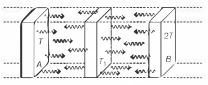
Generate a complete, print-ready paper with questions like this in minutes — across 16+ boards, with answer keys.
| Column $I$ | Column $II$ |
| $(A)$ Bimetallic strip | $(p)$ Radiation from a hot body |
| $(B)$ Steam engine | $(q)$ Energy conversion |
| $(C)$ Incandescent lamp | $(r)$ Melting |
| $(D)$ Electric fuse | $(s)$ Thermal expansion of solids |
$(i)\,\, C_6H_5COCl$
The correct decreasing order of their reactivity towards hydrolysis is