Question
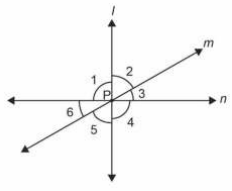
Three lines shown in the igure intersect each other at point $P.$
Image

Line lis perpendicular to line n.
The measure of $\angle 2$ is $65^\circ .$
$1.$ What is the measure of $\angle 6?$
$2.$ What is the sum of the measure of $\angle 3$ and $\angle 4?$
$A. 95^\circ $
$B. 115^\circ $
$C. 120^\circ $
$D. 155^\circ $
Answer

$9. 25^\circ $
$10. B. 115^\circ $

Need a full question paper?

Generate a complete, print-ready paper with questions like this in minutes — across 16+ boards, with answer keys.

Start Generating Free

Similar questions

Riya wrote an algebraic expression.
$56t^3 + 12t^2 + 6t + 16s^2 + 2s + 106$
$1.$ Which of the following terms has 6 as the coeficient$?$
$A. s$
$B. s^2$
$C. t$
$D. t^3$
$2.$ Write the factors of $56t^3.$
$3.$ What is the type of the algebraic expression written by Riya$?$
$A.$ Monomial
$B.$ Binomial
$C.$ Trinomial
$D.$ Polynomial
$4.$ Riya said, “There are two like terms in the algebraic expression.” Is Riya correct? Give reason.
$5.$ Riya added an algebraic expression to $56t^3 + 12t^2 + 6t + 16s^2 + 2s + 106.$ The resultant expression is $14t^2+ 7t + 9s.$ Which of the following algebraic expressions did she add?
$A. 56t^3+ 2t^2+ t - 16s^2+ 7s + 106$
$B. -56t^3+ 2t^2+ t - 16s^2+ 7s – 106$
$C. -56t^3 - 2t^2 - t - 16s^2 - 7s – 106$
$D. 56t^3+ 26t^2+ 11t + 16s^2+ 11s + 106$
Anand runs a computer repair service company. For a Lenovo laptop, he charges ₹450 for diagnosis and ₹60 per hour for repairs. For an Acer laptop, he charges ₹360 for diagnosis and ₹90 per hour for repairs.
Q.1. Anand repaired Mr Sharma's Lenovo laptop. He charged ₹810 for the work. How long did he take to complete the repair work?
(a) 5 hours$\quad$(b) 6 hours$\quad$(c) 7 hours$\quad$ (d) 8 hours
Q.2. Anand repaired Mr Singh's Acer laptop. The total charges were ₹1170. How long did he take to complete the repair work?
(a) 9 hours$\quad$(b) 8 hours$\quad$(c) 7 hours$\quad$(d) 6 hours
Q.3. What were the total service charges that Mr Dev had to pay for both the laptops?
(a) ₹ 630 $\quad$(b) ₹810$\quad$ (c) ₹1260$\quad$(d) ₹1620
Vibhor has a keen interest to invest in the share market. His investment consultant advised him to study the fluctuations in the values of certain shares over a period of 5 days. Vibhor found that on July 1, the price of one share of ABC company was ₹3735.
Q.1. On July 2, the price of the share increased by ₹ 147. What was the price of each share of ABC company on July 2?
(a) ₹3582$\quad$(b) ₹3872$\quad$(c)  ₹3882$\quad$(d) ₹3588
Q.2. On July 3, the share opened 27 below the previous day closing and again slipped by ₹9 by the end of the day. At what price did the share close on July 3?
(a) ₹3900 $\quad$(b) ₹3864$\quad$(c)₹ 3873 $\quad$(d) ₹3846
Q.3. On July 4, the share opened 128 above the previous day closing but again went down by ₹76 by the end of the day. What was the price of each share of ABC company at the end of the day on July 4?
(a) ₹3898$\quad$(b) ₹4050$\quad$(c) ₹3642$\quad$(d) ₹3787
Q.4. On July 5, the price of the share jumped ₹291 when the market opened. It rose further by ₹66 by the end of the day. What was the price of the share at the end of the day on July 5?
(a) ₹4123$\quad$(b) ₹3673$\quad$(c) ₹3541 $\quad$(d) ₹4255
Sameer arranged a vacation to Thailand with his children during their holidays. They were all excited to go scuba diving on the Coral Islands. Sameer dived 43 feet to reach the brain coral upon the directions of his instructor. He then rose by 18 feet to reach an underwater cave.
Q.1. What is the depth of the underwater cave?
(a) 18 feet$\quad$(b) 61 feet$\quad$(c) 25 feet$\quad$(d) 43 feet
Q.2. Sameer again dived 56 feet to reach the base of the reef. What is the depth of the reef?
(a) 56 feet$\quad$(b) 74 feet $\quad$(c) 99 feet $\quad$(d) 81 feet
Q.3. From the base of the reef, Sameer ascended 29 feet and reached a ridge. How deep is the ridge with respect to sea level?
(a) 52 feet$\quad$(b) 110 feet$\quad$(c) 85 feet$\quad$(d) 95 feet
Q.4. A whale passed at a depth of 23 feet from the sea level. How far was the whale from the ridge?
(a) 23 feet$\quad$(b) 81 feet$\quad$(c) 29 feet$\quad$(d) 52 feet
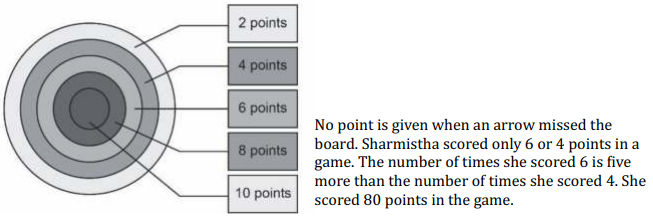
In an archery game, the points scored on hitting a circular region on a board is shown in the figure below.Image
$1.$ Which of the following equation represents Sharmistha’s score$?$
$A. 6x+ 4x= 80$
$B. 6x+ 4(x+ 5) =80$
$C. 6(x - 5) + 4x= 80$
$D. 6x+ 4(x - 5) = 80$
$2.$ How many arrows did Sharmistha shoot$?$
$A. 10$
$B. 11$
$C. 15$
$D. 30$
$3.$ Which of the following equations does $‘x= 5’$ not satisfy$?$
$A. 2x - 1 = 9$
$B. 3x+ 4 =19$
$C. 3x + 1 = 13$
$D. 4x - 3 = 17$
When Ram Niwas died, he left all his money for his grandchildren, 4 of whom were boys and 3 were girls. In his will he insisted that each grandchild must get equal share of the total amount of ₹$1,12,00,000$.
Q.1. What fraction of the money did the girls receive?
(a) $\frac{3}{4}$$\quad$(b)$\frac{1}{3}$$\quad$(c) $\frac{3}{7}$$\quad$(d) $\frac{3}{8}$
Q.2. What was the share of each child?
(a) ₹12,00,000$\quad$(b) ₹16,00,000$\quad$(c) ₹21,00,000$\quad$(d) ₹24,00,000
Q.3. How much money did the boys receive in total?
(a) ₹48,00,000$\quad$(b) ₹64,00,000$\quad$ (c) ₹56,00,000$\quad$(d) ₹76,00,000
Q.4. If one of the girls did not take her share and the money was divided among the remaining grandchildren, then the fraction of the money received by the boys is
(a) $\frac{1}{3}$$\quad$(b) $\frac{3}{7}$$\quad$(c) $\frac{1}{2}$$\quad$(d) $\frac{2}{3}$
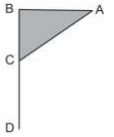
Pratibha made a paper lag by pasting an isosceles right triangle on a stick.
Image
$1.$ What is the measure of $\angle ACD?$
Salima was very happy because it was Eid. Everyone in her family put a few coins in her bag. She now had 30 one-rupee coins, 25 two-rupee coins, 15 five-rupee coins and 5 ten-rupee coins in her bag.
Q.1. The number of five-rupee coins is what per cent of the total number of coins in the bag?
(a) 5%$\quad$(b) 10%$\quad$(c) 15%$\quad$(d) 20%
Q.2. The value of two-rupee coins is what per cent of the total value of coins in the bag?
(a) $16 \frac{11}{36} \%$$\quad$(b) $24 \frac{16}{41} \%$$\quad$(c) $17 \frac{12}{37} \%$$\quad$(d) $21 \frac{9}{17} \%$
Q.3. The number of five-rupee coins is what per cent less than that of two-rupee coins?
(a) 60%$\quad$(b) 40%$\quad$(c) 50%$\quad$(d) 75%
Q.4. The value of five-rupee coins is what per cent more than that of two-rupee coins?
(a) 50%$\quad$(b) 40%$\quad$(c) $33 \frac{1}{3} \%$$\quad$(d) $66 \frac{2}{3} \%$