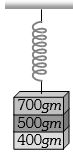
Three masses $700g, 500g$, and $400g$ are suspended at the end of a spring a shown and are in equilibrium. When the $700g$ mass is removed, the system oscillates with a period of $3$ seconds, when the $500 \,gm$ mass is also removed, it will oscillate with a period of ...... $s$
Medium
Download our app for free and get started
(b) When mass $700 \,gm$ is removed, the left out mass $(500 + 400)\, gm$ oscillates with a period of $3\, sec$
$3 = t = 2\pi \sqrt {\frac{{(500 + 400)}}{k}} $…...$(i)$
When $500 \,gm$ mass is also removed, the left out mass is $400\, gm.$
$t' = 2\pi \sqrt {\frac{{400}}{k}} $…..$(ii)$
==> $\frac{3}{{t'}} = \sqrt {\frac{{900}}{{400}}} $ ==> $t' = 2\sec $
$3 = t = 2\pi \sqrt {\frac{{(500 + 400)}}{k}} $…...$(i)$
When $500 \,gm$ mass is also removed, the left out mass is $400\, gm.$
$t' = 2\pi \sqrt {\frac{{400}}{k}} $…..$(ii)$
==> $\frac{3}{{t'}} = \sqrt {\frac{{900}}{{400}}} $ ==> $t' = 2\sec $

Download our appand get started for free
Experience the future of education. Simply download our apps or reach out to us for more information. Let's shape the future of learning together!No signup needed.*
Similar Questions
- 1What is the period of small oscillations of the block of mass $m$ if the springs are ideal and pulleys are massless ?View Solution

- 2A particle of mass $2 \,kg$, executing $SHM$ has amplitude $20 \,cm$ and time period $1 \,s$. Its maximum speed is ......... $m / s$View Solution
- 3A body oscillates with a simple harmonic motion having amplitude $0.05\, m .$ At a certain instant, its displacement is $0.01\, m$ and acceleration is $1.0 \,m / s ^{2} .$ The period of oscillation isView Solution
- 4A particle executes simple harmonic motion with an amplitude of $4 \,cm$. At the mean position the velocity of the particle is $10\, cm/s$. The distance of the particle from the mean position when its speed becomes $5 \,cm/s$ isView Solution
- 5A simple pendulum of length $l$ is made to oscillate with an amplitude of $45$ degrees. The acceleration due to gravity is $g$. Let $T_0=2 \pi \sqrt{l / g}$. The time period of oscillation of this pendulum will beView Solution
- 6View SolutionA pendulum is swinging in an elevator. Its period will be greatest when the elevator is
- 7View SolutionThe total energy of a particle executing S.H.M. is proportional to
- 8A block of mass m, attached to a spring of spring constant $k$, oscillates on a smooth horizontal table. The other end of the spring is fixed to a wall. The block has a speed $v$ when the spring is at its natural length. Before coming to an instantaneous rest, if the block moves a distance $x$ from the mean position, thenView Solution
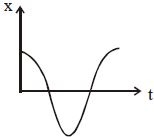
- 9Dispacement time graph of a particle executing $SHM$ is as shown in the figure. Corresponding graph between $PE$ and time isView Solution
- 10A particle of mass $m$ is performing linear simple harmonic motion. Its equilibrium is at $x = 0,$ force constant is $K$ and amplitude of $SHM$ is $A$. The maximum power supplied by the restoring force to the particle during $SHM$ will beView Solution