MCQ
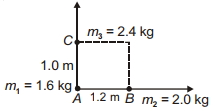
Three point masses $m_1, m_2$ and $m_3$ are placed at the corners of a thin massless rectangular sheet ($1.2 \,m \times$ $1.0 \,m$ ) as shown. Centre of mass will be located at the point ........... $m$
  • A
    $(0.8,0.6)$
  • B
    $(0.6,0.8)$
  • $(0.4,0.4)$
  • D
    $(0.5,0.6)$

Answer

Correct option: C.
$(0.4,0.4)$
c
(c)

$x_{ cm }=\frac{m_1 x_1+m_2 x_2+m_3 x_3}{m_1+m_2+m_3}$

$y_{ cm }=\frac{m_1 y_1+m_2 y_2+m_3 y_3}{m_1+m_2+m_3}$

$x_{ cm }=\frac{(1.6)(0)+(2.4)(0)+2(1.2)}{1.6+2.4+2}=0.4 \,m$

$y_{ cm }=\frac{(1.6)(0)+(2.4) 1+2(0)}{1.6+2.4+2}=0.4 \,m$

$\text { So, }\left(x_{ cm }, y_{ cm }\right)=(0.4,0.4) \,m$

Need a full question paper?

Generate a complete, print-ready paper with questions like this in minutes — across 16+ boards, with answer keys.

Start Generating Free

Similar questions

A body of mass $1\,kg$ collides head on elastically with a stationary body of mass $3\,kg$. After collision, the smaller body reverses its direction of motion and moves with a speed of $2\,m / s$. The initial speed of the smaller body before collision is $..........ms ^{-1}$
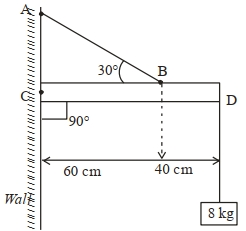
An object of mass $8\,kg$ is hanging from one end of a uniform rod $CD$ of mass $2\,kg$ and length $1\,m$ pivoted at its end $C$ on a vertical wall as shown in figure. It is supported by a cable $A B$ such that the system is in equilibrium. The tension in the cable is $............\,N$ (Take $g=10\,m / s ^2$ )
$Assertion$ : The earth is slowing down and as a result the moon is coming nearer to it.
$Reason$ : The angular momentum of the earth moon system is not conserved
In uniform circular motion
A bomb is projected with $200\,m/s$ at an angle $60^o$ with horizontal. At the highest point, it explodes into three particles of equal masses. One goes vertically upward with velocity $100\,m/sec,$ second particle goes vertically downward with the same velocity as the first. Then what is the velocity of the third one
A projectile is projected with speed $u$ of an angle of $60^o$ with horizontal from the foot of an inclined plane. If the projectile hits the inclined plane horizontally, the range on inclined plane will be :-
The moment of inertia of a thin rod about an axis passing through its mid point and perpendicular to the rod is $2400 \mathrm{~g} \mathrm{~cm}^2$. The length of the $400 \mathrm{~g}$ rod is nearly:
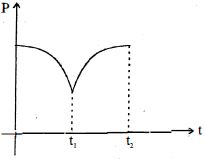
Graph between power and time is given below. Then which of the following option is correct for work done by force [from $t = 0$ to time $t$]
If $< E >$ and $< U >$  denote the average kinetic and the average potential energies respectively of mass describing a simple harmonic motion, over one period, then the correct relation is
Both earth and moon are subject to the gravitational force of the sun. As observed from the sun, the orbit of the moon.
  1. Will be elliptical.
  2. Will not be strictly elliptical because the total gravitational force on it is not central.
  3. Is not elliptical but will necessarily be a closed curve.
  4. Deviates considerably from being elliptical due to influence of planets other than earth.