- ✓$-40$
- B$-20$
- C$+40$
- D$+20$
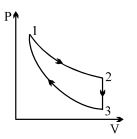
In the process $2 \rightarrow 3, \Delta W_{2 \rightarrow 3}=0$
In the process $3 \rightarrow 1, \Delta Q_{3 \rightarrow 1}=0$
The complete process being cyclic, $\Delta U=0$
Hence $\Delta Q=\Delta W \Rightarrow \Delta Q_{1 \rightarrow 2}+\Delta Q_{2 \rightarrow 3}+\Delta Q_{3 \rightarrow 1}=\Delta W_{1 \rightarrow 2}+\Delta W_{2 \rightarrow 3}+\Delta W_{3 \rightarrow 1} \Rightarrow$
$\Delta Q_{2 \rightarrow 3}=\Delta W_{3 \rightarrow 1}=-40 J$
Generate a complete, print-ready paper with questions like this in minutes — across 16+ boards, with answer keys.


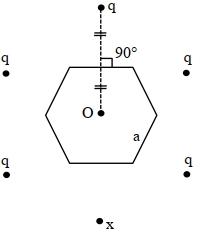
Which of the following statement($s$) is(are) correct in SI units?
$(A)$ When $x=q$, the magnitude of the electric field at $O$ is zero.
$(B)$ When $x=-q$, the magnitude of the electric field at $O$ is $\frac{q}{6 \pi \epsilon_0 a^2}$.
$(C)$ When $x=2 q$, the potential at $O$ is $\frac{7 q}{4 \sqrt{3} \pi \epsilon_0 a}$.
$(D)$ When $x=-3 q$, the potential at $O$ is $\frac{3 q}{4 \sqrt{3} \pi \epsilon_0 a}$.