Question
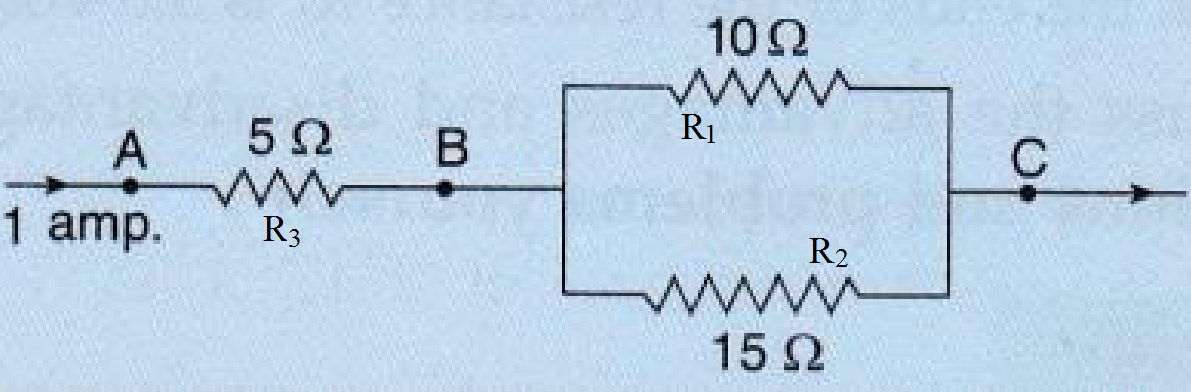
Three resistors are connected as shown in the diagram.
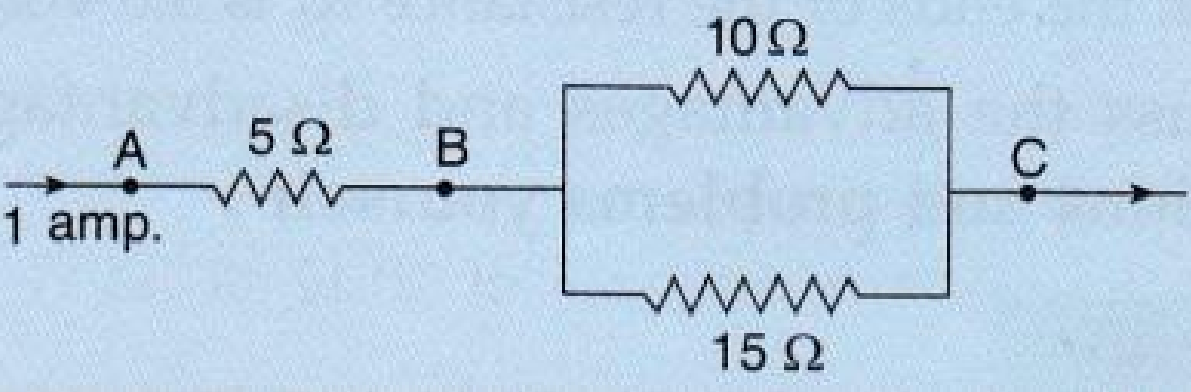
Through the resistor 5 ohm, a current of 1 ampere is flowing,
  1. What is the current through the other two resistors?
  2. What is the p.d. across AB and across AC?
  3. What is the total resistance?

Answer


According to the diagram

  1. Total current I = 1 amp is entering the parallel combination of R1 and R. Let I1 current flows through R1 and I2 current flows through R2

Then

$\text{I}_1=\frac{\text{IR}_2}{\text{R}_1+\text{R}_2}$

$=\frac{1\times15}{10+15}=0.6\text{A}$

$\text{I}_2=\frac{\text{IR}_2}{\text{R}_1+\text{R}_2}$

$=\frac{1\times10}{10+15}=0.4\text{A}$

  1. p.d. across AB = IR3 = 1 × 5 = 5V

Equivalent resisyance between B and C is

$\frac{1}{\text{R}'}=\frac{1}{\text{R}_1}+\frac{1}{\text{R}_2}=\frac{1}{10}+\frac{1}{15}$

$\frac{1}{\text{R}'}=\frac{5}{30}$

R' = 6 ohm

Total resistance between A and C is R = 5 + 6 = 11 ohm

p.d. across AC = IR = 1 × 11 = 11V

  1. Total resistance = R3 + R' = 5 + 6 = 11 ohm.

Need a full question paper?

Generate a complete, print-ready paper with questions like this in minutes — across 16+ boards, with answer keys.

Start Generating Free

Similar questions

What is Joule’s heating effect? How can it be demonstrated experimentally? List its four applications in daily life.
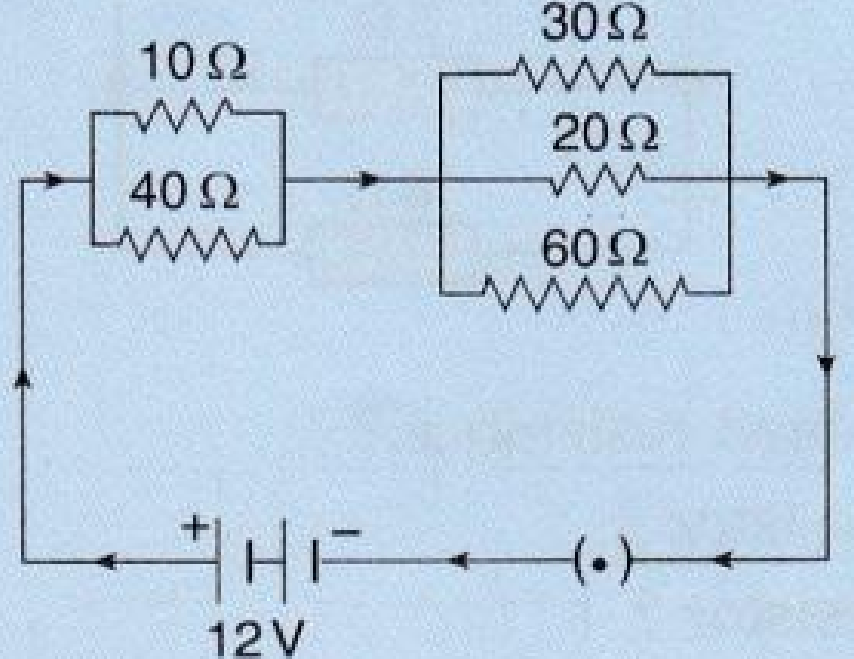
In the circuit diagram given below five resistances of $10 Ω, 40 Ω, 30 Ω, 20 Ω\ \text{and}\ 60 Ω$ are connected as shown to a 12V battery.

Calculate:
  1. Total resistance in the circuit.
  2. Total current flowing in the circuit.
What is electrical resistivity of a material? What is its unit? Describe an experiment to study the factors on which the resistance of conducting wire depends.
Two resistors, with resistances $ 5 Ω$ and $10 Ω$ respectively are to be connected to a battery of emf 6V so as to obtain:
  1. Minimum current flowing.
  2. Maximum current flowing.
  1. How will you connect the resistances in each case?
  2. Calculate the strength of the total current in the circuit in the two cases.
  1. Draw a ray diagram to show the formation of image by a convex lens when an object is placed in front of the lens between its optical centre and principal focus.
  2. In the above ray diagram mark the object-distance (u) and the image-distance (v) with their proper signs (+ve or – ve as per the new Cartesian sign convention) and state how these distances are related to the focal length (f) of the convex lens in this case.
  3. Find the power of a convex lens which forms a real, and inverted image of magnification -1 of an object placed at a distance of 20cm from its optical centre.
Explain the functions of the following parts of the eye:
  1. Iris.
  2. Pupil.
  3. Ciliary. 
  4. Muscles. 
  5. Eye-lens.
  6. Retina.
  7. Optic nerve.
Explain the underlying principle and working of an electric generator by drawing a labelled diagram. What is the function of brushes?
i. State laws of reflection of light.
ii. An object of height 5.0 cm is placed at 15 cm in front of a concave mirror of focal length 10 cm . At what distance from the mirror should a screen be placed, so that a focussed image is obtained on it? Find the height of the image.
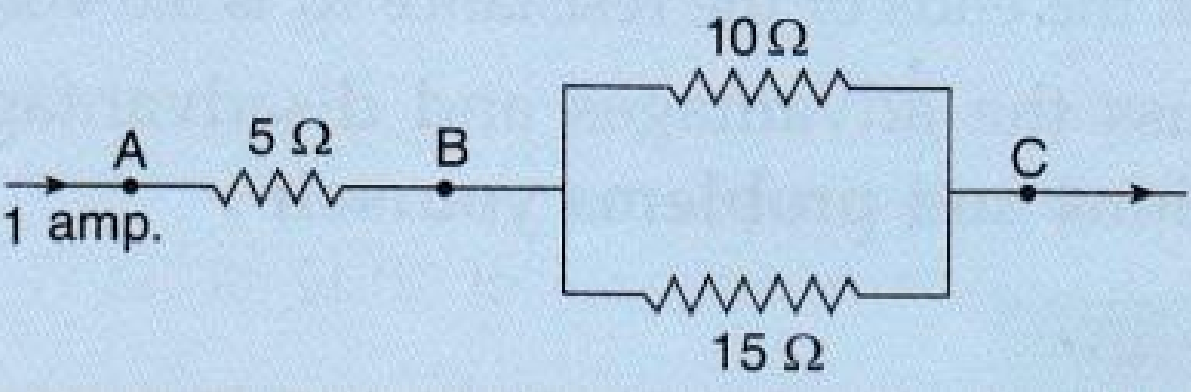
Three resistors are connected as shown in the diagram.

Through the resistor 5 ohm, a current of 1 ampere is flowing,
  1. What is the current through the other two resistors?
  2. What is the p.d. across AB and across AC?
  3. What is the total resistance?
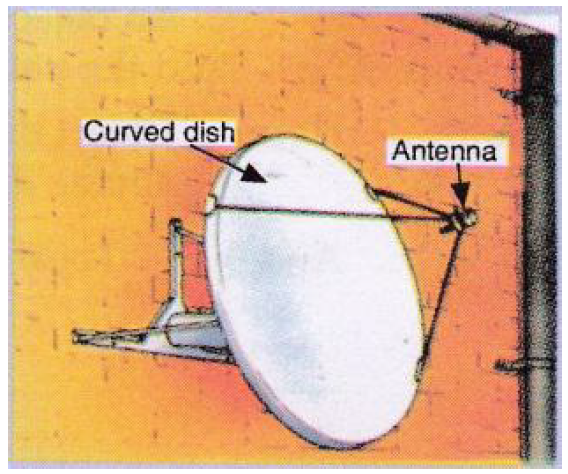
The diagram shows a dish antenna which is used to receive television signals from a satellite. The antenna (signal detector) is fixed in front of the curved dish.

  1. What is the purpose of the dish?
  2. Should it be concave or convex?
  3. Where should the antenna be positioned to receive the strongest possible signals?
  4. Explain what change you would expect in the signals if a larger dish was used.