Question
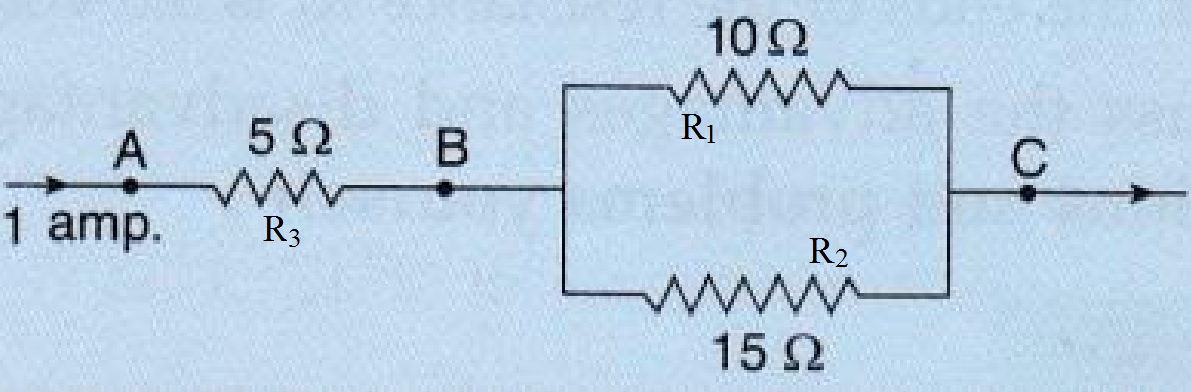
Three resistors are connected as shown in the diagram.
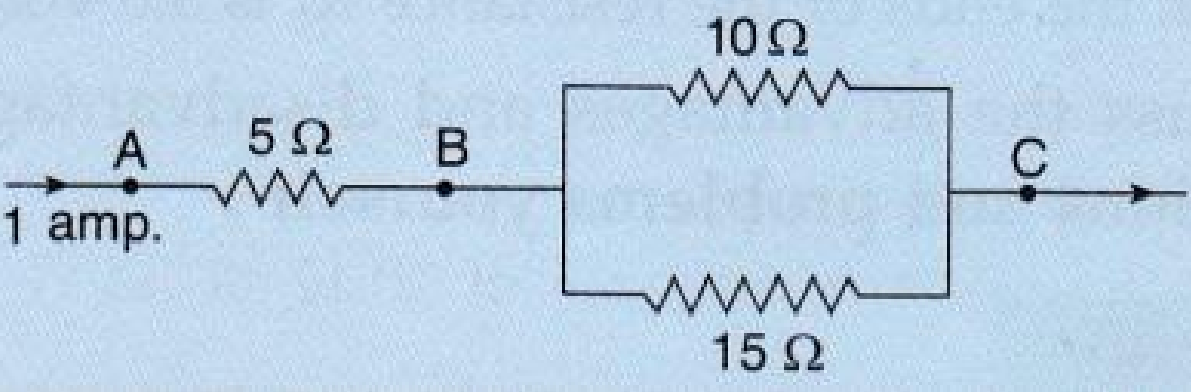
Through the resistor 5 ohm, a current of 1 ampere is flowing,
  1. What is the current through the other two resistors?
  2. What is the p.d. across AB and across AC?
  3. What is the total resistance?

Answer


According to the diagram
  1. Total current I = 1 amp is entering the parallel combination of R1 and R. Let I1 current flows through R1 and I2 current flows through R2
Then

$\text{I}_1=\frac{\text{IR}_2}{\text{R}_1+\text{R}_2}$

$=\frac{1\times15}{10+15}=0.6\text{A}$

$\text{I}_2=\frac{\text{IR}_2}{\text{R}_1+\text{R}_2}$

$=\frac{1\times10}{10+15}=0.4\text{A}$
  1. p.d. across AB = $IR_3 = 1 × 5 = 5V$
Equivalent resisyance between B and C is

$\frac{1}{\text{R}'}=\frac{1}{\text{R}_1}+\frac{1}{\text{R}_2}=\frac{1}{10}+\frac{1}{15}$

$\frac{1}{\text{R}'}=\frac{5}{30}$

R' = 6 ohm

Total resistance between A and C is R = 5 + 6 = 11 ohm

p.d. across AC = IR = 1 × 11 = 11V
  1. Total resistance $=R_3+R^{\prime}=5+6=11$ ohm.

Need a full question paper?

Generate a complete, print-ready paper with questions like this in minutes — across 16+ boards, with answer keys.

Start Generating Free

Similar questions

A metal carbonate $X$ on reacting with an acid gives a gas which when passed through a solution $Y$ gives the carbonate back. On the other hand, a gas $G$ that is obtained at anode during electrolysis of brine is passed on dry $Y$, it gives a compound $Z$, used for disinfecting drinking water. Identity $X$, $Y$, $G$ and $Z$.
Give reasons for the appearance of new combinations of characters in the $F_2$ progeny.
Explain why, though both a plane mirror and a sheet of paper reflect light but we can see the image of our face in a plane mirror but not in a sheet of paper.
State any five physical properties of metals and five physical properties of non-metals.
On the basis of Mendeleev’s Periodic Table given below, answer the questions that follow the table:
  1. Name the element which is in:
  1. i. $1^{\text {st }}$ group and $3^{\text {rd }}$ period.
    ii. $VII ^{\text {th }}$ group and 2nd period.
  1. Suggest the formula for the following:
  1. Oxide of nitrogen.
  2. Hydride of oxygen.
  1. In group VIII of the Periodic Table, why does cobalt with atomic mass 58.93 appear before nickel having atomic mass 58.71?
  2. Besides gallium, which two other elements have since been discovered for which Mendeleev had left gaps in his Periodic Table?
  3. Using atomic masses of Li, Na and K, find the average atomic mass of Li and K and compare it with the atomic mass of Na. State the conclusion drawn from this activity.
What is a plant hormone? Name four plant hormones. State one function of each.
  1. What is scattering of light? Explain how the colour of the scattered light depends on the size of the scattering particles.
  2. Explain the reddish appearance of the Sun at sunrise or sunset. Why does it not appear red at noon?
A certain form of energy is available due to the difference in the temperature of water at the surface of the ocean and its deeper levels.
  1. Name the form of energy.
  2. Is this energy ultimately derived from the sun or not?
  3. Explain, how this form of energy can be converted into electricity?
Explain how deoxygenated blood travel from body to lung for purification. Draw well-labeled diagram in support of your answer.
Define ‘speciation’. Explain how speciation occurs.