MCQ
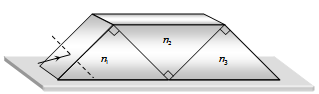
Three right angled prisms of refractive indices $n _1, n _2$ and $n _3$ are fixed together using an optical glue as shown in figure. If a ray passes through the prisms without suffering any deviation, then
  • A
     $n _1= n _2= n _3$
  • B
     $n _1= n _2 \neq n _3$
  • C
     $1+ n _1= n _2+ n _3$
  • $1+ n _2^2= n _1^2+ n _3^2$

Answer

Correct option: D.
$1+ n _2^2= n _1^2+ n _3^2$

Need a full question paper?

Generate a complete, print-ready paper with questions like this in minutes — across 16+ boards, with answer keys.

Start Generating Free

Similar questions

If $n$ represents the actual number of deflections in a converted galvanometer of resistance $G$ and shunt resistance $S$. Then the total current I when its figure of merit is $K$ will be
A uniform electric field pointing in positive x-direction exists in a region. Let A be the origin, B be the point on the x-axis at x = +1 cm and C be the point on the y-axis at y = +1 cm. Then the potentials at the points A, B and C satisfy 
A current $I$ flows in an infinitely long wire with cross-section in the form of a semicircular ring of radius $R$. The magnitude of the magnetic induction along its axis is
A railway compartment is lit up by thirteen lamps each taking 2.1 amp at 15 volts. The heat generated per second in each lamp will be
In which of the following systems will the radius of the first orbit (n = 1) be minimum
The following four wires are made of the same material and are at the same temperature. Which one of them has highest electrical resistance
A charge $q$ is placed at the centre of the line joining two equal charges $Q$. The system of the three charges will be in equilibrium, if $q$ is equal to
The work done in moving a unit positive test charge over a closed path in an electric field is $......$.
Similar charges are placed at corners of a square and a charge $q_0$ is placed at it's centre find net force on it
Two concentric hollow metallic spheres of radii $r_1$ and $r_2 (r_1 > r_2)$ contain charges $q_1$ and $q_2$ respectively. The potential at a distance $x$ between $r_1$ and $r_2$ will be