MCQ
Three rods made of the same material and having the same cross section have been joined as shown in the figure. Each rod is of the same length. The left and right ends are kept at ${0^o}C$ and ${90^o}C$ respectively. The temperature of the junction of the three rods will be ...... $^oC$
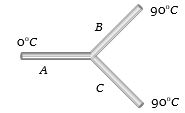
  • A
    $45$
  • $60$
  • C
    $30$
  • D
    $20$

Answer

Correct option: B.
$60$
b
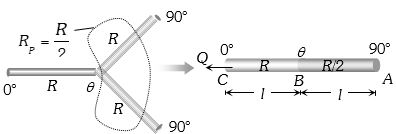
(b) Let the temperature of junction be $\theta$. Since roads $B$ and $C$ are parallel to each other (because both having the same temperature difference).

Hence given figure can be redrawn as follows
( $\frac{Q}{t} = \frac{{({\theta _1} - {\theta _2})}}{R}$ and ${\left( {\frac{Q}{t}} \right)_{AB}} = {\left( {\frac{Q}{t}} \right)_{BC}}$

==> $\frac{{(90 - \theta )}}{{R/2}} = \frac{{(\theta - 0)}}{R}$

==> $180 - 2\theta = \theta $

==>$\theta = 60^\circ C$

Need a full question paper?

Generate a complete, print-ready paper with questions like this in minutes — across 16+ boards, with answer keys.

Start Generating Free

Similar questions

A particle is projected with speed $u$ at angle $\theta$ with horizontal from ground. If it is at same height from ground at time $t_1$ and $t_2$, then its average velocity in time interval $t_1$ to $t_2$ is .........
The earth radiates in the infra-red region of the spectrum. The spectrum is correctly given by
$Assertion$ : In a free fall, weight of a body becomes effectively zero.

$Reason$ : Acceleration due to gravity acting on a body having free fall is zero.

$A$ man is sitting in $a$ smooth groove on a horizontal circular table at the edge by holding a rope joined to the centre. The moment of inertia of table is $I$. Mass of man $= M$. Man now pulls the rope so that he comes to the centre. The angular velocity of the table :
The dimension of $\frac{\mathrm{B}^{2}}{2 \mu_{0}}$, where $\mathrm{B}$ is magnetic field and $\mu_{0}$ is the magnetic permeability of vacuum, is
A point moves such that its displacement as a function of time is given by $x^3$ = $t^3 + 1$. Its acceleration as a function of time $t$ will be
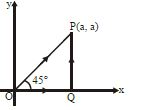
A particle is moved from $(0, 0)$  to $(a, a)$  under a force $F = (3\hat i + 4\hat j)$ from two paths. Path $1$ is $OP$ and path $2$  is $OQP$ . Let $W_1$ and $W_2$ be the work done by this force in these two paths respectively. Then
A pen of mass $m$ is lying on a piece of paper of mass $M$ placed on a rough table. If the coefficients of friction between the pen and paper and the paper and the table are $\mu_1$ and $\mu_2$, respectively. Then, the minimum horizontal force with which the paper has to be pulled for the pen to start slipping is given by
Viscosity of gas on increases of temperature:
When an ideal diatomic gas is heated at constant pressure, the fraction of the heat energy supplied which increases the internal energy of the gas, is