MCQ
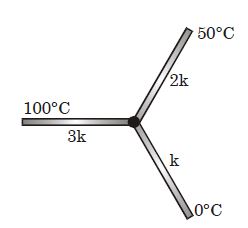
Three rods of the same dimensions have thermal conductivities $3k, 2k$ and $k$. They are arranged as shown, with their ends at $100\,^oC, 50\,^oC$ and $0\,^oC$. The temperature of their junction is
  • A
    $75\,^oC$
  • $\frac{{200}}{3}\,^oC$
  • C
    $40\,^oC$
  • D
    $\frac{{100}}{3}\,^oC$

Answer

Correct option: B.
$\frac{{200}}{3}\,^oC$
b
$\frac{3 \mathrm{K}(100-\theta)}{\mathrm{L}}=\frac{2 \mathrm{K}(\theta-50)}{\mathrm{L}}+\frac{\mathrm{K}(\theta-0)}{\mathrm{L}}$

$300-3 \theta=2 \theta-100+\theta$

$400=6 \theta$

$\theta=\frac{200}{3}^{\circ} \mathrm{C}$

Need a full question paper?

Generate a complete, print-ready paper with questions like this in minutes — across 16+ boards, with answer keys.

Start Generating Free

Similar questions

A thin, metallic spherical shell contains a charge $Q$ on it. A point charge $q$ is placed at the centre of the shell and another charge $q_1$ is placed outside it as shown in figure. All the three charges are positive. The force on the charge at the centre is:
A rope ladder with a length $l$ carrying a man with a mass $m$ at its end is attached to the basket of balloon with a mass $M.$ The entire system is in equilibrium in the air. As the man climbs up to the end of the ladder into the balloon, the balloon descends by a height $h.$ Then the potential energy of the man
A projectile thrown with velocity $v$ making angle $\theta$ with vertical gains maximum height $H$ in the time for which the projectile remains in air, the time period is
A cube of metal is subjected to a hydrostatic pressure of $4\;GPa.$ The percentage change in the length of the side of the cube is close to.......$\%$
(Given bulk modulus of metal, $B =8 \times 10^{10}\, Pa$ )
prism can produce a minimum deviation $\delta$ in a light beam. If three such prisms are combined, the minimum deviation that can be produced in this beam is:
A real gas behaves like an ideal gas if its
A particle is moving on a circular path of $10m$ radius. At any instant of time, its speed is $5\ ms^{-1}$ and the speed is increasing at a rate of $2\ ms^{-2}$. The magnitude of net acceleration at this instant is:
Match List $I$ with List $II$

List $I$ List $II$
$A$ Spring constant $I$ $(T ^{-1})$
$B$ Angular speed $II$ $(MT ^{-2})$
$C$ Angular momentum $III$ $(ML ^2)$
$D$ Moment of Inertia $IV$ $(ML ^2 T ^{-1})$

Choose the correct answer from the options given below

The internal energy of an ideal gas depends on:
Speed of a transverse wave on a straight wire (mass $6.0\; \mathrm{g}$, length $60\; \mathrm{cm}$ and area of cross-section $1.0\; \mathrm{mm}^{2}$ ) is $90\; \mathrm{ms}^{-1} .$ If the Young's modulus of wire is $16 \times 10^{11}\; \mathrm{Nm}^{-2},$ the extension of wire over its natural length is