Question
Three slogans on chart papers are to be placed on a school bulletin board at the points A, Band C displaying A (Hub of Learning), B (Creating a better world for tomorrow) and C (Education comes first). The coordinates of these points are (1, 4, 2), (3, -3, -2) and (-2, 2, 6) respectively.
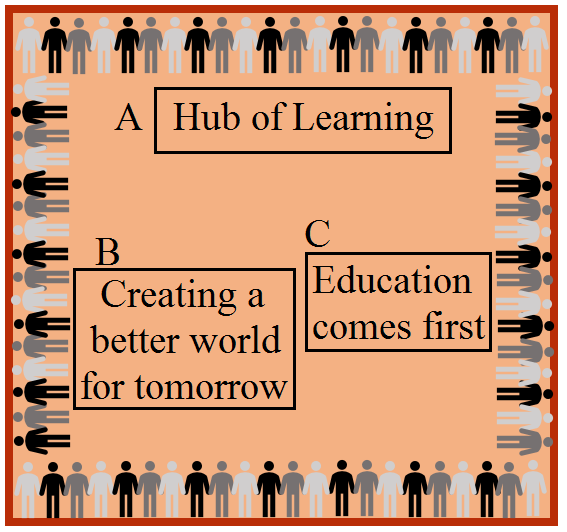
Based on the above information, answer the following questions.
  1. Let $\vec{\text{a}},\vec{\text{b}}$ and $\vec{\text{c}}$ be the position vectors of points A, B and C respectively, then $\vec{\text{a}}+\vec{\text{b}}+\vec{\text{c}}$ is equal to:
  1. $2\hat{\text{i}}+3\hat{\text{j}}+6\hat{\text{k}}$
  2. $2\hat{\text{i}}-3\hat{\text{j}}-6\hat{\text{k}}$
  3. $2\hat{\text{i}}+8\hat{\text{j}}+3\hat{\text{k}}$
  4. $2(7\hat{\text{i}}+8\hat{\text{j}}+3\hat{\text{k}})$
  1. Which of the following is not true?
  1. $\overline{\text{AB}}+\overline{\text{BC}}+\overline{\text{CA}}=\vec{0}$
  2. $\overline{\text{AB}}+\overline{\text{BC}}-\overline{\text{AC}}=\vec{0}$
  3. $\overline{\text{AB}}+\overline{\text{BC}}-\overline{\text{CA}}=\vec{0}$
  4. $\overline{\text{AB}}-\overline{\text{CB}}+\overline{\text{CA}}=\vec{0}$
  1. Area of $\triangle\text{ABC}$ is:
  1. 19 sq. units
  2. $\sqrt{1937}\text{sq}.\text{units}$
  3. $\frac{1}{2}\sqrt{1937}\text{sq}.\text{units}$
  4. $\sqrt{1837}\text{sq}.\text{units}$
  1. Suppose, if the given slogans are to be placed on a straight line, then the value of $|\vec{\text{a}}\times\vec{\text{b}}+\vec{\text{b}}\times\vec{\text{c}}+\vec{\text{c}}\times\vec{\text{a}}|$ will be equal to:
  1. -1
  2. -2
  3. 2
  4. 0
  1. If $\vec{\text{a}}=2\hat{\text{i}}+3\hat{\text{j}}+6\hat{\text{k}},$ then unit vector in the direction of vector $\vec{\text{a}}$ is:
  1. $\frac{2}{7}\hat{\text{i}}-\frac{3}{7}\hat{\text{j}}-\frac{6}{7}\hat{\text{k}}$
  2. $\frac{2}{7}\hat{\text{i}}+\frac{3}{7}\hat{\text{j}}+\frac{6}{7}\hat{\text{k}}$
  3. $\frac{3}{7}\hat{\text{i}}+\frac{2}{7}\hat{\text{j}}+\frac{6}{7}\hat{\text{k}}$
  4. None of these

Answer

  1. (a) $2\hat{\text{i}}+3\hat{\text{j}}+6\hat{\text{k}}$
Solution:

$\vec{\text{a}}=\hat{\text{i}}+4\hat{\text{j}}+2\hat{\text{k}},\vec{\text{ b}}=3\hat{\text{i}}-3\hat{\text{j}}-2\hat{\text{k}}$

And $\vec{\text{c}}=2\hat{\text{i}}+2\hat{\text{j}}+6\hat{\text{k}}$

$\therefore\vec{\text{a}}+\vec{\text{b}}+\vec{\text{c}}=2\hat{\text{i}}+3\hat{\text{j}}+6\hat{\text{k}}$
  1. (c) $\overline{\text{AB}}+\overline{\text{BC}}-\overline{\text{CA}}=\vec{0}$
Solution:

Using triangle law of addition in $\triangle\text{ABC},$ we get $\overline{\text{AB}}+\overline{\text{BC}}-\overline{\text{CA}}=\vec{0}$ which can be rewritten as,

$\overline{\text{AB}}+\overline{\text{BC}}-\overline{\text{CA}}=\vec{0}$ or $\overline{\text{AB}}-\overline{\text{CB}}+\overline{\text{CA}}=\vec{0}$
  1. (c) $\frac{1}{2}\sqrt{1937}\text{sq}.\text{units}$
Solution:

We have, A(1 ,4, 2), B(3, -3, -2) and C(-2, 2, 6)

Now, $\overline{\text{AB}}=\vec{\text{b}}-\vec{\text{a}}=2\hat{\text{i}}-7\hat{\text{j}}-4\hat{\text{k}}$

And $\overline{\text{AC}}=\vec{\text{c}}-\vec{\text{a}}=-3\hat{\text{i}}-2\hat{\text{j}}+4\hat{\text{k}}$

$\therefore\overline{\text{AB}}\times\overline{\text{AC}}=\begin{vmatrix}\hat{\text{i}}&\hat{\text{j}}&\hat{\text{k}}\\2&-7&-4\\-3&-2&4\end{vmatrix}$

$=\hat{\text{i}}(-28-8)-\hat{\text{j}}(8-12)+\hat{\text{k}}(-4-21)$

$=-36\hat{\text{i}}+4\hat{\text{j}}-25\hat{\text{k}}$

Now, $|\overline{\text{AB}}\times\overline{\text{AC}}|=\sqrt{(-36)^2+4^2+(-25)^2}$

$=\sqrt{1296+16+625}=\sqrt{1937}$

$\therefore$ Area of $\triangle\text{ABC}=\frac{1}{2}|\overline{\text{AB}}\times\overline{\text{AC}}|$

$=\frac{1}{2}\sqrt{1937}\text{sq}.\text{units}.$
  1. (d) 0
Solution:

If the given points lie on the straight line, then the points will be collinear and so area of $\triangle\text{ABC}=0.$

$\Rightarrow|\vec{\text{a}}\times\vec{\text{b}}+\vec{\text{b}}\times\vec{\text{c}}+\vec{\text{c}}\times\vec{\text{a}}|=0$

[$\because$ If $\vec{\text{a}},\vec{\text{b}},\vec{\text{c}}$ are the position vectors of the three vertices A, B and C of $\triangle\text{ABC},$ then area of triangle

$=\frac{1}{2}|\vec{\text{a}}\times\vec{\text{b}}+\vec{\text{b}}\times\vec{\text{c}}+\vec{\text{c}}\times\vec{\text{a}}|]$
  1. (b) $\frac{2}{7}\hat{\text{i}}+\frac{3}{7}\hat{\text{j}}+\frac{6}{7}\hat{\text{k}}$
Solution:

Here, $|\vec{\text{a}}|=\sqrt{2^2+3^2+6^2}=\sqrt{4+6+36}$

$=\sqrt{49}=7$

$\therefore$ Unit vector in the direction of vector $\vec{\text{a}}$ is

$\hat{\text{a}}=\frac{2\hat{\text{i}}+3\hat{\text{j}}+6\hat{\text{k}}}{7}$

$=\frac{2}{7}\hat{\text{i}}+\frac{3}{7}\hat{\text{j}}+\frac{6}{7}\hat{\text{k}}$

Need a full question paper?

Generate a complete, print-ready paper with questions like this in minutes — across 16+ boards, with answer keys.

Start Generating Free

Similar questions

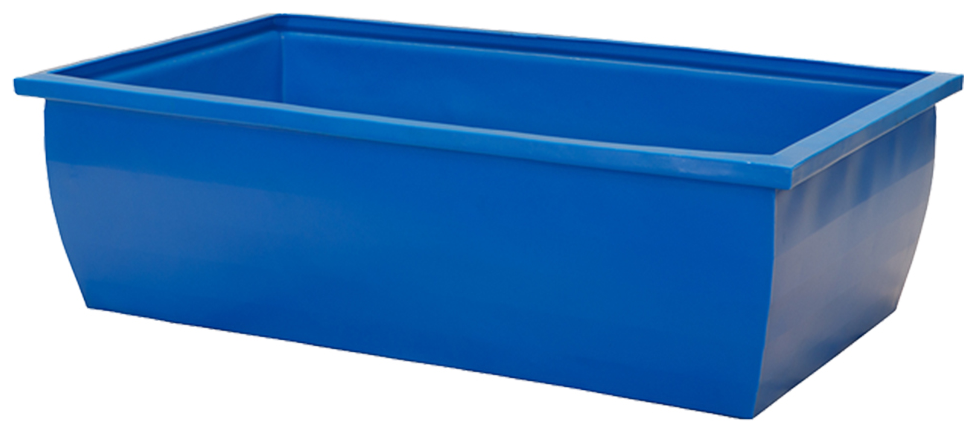
Nitin wants to construct a rectangular plastic tank for his house that can hold $80\ ft^3$ of water. The top of the tank is open. The width of tank will be $5$ ft but the length and heights are variables. Building the tank cost$?\ ₹ 20$ per sq. foot for the base and $₹\ 10$ per sq. foot for the side.

Based on the above information, answer the following questions.
  1. In order to make a least expensive water tank, Nitin need to minimize its.
  1. Volume
  2. Base
  3. Curved surface area
  4. Cost
  1. Total cost of tank as a function of h can be represented as.
  1. $c(h) = 100h - 320 - 1600/ h$
  2. $c(h) = 100h - 320h - 720h^2$
  3. $c(h) = 100 + 320h + 1600h^2$
  4. $\text{c}\big(\text{h}\big)=100\text{h}+320+\frac{1600}{\text{h}}$
  1. Range of $h$ is.
  1. $(3, 5)$
  2. $\big(0,\infty\big)$
  3. $(0, 8)$
  4. $(0, 3)$
  1. Value of hat which $c(h)$ is minimum, is.
  1. $4$
  2. $5$
  3. $6$
  4. $6, 7$
  1. The cost of least expensive tank is.
  1. $₹\ 1020$
  2. $₹\ 1100$
  3. $₹\ 1120$
  4. $₹\ 1220$
To teach the application of probability a maths teacher arranged a surprise game for 5 of his students namely Archit, Aadya, Mivaan, Deepak and Vrinda. He took a bowl containing tickets numbered 1 to 50 and told the students go one by one and draw two tickets simultaneously from the bowl and replace it after noting the numbers. Based on the above information, answer the following questions.
  1. Teacher ask Vrinda, what is the probability that both tickets drawn by Arch it shows even number?
  1. $\frac{1}{50}$
  2. $\frac{12}{49}$
  3. $\frac{13}{49}$
  4. $\frac{15}{49}$
  1. Teacher ask Mivaan, what is the probability that both tickets drawn by Aadya shows odd number?
  1. $\frac{1}{50}$
  2. $\frac{2}{49}$
  3. $\frac{12}{49}$
  4. $\frac{5}{49}$
  1. Teacher ask Deepak, what is the probability that tickets drawn by Mivaan, shows a multiple of 4 on one ticket and a multiple 5 on other ticket?
  1. $\frac{14}{245}$
  2. $\frac{16}{245}$
  3. $\frac{24}{245}$
  4. None of these.
  1. Teacher ask Arch it, what is the probability that tickets are drawn by Deepak, shows a prime number on one ticket and a multiple of 4 on other ticket?
  1. $\frac{3}{245}$
  2. $\frac{17}{245}$
  3. $\frac{18}{245}$
  4. $\frac{36}{245}$
  1. Teacher ask Aadya, what is the probability that tickets drawn by Vrinda, shows an even number on first ticket and an odd number on second ticket?
  1. $\frac{15}{98}$
  2. $\frac{25}{98}$
  3. $\frac{35}{98}$
  4. None of these.
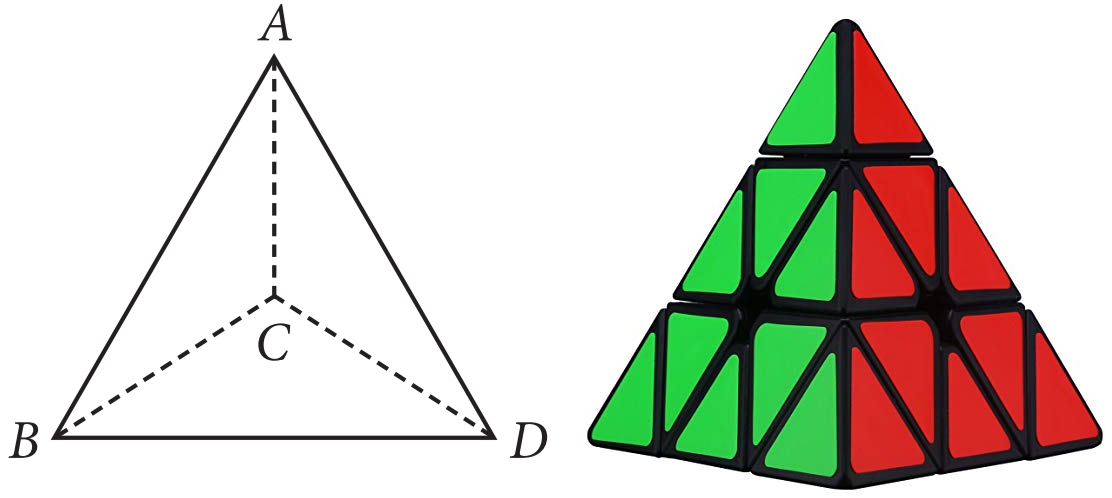
A building is to be constructed in the form of a triangular pyramid, ABCD as shown in the figure.

Let its angular points are A(0, 1, 2), B(3, 0, 1), C(4, 3, 6), and D(2, 3, 2), and G be the point of intersection of the medians of $\triangle\text{BCD}.$
Based on the above information, answer the following questions.
  1. The coordinates of point Gare:
  1. (2, 3, 3)
  2. (3, 3, 2)
  3. (3, 2, 3)
  4. (0, 2, 3)
  1. The length of vector $\overline{\text{AG}}$ is:
  1. $\sqrt{17}\text{ units}$
  2. $\sqrt{11}\text{ units}$
  3. $\sqrt{13}\text{ units}$
  4. $\sqrt{19}\text{ units}$
  1. Area of $\triangle\text{ABC}$ (in sq. units) is:
  1. $\sqrt{10}$
  2. $2\sqrt{10}$
  3. $3\sqrt{10}$
  4. $5\sqrt{10}$
  1. The sum of lengths of $\overline{\text{AB}}$ and $\overline{\text{AC}}$ is:
  1. 5 units
  2. 9.32 units
  3. 10 units
  4. 11 units
  1. The length of the perpendicular from the vertex D on the opposite face is:
  1. $\frac{6}{\sqrt{10}}\text{ units}$
  2. $\frac{2}{\sqrt{10}}\text{ units}$
  3. $\frac{3}{\sqrt{10}}\text{ units}$
  4. $8\sqrt{10}\text{ units}$
Read the following text carefully and answer the questions that follow:
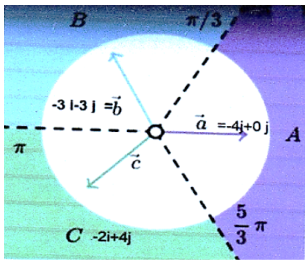
Three friends Ganesh, Dinesh and Ramesh went for playing a Tug of war game. Team $A, B,$ and $C$ belong to Ganesh, Dinesh and Ramesh respectively.
Teams $A, B, C$ have attached a rope to a metal ring and is trying to pull the ring into their own area $($team areas shown below$)$.
Team $A$ pulls with $F _1=4 \hat{i}+0 \hat{j} KN$
Team $B \rightarrow F _2=-2 \hat{i}+4 \hat{j} KN$
Team $C \rightarrow F _3=-3 \hat{i}-3 \hat{j} KN$
Image
$i$. Which team will win the game? $(1)$
$ii$. What is the magnitude of the teams combine Force? $(1)$
$iii.$  What is the magnitude of the force of Team $B? (2)$
OR
How many $KN$ Force is applied by Team $A? (2)$
Read the following passage and answer the questions given below.

Image

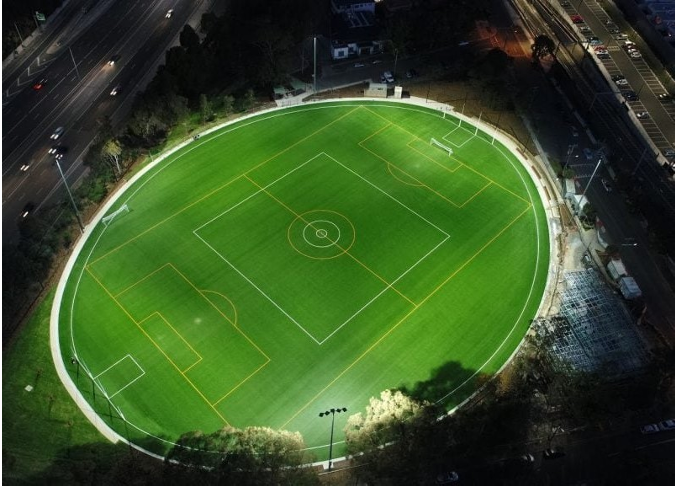
In an elliptical sport field the authority wants to design a rectangular soccer field with the maximum possible area. The sport field is given by the graph of $\frac{x^2}{a^2}+\frac{y^2}{b^2}=1$

(i) If the length and the breadth of the rectangular field be $2 x$ and $2 y$ respectively, then find the area function in terms of $x$.

(ii) Find the critical point of the function.

(iii) Use First derivative Test to find the length $2 x$ and width $2 y$ of the soccer field (in terms of $a$ and b) that maximize its area.

OR

(iii) Use Second Derivative Test to find the length $2 x$ and width $2 y$ of the soccer field (in terms of $a$ and $b$ ) that maximize its area.

Read the following text carefully and answer the questions that follow:
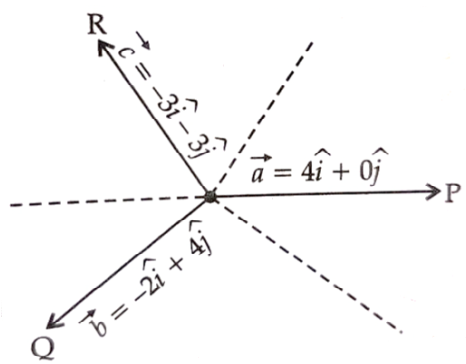
Team $P, Q, R$ went for playing a tug of war game. Teams $P, Q, R$ have attached a rope to a metal ring and is trying to pull the ring into their own areas $($team areas when in the given figure below$)$. Team $P$ pulls with force$F _1=4 \hat{i}+0 \hat{j} KN$
Team $Q$ pull with force $F _2=-2 \hat{i}+4 \hat{j} KN$
Team $R$ pulls with force $F _3=-3 \hat{i}-3 \hat{j} KN$
Image
$i$. What is the magnitude of the teams combined force? $(1)$
$ii$. Find the magnitude of Team $B. (1)$
$iii$. Which team will win the game? $(2)$
OR
Find the probability that she gets grade $A$ in at least one subject. $(2)$
The upward speed v(I) of a rocket at time I is approximated by $\text{v}(\text{t})=\text{at}^2+\text{bt}+\text{c},0\leq\text{t}\leq100,$ here $a, b$ and $c$ are constants. It has been found that the speed at times $t = 3, t = 6$ and $t = 9$ seconds are respectively $64, 133$ and $208$ miles per second..

If $\begin{bmatrix}9&3&1\\36&6&1\\81&9&1\end{bmatrix}^{-1}=\frac{1}{18}\begin{bmatrix}1&-2&1\\-15&24&-9\\54&-54&18\end{bmatrix},$ then answer the following questions.
  1. The value of $b + c$ is:
  1. $20$
  2. $21$
  3. $\frac{3}{4}$
  4. $\frac{4}{3}$
  1. The value of $a + c$ is:
  1. $1$
  2. $20$
  3. $\frac{4}{3}$
  4. None of these.
  1. v(t) is given by:
  1. $\text{t}^2+20\text{t}+1$
  2. $\frac{1}{3}\text{t}^2+20\text{t}+1$
  3. $\text{t}^2+\frac{1}{3}\text{t}+20$
  4. $\text{t}^2+\text{t}+1$
  1. The speed at time $1 = 15$ seconds is:
  1. $346$ miles/ sec
  2. $356$ miles/ sec
  3. $366$ miles/ sec
  4. $376$ miles/ sec
  1. The time at which the speed of rocket is $784$ miles/ sec is:
  1. $20$ seconds
  2. $30$ seconds
  3. $25$ seconds
  4. $27$ seconds
A trust fund has $₹ 35000$ that must be invested in two different types of bonds, say $\mathrm{X}$ and $\mathrm{Y}$. The first bond pays $10 \%$ interest p.a. which will be given to an old age home and second one pays $8 \%$ interest p.a. which will be given to WWA (Women Welfare Association). Let A be a $1 \times 2$ matrix and B be a $2 \times 1$ matrix, representing the investment and interest rate on each bond respectively.

Image

(i) Represent the given information in matrix algebra.

(ii) If ₹ 15000 is invested in bond $\mathrm{X}$, then find total amount of interest received on both bonds?

(iii) If the trust fund obtains an annual total interest of ₹ 3200 , then find the investment in two bonds.

OR

If the amount of interest given to old age home is ₹500, then find the amount of investment in bond Y.

Suppose a dealer in rural area wishes to purpose a number of sewing machines. He has only ₹ 5760 to invest and has space for at most 20 items for storage. An electronic sewing machine costs him ₹ 360 and a manually operated sewing machine ₹ 240. He can sell an electronic sewing machine at a profit of ₹ 22 and a manually operated sewing machine at a profit of ₹ 18.

Based on the above information, answer the following questions.
  1. Let x and y denotes the number of electronic sewing machines and manually operated sewing machines purchased by the dealer. If it is assume that the dealer purchased atleast one of the the given machines, then:
  1. $\text{x}+\text{y}\geq0$
  2. $\text{x}+\text{y}<0$
  3. $\text{x}+\text{y}>0$
  4. $\text{x}+\text{y}\leq0$
  1. Let the constraints in the given problem is represented by the following inequalities.
$\text{x}+\text{y}\leq20$

$360\text{x}+240\text{y}\leq5760$

$\text{x},\text{y}\geq0$

Then which of the following point lie in its feasible region.
  1. (0, 24)
  2. (8, 12)
  3. (20, 2)
  4. None of these
  1. If the objective function of the given problem is maximise z = 22x + 18y, then its optimal value occur at:
  1. (0, 0)
  2. (16, 0)
  3. (8, 12)
  4. (0, 20)
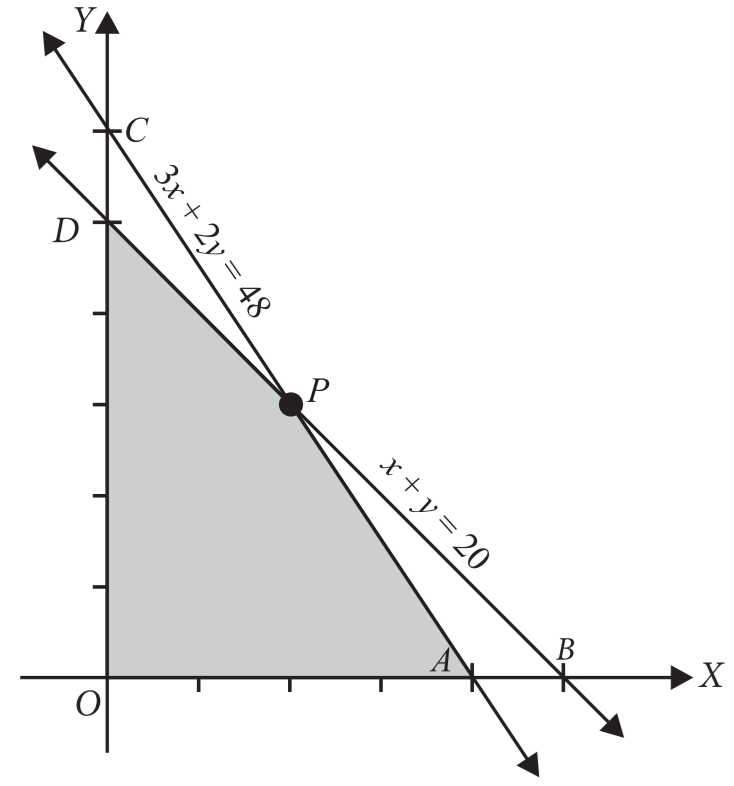
  1. Suppose the following shaded region APDO, represent the feasible region corresponding to mathematical formulation of given problem.
Then which of the following represent the coordinates of one of its corner points

  1. (0, 24)
  2. (12, 8)
  3. (8, 12)
  4. (6, 14)
  1. If an LPP admits optimal solution at two consecutive vertices of a feasible region, then:
  1. The required optimal solution is at the midpoint of the tine joining two points.
  2. The optimal solution occurs at every point on the tine joining these two points.
  3. The LPP under consideration is not solvable.
  4. The LPP under consideration must be reconstructed.
A relation R on a set A is said to be an equivalence relation on A iff it is:
  1. Reflexive i.e., $(\text{a, a})\in\ \text{R} \ \forall \ \text{a}\in\text{A}.$
  2. Symmetric i.e., $(\text{a, b})\in\ \text{R} \Rightarrow \text{(b, a) } \in\text{R}\ \forall \ \text{a, b}\in\text{A}.$
  3. Transitive i.e., $(\text{a, b})\in\ \text{R} \ \text{and}\ \text{(b, c) } \in\text{R}\Rightarrow\text{(a, c)}\in\text{R}\ \forall \ \text{a, b, c}\in\text{A}.$
Based on the above information, answer the following questions.

  1. If the relation R = {(1, 1), (1, 2), (1, 3), (2, 2), (2, 3), (3, 1), (3, 2), (3, 3)} defined on the set A = {1, 2, 3}, then R is:
  1. Reflexive
  2. Symmetric
  3. Transitive
  4. Equivalence
  1. If the relation R = {(1, 2), (2, 1), (1, 3), (3, 1)} defined on the set A = {1, 2, 3}, then R is:
  1. Reflexive
  2. Symmetric
  3. Transitive
  4. Equivalence
  1. If the relation R on the set N of all natural numbers defined as R = {(x, y): y = x + 5 and x < 4}, then R is:
  1. Reflexive
  2. Symmetric
  3. Transitive
  4. Equivalence
  1. If the relation R on the set A = {1, 2, 3, ........., 13, 14} defined as R = {(x, y): 3x - y = O}, then R is:
  1. Reflexive
  2. Symmetric
  3. Transitive
  4. Equivalence
  1. If the relation R on the set A = {I, 2, 3} defined as R = {(1, 1), (1, 2), (1, 3), (2, 1), (2, 2), (2, 3), (3, 1), (3, 2), (3, 3)}, then R is:
  1. Reflexive only
  2. Symmetric only
  3. Transitive only
  4. Equivalence