MCQ
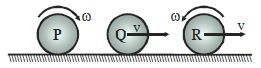
Three solid spheres are made to move on a rough horizontal surface. Sphere $P$ is given a spin and released. Sphere $Q$ is given a forward linear velocity. Sphere $R$ is given linear and rotational motions as shown in the figure. Directions of the friction force on spheres $P, Q, R$ are respectively
  • A
    Right, Left, Right
  • B
    Left, Right, Right
  • C
    Left, Right, Left
  • Right, Left, Left

Answer

Correct option: D.
Right, Left, Left
d
Frictional force act in opposite direction to tendency of motion of contact point.

Need a full question paper?

Generate a complete, print-ready paper with questions like this in minutes — across 16+ boards, with answer keys.

Start Generating Free

Similar questions

A hollow sphere and a solid sphere having same mass and same radius are rolled down a rough inclined plane
In the non-resonant circuit, what will be the nature of the circuit for frequencies higher than the resonant frequency
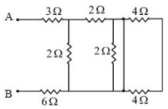
In the given circuit, the equivalent resistance between the terminal $A$ and $B$ is $........\Omega$.
A body of mass $1.0\,kg$ is falling with an acceleration of $10 \,m/se{c^2}$. Its apparent weight will be ......... $kg\,wt$ $(g = 10\,m/{\sec ^2})$ 
A ball is projected with kinetic energy $E$, at an angle of $60^{\circ}$ to the horizontal. The kinetic energy of this ball at the highest point of its flight will become.
A heavy body moving with a velocity $30\, m/s$ and another small object at rest undergo  an elastic collision. The latter will move with a velocity of .............. $\mathrm{m}/ \mathrm{s}$
The activity of a sample of a radioactive material is ${A_1}$ at time ${t_1}$ and ${A_2}$ at time ${t_2}$ $({t_2} > {t_1}).$ If its mean life $T$, then
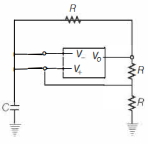
The box in the circuit below has two inputs marked $V_{+}$and $V_{-}$and a single output marked $V_{o}$. The output obeys $V_{o}=\left\{\begin{array}{l}+10 V \text { if } V_{+} > V_{-} \\ -10 V \text { if } V_{+} < V_{-}\end{array}\right.$
A street car moves rectilinearly from station $A$ to the next station $B$ with an acceleration varying according to the law $a=(b-c x)$, where $b$ and $c$ are constants and $x$ is the distance from station $A$. The distance between the two stations and the maximum velocity are
A man on a rectilinearly moving cart, facing the direction of motion, throws a ball straight up with respect to himself