MCQ
Three substances $A, B$ and $C$ can react to form $E$ and $D$ as shown $2A + 3B + C \rightarrow  4D + 2E$  If molar masses of  $A,B,C$ and $D$ are $40, 30, 20$ and $15$ respectively and $570\  gm$ of mixture of $A, B$ & $C$ is reacted then maximum mass of $E$ which can be obtained will be ............ $\mathrm{gm}$
  • A
    $570$
  • B
    $400$
  • $390$
  • D
    $90$

Answer

Correct option: C.
$390$
c
$\begin{gathered}
  2{\text{A}} + 3{\text{B}} + {\text{C}} \to 4{\text{D}} + 2{\text{E}} \hfill \\
  80\quad 90\quad 20\quad \,\,60\quad 2 \times M \hfill \\ 
\end{gathered} $

$2x$    $3x$   $x$

$80+90+20=60+2 \times M$

Mixture $\longrightarrow 570\, \mathrm{gm}$

$2 x \times 40+3 x \times 30+x \times 20=570$

$x=3$

Mole of $\mathrm{E}$ produce $=2 \mathrm{x}$ $=6$ mole

Weight of $E$ produce $=390$

Need a full question paper?

Generate a complete, print-ready paper with questions like this in minutes — across 16+ boards, with answer keys.

Start Generating Free

Similar questions

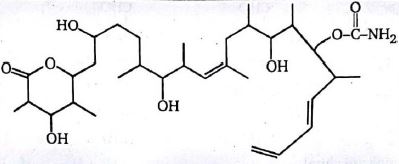
What is the maximum number of stereoisomers possible for discodermolide ? 
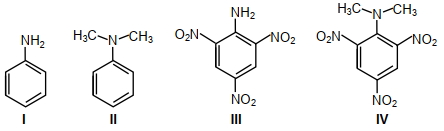
Consider the following four compounds $I, II, III,$ and $IV$.

Choose the correct statement($s$).

$(A)$ The order of basicity is $II > I > III > IV$ .

$(B)$ The magnitude of $p K_{ b }$ difference between $I$ and $II$ is more than that between $III$ and $IV$.

$(C)$ Resonance effect is more in $III$ than in $IV$.

$(D)$ Steric effect makes compound $IV$ more basic than $III$.

In a catalytic conversion of ${N_2}$ to $N{H_3}$ by Haber's process, the rate of reaction was expressed as change in the concentration of ammonia per time is $40 \times {10^{ - 3}}\,mol\,litr{e^{ - 1}}{s^{ - 1}}$. If there are no side reaction, the rate of the reaction as expressed in terms of hydrogen is (in mol $litr{e^{ - 1}}{s^{ - 1}}$)
The empirical formula of a compound is $C{H_2}O.$ $0.0835$ moles of the compound contains $1.0\ g$ of hydrogen. Molecular formula of the compound is
The number of moles of $Ca(OH)_2$ required to prepare $250\, mL$ of solution with $pH\, 14$  (assuming complete ionization) is :-
When ethanol mixes in cyclohexane; cyclohexane reduces the intermolecular forces between ethanol molecule. In this, liquid pair shows
We have three aqueous solutions of NaCl labelled as 'A', 'B' and 'C' with concentration 0.1 M , $0.01 M \& 0.001 M$, respectively. The value of van t' Haft factor (i) for these solutions will be in the order.
Which of the following is a meso compound ?
The IUPAC name of $\left[ {Ni{{(CO)}_4}} \right]$ is
When glycerol is treated with excess of $HI$, it produces