Three unequal resistors in parallel are equivalent to a resistance $1\, ohm$. If two of them are in the ratio $1 : 2$ and if no resistance value is fractional, the largest of the three resistances in $ohms$ is
Medium


Download our appand get started for free
Experience the future of education. Simply download our apps or reach out to us for more information. Let's shape the future of learning together!No signup needed.*
Similar Questions
- 1Voltmeter reads potential difference across the terminals of an old battery as $1.2\,volt$ , while a potentiometer reads $1.4\,volt$ . The internal resistance of battery is $40\,\Omega $ , then voltmeter resistance is .............. $\Omega$View Solution
- 2The power rating of an electric motor which draws a current of $3.75\, amperes$ when operated at $200\, V$ is aboutView Solution
- 3Two $220\; V , 100 \;W$ bulbs are connected first in series and then in parallel. Each time the combination is connected to a $220 \;V \;AC$ supply line. The power drawn by the combination in each case respectively will beView Solution
- 4A bulb rated at ($100\,W$ - $200\,V$) is used on a $100\,V$ line. The current in the bulb isView Solution
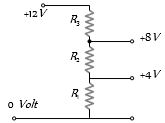
- 5A potential divider is used to give outputs of $4\, V$ and $8\, V$ from a $12\, V$ source. Which combination of resistances, $(R_1, R_2, R_3)$ gives the correct voltages ? $R_1 : R_2 : R_3$View Solution
- 6Read the following statements carefully :View Solution
$Y :$ The resistivity of a semiconductor decreases with increases of temperature.
$Z :$ In a conducting solid, the rate of collision between free electrons and ions increases with increase of temperature.
Select the correct statement from the following :
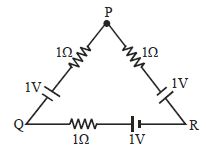
- 7In given circuit find potential difference between $P$ and $Q$ .................. $V$View Solution
- 8If you are provided a set of resistances $2\, \Omega, 4\, \Omega$ $6\, \Omega$ and $8\, \Omega$. Connect these resistances so as to obtain an equivalent resistance of $\frac{46}{3}\, \Omega$.View Solution
- 9A uniform metallic wire has a resistance of $18\,\Omega $ and is bent into an equilateral triangle. Then, the resistance between any two vertices of the triangle is .................. $\Omega$View Solution
- 10A copper wire of diameter $1.02\, mm$ carries a current of $1.7\, amp$. Find the drift velocity $(v_d)$ of electrons in the wire. Given $n$, number density of electrons in copper $= 8.5 \times 10^{27} /m^3$....................... $mm/sec$View Solution