MCQ
Three vectors $\overrightarrow a ,\,\overrightarrow b $and $\overrightarrow c $ satisfy the relation $\overrightarrow a \,.\,\overrightarrow b = 0$ and $\overrightarrow a \,.\,\overrightarrow c = 0.$ The vector $\overrightarrow a $ is parallel to
  • A
    $\overrightarrow b $
  • B
    $\overrightarrow c $
  • C
    $\overrightarrow b \,.\,\overrightarrow c $
  • $\overrightarrow b \times \overrightarrow c $
Answer

Correct option: D.
$\overrightarrow b \times \overrightarrow c $
d
(d ) $\vec a\,.\,\vec b = 0$ i.e. $\vec a $ and $\vec b$ will be perpendicular to each other

$\vec a\,.\,\vec c = 0$ i.e. $\vec a$ and $\vec c$ will be perpendicular to each other

$\vec b \times \vec c$ will be a vector perpendicular to both $\vec b$ and $\vec c$

So $\vec a$ is parallel to $\vec b \times \vec c$

Need a full question paper?

Generate a complete, print-ready paper with questions like this in minutes — across 16+ boards, with answer keys.

Start Generating Free

Similar questions

If the momentum of a body is increased $n$ times, its kinetic energy increases
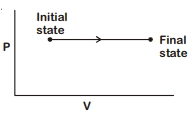
The $P-V$ diagram for an ideal gas in a piston cylinder assembly undergoing a thermodynamic process is shown in the figure. The process is
When a force is applied on a wire of uniform cross-sectional area $3 \times {10^{ - 6}}\,{m^2}$ and length $4m$, the increase in length is $1\, mm.$ Energy stored in it will be $(Y = 2 \times {10^{11}}\,N/{m^2})$
In a sinusoidal wave, the time required for a particular point to move from maximum displacement to zero displacement is 0.17s. The frequency of the wave is:
Two bodies at different temperatures are mixed in a calorimeter. Which of the following quantities remains conserved?
A particle is projected from ground at an angle $\theta$ with horizontal with speed $u$. The ratio of radius of curvature of its trajectory at point of projection to radius of curvature at maximum height is ........
Cooking gas containers are kept in a lorry moving with uniform speed. The temperature of the gas molecules inside will
Physical independence of force is a consequence of:
A projectile of mass $1\,\, kg$ is projected with a velocity of $\sqrt {20} \,\,m/s$ such that it strikes on the same level as the point of projection at a distance of $\sqrt {3} \,\,m$. Which of the following options are incorrect:
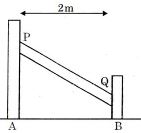
Two vertical walls are separated by a distance of $2\  m$. Wall $A$ is smooth while wall $B$ is rough with a coefficient of friction $0. 5$. A uniform rod is placed between them as shown. The length of longest rod that can be placed between walls is equal to