MCQ
Threshold wavelength for photoelectric effect on sodium is $5000 \mathring A.$ Its work function is
  • A
    $15\ J$
  • B
    $16 \times 10^{-14}\ J$
  • $4 \times 10^{-19}\ J$
  • D
    $4 \times 10^{-81}\ J$

Answer

Correct option: C.
$4 \times 10^{-19}\ J$
$4 \times 10^{-81}\ J$

Need a full question paper?

Generate a complete, print-ready paper with questions like this in minutes — across 16+ boards, with answer keys.
Start Generating Free

Similar questions

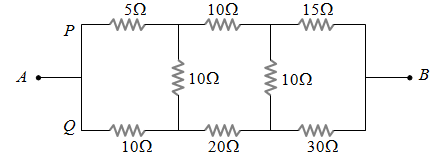
In the arrangement of resistances shown below, the effective resistance between points $A$ and $B$ is
A player with $3 m$ long iron rod runs towards east with a speed of $30 \ km/hr.$ Horizontal component of earth's magnetic field is $4\times 10^{-5} \mathrm{wb} / \mathrm{m}^2$.. If he is running with rod in horizontal and vertical positions, then the potential difference induced between the two ends of the rod in two cases will be
The fusion of light elements take place at about the temperatures of about:
The direction of magnetic lines of forces close to a straight conductor carrying current will be(a) Along the length of the conductor(a) Along the length of the conductor(c) Circular in a plane perpendicular to the conductor(d) Helical


A star emitting light of wavelength $5896 \mathring A $ is moving away from the earth with a speed of $3600 \ km /\sec.$ The wavelength of light observed on earth will $(c = 3 \times 10^8 m /\sec$  is the speed of light$)$
If refractive index of red, violet and yellow lights are 1.42, 1.62 and 1.50 respectively for a medium. Its dispersive power will be(a) 0.4(b) 0.3(c) 0.2(d) 0.1
       
Let $n_p$ and $n_e$ be the number of holes and conduction electrons in an intrinsic semiconductor.
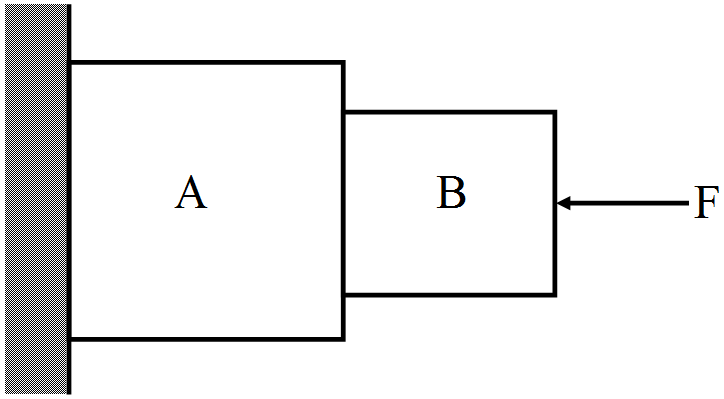
Consider the situation shown in figure. The wall smooth but the surface of A and B in contact are rough. The friction on B due to A in equilibrium:
  1. Is upward.
  2. Is downward.
  3. Is zero.
  4. The system cannot remain in equilibrium.
Wavelength of a particle of mass $m$ moving with velocity V is :
Which of the following are in the ascending order of wavelength?