MCQ
Threshold wavelength for photoelectric effect on sodium is $5000\;\mathring A$. Its work function is
  • A
    $1\;J$
  • B
    $3 \times 10^{-19}\;J$
  • $4 \times {10^{ - 19}}J$
  • D
    $2 \times 10^{-19}\;J$

Answer

Correct option: C.
$4 \times {10^{ - 19}}J$
c
(c) ${W_0} = \frac{{hc}}{{{\lambda _0}}} = \frac{{6.625 \times {{10}^{ - 34}} \times 3 \times {{10}^8}}}{{5000 \times {{10}^{ - 10}}}}J = 4 \times {10^{ - 19}}J$

Need a full question paper?

Generate a complete, print-ready paper with questions like this in minutes — across 16+ boards, with answer keys.
Start Generating Free

Similar questions

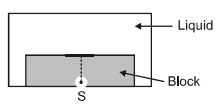
A point source $S$ is placed at the bottom of a transparent block of height $10 \ mm$ and refractive index $2.72$ . It is immersed in a lower refractive index liquid as shown in the figure. It is found that the light emerging from the block to the liquid forms a circular bright spot of diameter $11.54 \ mm$ on the top of the block. The refractive index of the liquid is
Two balls are dropped from heights $h$ and $2h$ respectively from the earth surface. The ratio of time of these balls to reach the earth is
If the surface area of the soap solution is increased then its surface tension
Which one of the following statements is correct
The radiation corresponding to $3 \rightarrow 2$ transition ofhydrogen atom falls on a metal surface to produce photoelectrons. These electrons are made to enter a magnetic field of $3 \times  10^{-4}$ $T$ If the radius of the largest circular path followed by these electrons is $10.0\ mm$, the work function of the metal is close to......$ eV$
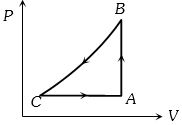
A sample of an ideal gas is taken through a cycle a shown in figure. It absorbs $50J$ of energy during the process $AB$, no heat during $BC$, rejects $70J$ during $CA.$ $40J$ of work is done on the gas during $BC$. Internal energy of gas at $A$ is $1500J$, the internal energy at $C$ would be ........ $J$
To obtain $P-$type $Si$ semiconductor, we need to dope pure $Si$ with
The respective speeds of the molecules are $1, 2, 3, 4$ and $5\, km/sec.$ The ratio of their $r.m.s. $ velocity and the average velocity will be
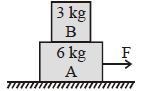
Two blocks $A$ and $B$ of masses $6\, kg$ and $3\, kg$ rest on a smooth horizontal surface as shown in the figure. If coefficient of friction between $A$ and $B$ is $0.4$, the maximum horizontal force which can make them without separation is  ........ $N$ 
A particle of mass $m$ is attached to one end of a mass-less spring of force constant $k$, lying on a frictionless horizontal plane. The other end of the spring is fixed. The particle starts moving horizontally from its equilibrium position at time $t=0$ with an initial velocity $u_0$. When the speed of the particle is $0.5 u_0$, it collies elastically with a rigid wall. After this collision :

$(A)$ the speed of the particle when it returns to its equilibrium position is $u_0$.

$(B)$ the time at which the particle passes through the equilibrium position for the first time is $t=\pi \sqrt{\frac{ m }{ k }}$.

$(C)$ the time at which the maximum compression of the spring occurs is $t =\frac{4 \pi}{3} \sqrt{\frac{ m }{ k }}$.

$(D)$ the time at which the particle passes througout the equilibrium position for the second time is $t=\frac{5 \pi}{3} \sqrt{\frac{ m }{ k }}$.