Question
Through what potential difference should an electron be accelerated to give it a speed of:
  1. 0.6c
  2. 0.9c
  3. 0.99c

Answer

  1. $\text{eV}-\text{m}_0\text{C}^2=\frac{\text{m}_0\text{C}^2}{2\sqrt{1-\frac{\text{V}^2}{\text{C}^2}}}$
$\Rightarrow\text{eV}-9.1\times10^{-31}\times9\times10^{16}$

$=-\frac{9.1\times9\times10^{-31}\times10^{16}}{2\sqrt{1-\frac{0.36\text{C}^2}{\text{C}^2}}}$

$\Rightarrow\text{eV}-9.1\times9\times10^{-15}$

$=\frac{9.1\times9\times10^{-15}}{2\times0.08}$

$\Rightarrow\text{ev}-9.1\times9\times10^{-15}$

$=\frac{9.1\times9\times10^{-15}}{1.6}$

$\Rightarrow\text{eV}=\Big(\frac{9.1\times9}{1.6}+9.1\times9\Big)\times10^{-15}$

$=\text{eV}\Big(\frac{81.9}{1.6}+81.9\Big)\times10^{-15}$

$=\text{eV}=133.0875\times10^{-15}$

$\Rightarrow\text{V}=83.179\times10^{4}=831\text{KV}$
  1. $\text{eV}=\text{m}_0\text{C}^2=\frac{\text{m}_0\text{C}^2}{2\sqrt{1-\frac{\text{V}^2}{\text{C}^2}}}$
$\Rightarrow\text{eV}-9.1\times9\times10^{-19}\times9\times10^{16}$

$=\frac{9.1\times9\times10^{-15}}{2\sqrt{1-\frac{0.81\text{C}^2}{\text{C}^2}}}$

$\Rightarrow\text{eV}-81.9\times10^{-15}=\frac{9.1\times9\times10^{-15}}{2\times0.435}$

$\Rightarrow\text{eV}=12.237\times10^{-15}$

$\Rightarrow\text{V}=\frac{12.237\times10^{-15}}{1.6\times10^{-19}}=76.48\text{kV}$

$\text{V}=0.99\text{C}=\text{ev}-\text{m}_0\text{C}^2=\frac{\text{m}_0\text{C}^2}{2\sqrt{1-\frac{\text{V}^2}{\text{C}^2}}}$

$\Rightarrow\text{eV}=\frac{\text{m}_0\text{C}^2}{2\sqrt{1-\frac{\text{V}^2}{\text{C}^2}}}+\text{m}_0\text{C}^2$

$=\frac{9.1\times10^{31}\times9\times10^{16}}{2\sqrt{1-(0.99)^2}} +9.1\times10^{-31}\times9\times10^{16}$

$\Rightarrow\text{eV}=372.18\times10^{-15}$

$\Rightarrow\text{V}=\frac{372.18\times20^{-15}}{1.6\times10^{-19}}=272.6\times10^{4}$

$\Rightarrow\text{V}=2.726\times10^{6}=2.7\text{MeV}$

Need a full question paper?

Generate a complete, print-ready paper with questions like this in minutes — across 16+ boards, with answer keys.
Start Generating Free

Similar questions

An ornament weighing 36g in air, weighs only 34g in water. Assuming that some copper is mixed with gold to prepare the ornament, find the amount of copper in it. Specific gravity of gold is 19.3 and that of copper is 8.9.
An operator sitting in his base camp sends a sound signal of frequency 400Hz. The signal is reflected back from a car moving towards him. The frequency of the reflected sound is found to be 410Hz. Find the speed of the car. Speed of sound in air = 324m/s.
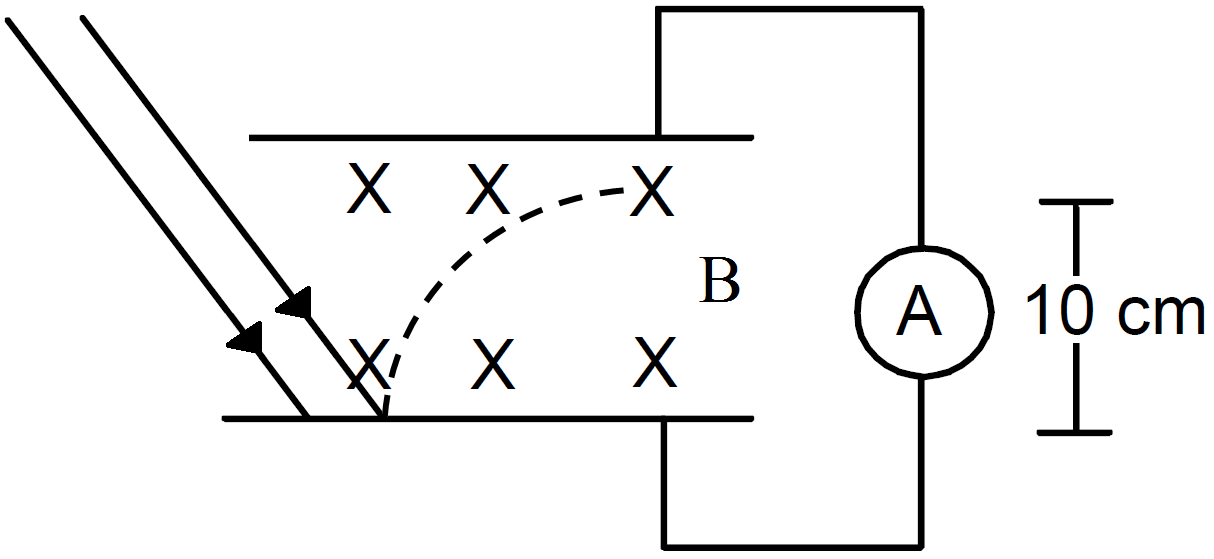
In an experiment on photoelectric effect, the emitter and the collector plates are placed et a separation of 10cm and are connected through en ammeter without any cell A magnetic field B exists parallel to the plates. The work function of the emitter is 2.39eV and the light incident on it has wavelengths between 400nm and 600nm. Find the minimum value of B for which the current registered by the ammeter is zero. Neglect any effect of space charge.
When the sun is directly overhead, the surface of the earth receives $1.4 \times 10^3\ W\ m^{-2}$ of sunlight. Assume that the light is monochromatic with average wavelength 500nm and that no light is absorbed in between the sun and the earth's surface. The distance between the sun and the earth is $1.5 \times 10^{11}m.$​​​​​​​
  1. Calculate the number of photons falling per second on each square metre of earth's surface directly below the sun.
  2. How many photons are there in each cubic metre near the earth's surface at any instant?
  3. How many photons does the sun emit per second?
A point object 'O' is kept in a medium of refractive index $n_1$ in front of a convex spherical surface of radius of curvature R which separates the second medium of refractive index $n_2$ from the first one, as shown in the figure.
  1. Draw the ray diagram showing the image formation and deduce the relationship between the object distance and the image distance in terms of $n_1, n_2$ and R.
  2. When the image formed above acts as a virtual object for concave spherical, surface separating the medium $n_2$ from $n_1 (n_2> n_1)$, draw this ray diagram and write the similar (similar to (a) relation. Hence obtain the expression for the lens maker's formula.
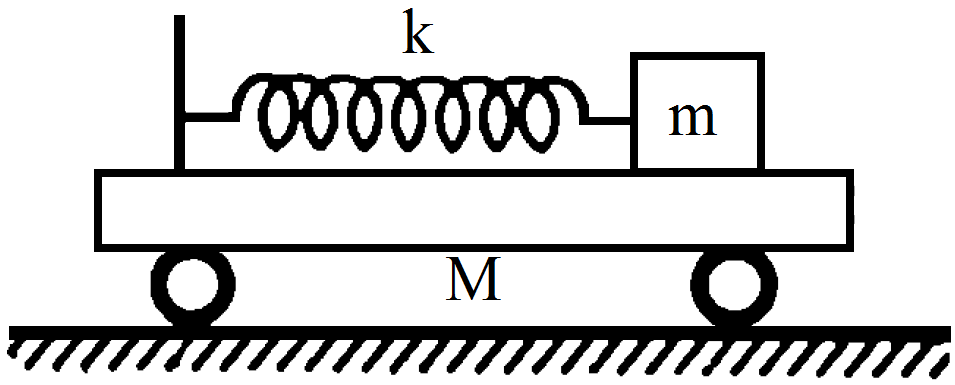
All the surfaces shown in are frictionless. The mass of the car is M, that of the block is m and the spring has spring constant k. Initially, the car and the block are at rest and the spring is stretched through a length x, when the system is released.
  1. Find the amplitudes of the simple harmonic motion of the block and of the car as seen from the road.
  2. Find the time period(s) of the two simple harmonic motions.
Find the typical de Broglie wavelength associated with a He atom in helium gas at room temperature (27ºC) and 1 atm pressure; and compare it with the mean separation between two atoms under these conditions.
Derive Snell's law for refraction of light by Huygen's wave theory.
The time constant of an LR circuit is 40ms. The circuit is connected at t = 10 and the steady-state current is found to be 2.0A. Find the current at:
  1. t = 10ms
  2. t = 20ms
  3. t = 100ms
  4. t = 1s.
A metre scale made of steel reads accurately at $20^{\circ} \mathrm{C}$. In a sensitive experiment, distances accurate up to 0.055 mm in 1 m are required. Find the range of temperature in which the experiment can be performed with this metre scale. Coefficient of linear expansion of steel $=11 \times 10^{-6}{ }^{\circ} \mathrm{C}^{-1}$.