Time period of a particle executing $SHM$ is $8\, sec.$ At $t = 0$ it is at the mean position. The ratio of the distance covered by the particle in the $1^{st}$ second to the $2^{nd}$ second is :
Advanced
Download our app for free and get started
$x=A \sin \omega t$
$x(t=1 s)=A \sin \left(\frac{2 \pi}{T} t\right)=A \sin \left(\frac{2 \pi}{8}\right)=A \sin \left(\frac{\pi}{4}\right)=\frac{A}{\sqrt{2}}$
$x(t=2 s)=A \sin \left(\frac{2 \pi}{T} t\right)=A \sin \left(\frac{2 \pi}{8} \times 2\right)=A \sin \left(\frac{\pi}{2}\right)=A$
And the required ratio is$:$
$\frac{x(t=1 s)}{x(t=2 s)-x(t=1 s)}=\frac{\frac{A}{\sqrt{2}}}{A-\frac{A}{\sqrt{2}}}=\frac{1}{\sqrt{2}-1}=\sqrt{2}+1$

Download our appand get started for free
Experience the future of education. Simply download our apps or reach out to us for more information. Let's shape the future of learning together!No signup needed.*
Similar Questions
- 1A particle executes simple harmonic motion (amplitude $= A$) between $x = - A$ and $x = + A$. The time taken for it to go from $0$ to $A/2$ is ${T_1}$ and to go from $A/2$ to $A$ is ${T_2}$. ThenView Solution
- 2A particle moves with simple harmonic motion in a straight line. In first $\tau \,s,$ after starting from rest it travels a distance $a,$ and in next $\tau \,s$ it travels $2a,$ in same direction, thenView Solution
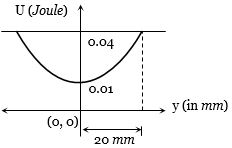
- 3View SolutionThe variation of potential energy of harmonic oscillator is as shown in figure. The spring constant is
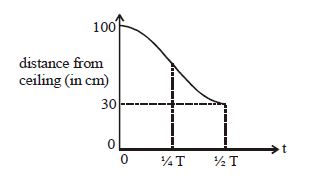
- 4A spring hangs vertically from the ceiling and a mass is attached to its free end. When the mass is pulled down and released, it oscillates vertically with simple harmonic motion of period $T$ . The variation with time $t$ of its distance from the ceiling is as shown. Which statement gives a correct deduction from this graph?View Solution
- 5View SolutionTwo oscillating systems; a simple pendulum and a vertical spring-mass-system have same time period of motion on the surface of the Earth. If both are taken to the moon, then-
- 6At a given point of time the value of displacement of a simple harmonic oscillator is given as $y = A \cos \left(30^{\circ}\right)$. If amplitude is $40\,cm$ and kinetic energy at that time is $200\, J$, the value of force constant is $1.0 \times 10^{ x }\,Nm ^{-1}$. The value of $x$ is ......View Solution
- 7A particle executes simple harmonic motion with an amplitude of $4 \,cm$. At the mean position the velocity of the particle is $10\, cm/s$. The distance of the particle from the mean position when its speed becomes $5 \,cm/s$ isView Solution
- 8The function of time representing a simple harmonic motion with a period of $\frac{\pi}{\omega}$ is :View Solution
- 9A particle of mass $m$ is attached to one end of a mass-less spring of force constant $k$, lying on a frictionless horizontal plane. The other end of the spring is fixed. The particle starts moving horizontally from its equilibrium position at time $t=0$ with an initial velocity $u_0$. When the speed of the particle is $0.5 u_0$, it collies elastically with a rigid wall. After this collision :View Solution
$(A)$ the speed of the particle when it returns to its equilibrium position is $u_0$.
$(B)$ the time at which the particle passes through the equilibrium position for the first time is $t=\pi \sqrt{\frac{ m }{ k }}$.
$(C)$ the time at which the maximum compression of the spring occurs is $t =\frac{4 \pi}{3} \sqrt{\frac{ m }{ k }}$.
$(D)$ the time at which the particle passes througout the equilibrium position for the second time is $t=\frac{5 \pi}{3} \sqrt{\frac{ m }{ k }}$.
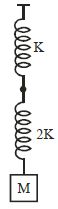
- 10Two springs of force constant $K$ and $2K$ are connected to a mass as shown below. The frequency of oscillation of the mass isView Solution