MCQ
Time periods of oscillation of the same simple pendulum measured using four different measuring clocks were recorded as $4.62 \mathrm{~s}, 4.632 \mathrm{~s}, 4.6 \mathrm{~s}$ and $4.64 \mathrm{~s}$. The arithmetic mean of these reading in correct significant figure is.
  • A
    $4.623 \mathrm{~s}$
  • B
    $4.62 \mathrm{~s}$
  • $4.6 \mathrm{~s}$
  • D
    $5 \mathrm{~s}$

Answer

Correct option: C.
$4.6 \mathrm{~s}$
c
Sum of number by considering significant digit sum $=4.6+4.6+4.6+4.6=18.4$

$\text { Arithmetic Mean }=\frac{\text { sum }}{4}=\frac{18.4}{4}=4.6$

Need a full question paper?

Generate a complete, print-ready paper with questions like this in minutes — across 16+ boards, with answer keys.

Start Generating Free

Similar questions

A $120\, volt$ $ac$ source is connected across a pure inductor of inductance $0.70 \,henry.$ If the frequency of the source is $60\, Hz$, the current passing through the inductor is
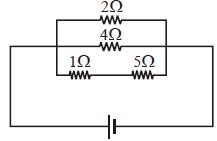
A current of $3\,amp$ flows through the $2\,\Omega $ resistor shown in the circuit. The power dissipated in the $5\,\Omega $ resistor is ................. $watt$
According to Bohr's theory the radius of electron in an orbit described by principal quantum number $n$ and atomic number $Z$ is proportional to
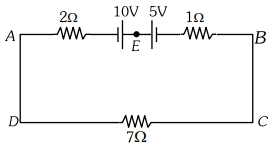
The magnitude and direction of the current in the following circuit is :-
The product of this reaction should be
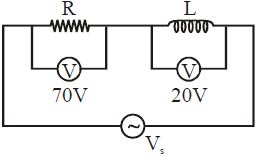
The adjoining figure shows an $AC$ circuit with resistance $R$, inductance $L$ and  source voltage $V_s$. Then
Two resistors are joined in parallel whose, resultant is $\frac{6}{5} \,\Omega$. One of the resistance wire is broken and the effective resistance becomes $2 \,ohms$. Then the resistance (in $ohm$) of the wire that got broken is ..........
What equal length of an iron wire and a copper-nickel alloy wire, each of $2 \; {mm}$ diameter connected parallel to give an equivalent resistance of $3 \Omega ?$

(Given resistivities of iron and copper-nickel alloy wire are $12 \;\mu \Omega {cm}$ and $51\; \mu \Omega {cm}$ respectively) (in ${m}$)

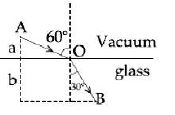
A ray of light $AO$ in vacuum is incident on a glass slab at angle $60^o$ and refracted at angle $30^o$ along $OB$ as shown in the figure. The optical path length of light ray from $A$ to $B$ is
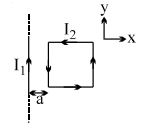
A square loop of side $\lambda $ is placed in the neighbourhood of an infinitely long straight wire carrying a current $I_1.$ The loop carries a current $I_2$ as shown in figure