MCQ
Tischenko reaction is a modification of
- AAldol condensation
- BClaisen condensation
- ✓Cannizzaro reaction
- DPinacol-pinacolon reaction
In cannizzaro's reaction the base is sodium hydroxide and the oxidation product is a carboxylic acid and the reduction product is an alcohol. 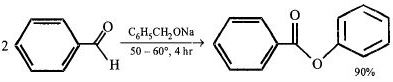
Generate a complete, print-ready paper with questions like this in minutes — across 16+ boards, with answer keys.
$(A)$ The elevation in boiling point temperature of water will be same for $0.1 M NaCl$ and $0.1 M$ urea.
$(B)$ Azeotropic mixtures boil without change in their composition
$(C)$ Osmosis always takes place from hypertonic to hypotonic solution
$(D)$ The density of $32 \% H _2 SO _4$ solution having molarity $4.09\,M$ is approximately $1.26\,g\,mL ^{-1}$
$(E)$ A negatively charged sol is obtained when $KI$ solution is added to silver nitrate solution.
Choose the correct answer from the options given below :
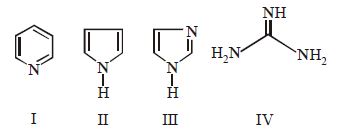
True statement about sequence on the basis of assumption that $R$ contains $3$ different groups is
$\mathop R\limits^{\delta \oplus } \,\mathop {Br}\limits^{\delta \,\Theta } \, \rightleftharpoons $ $\mathop {\boxed{{R^ \oplus }B{r^\Theta }}}\limits_{(a)} \,\,\, \rightleftharpoons \,$$\,\mathop {\boxed{{R^ \oplus }}\,\boxed{B{r^\Theta }}\,}\limits_{(b)} \,\, \rightleftharpoons $ ${\boxed{{R^ \oplus }}}$ $ \rightleftharpoons $ $\mathop {\,\boxed{B{r^\Theta }}\,}\limits_{(c)} \,$