MCQ
To avoid slipping while walking on ice, one should take smaller steps because of the
  • A
    Friction of ice is large
  • B
    Larger normal reaction
  • Friction of ice is small
  • D
    Smaller normal reaction

Answer

Correct option: C.
Friction of ice is small
c
(c) To avoid slipping one should take smaller steps because the frictional force of ice is small.

Smaller steps will give larger normal force and more the normal force more the friction.

Also the advantage of talking small steps is that lateral forces are decreased. When we put down are foot it will be pushing forwards on the concrete and at the end of the step it will be pushing backwards. Hence larger the step these forward and backward forces will be larger increasing the chances of slipping.

Need a full question paper?

Generate a complete, print-ready paper with questions like this in minutes — across 16+ boards, with answer keys.
Start Generating Free

Similar questions

If a convex lens of focal length $80 \;cm$ and a concave lens of focal length $50 \;cm$ are combined together, what will be their resulting power
Image
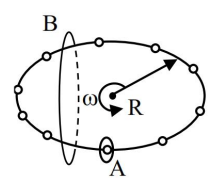
N equally spaced charges each of value q , are placed on a circle of radius R . The circle rotates about its axis with an angular velocity $\omega$ as shown in the figure. A bigger Amperian loop B encloses the whole circle where as a smaller Amperian loop A encloses a small segment. The difference between enclosed currents, $I_A-I_B$, for the given Amperian loops is
Match List I with List II
List IList II
A.$\oint \overrightarrow{ B } \cdot \overrightarrow{ dl }=\mu_0 i _{ c }+\mu_0 \varepsilon_0 \frac{d \phi_{ E }}{ dt }$I.Gauss’ law for electricity
B.$\oint \overrightarrow{ E } \cdot \overrightarrow{ d }=\frac{ d \phi_{ B }}{ dt }$II.Gauss' law for magnetism
C.$\oint \overrightarrow{ E } \cdot \overrightarrow{ dA }=\frac{ Q }{\varepsilon_0}$III.Faraday law
D.$\oint \overrightarrow{ B } \cdot \stackrel{\rightharpoonup}{ dA }=0$IV.Ampere –Maxwell law
Chose the correct answer from the options given below.
The mass of the moon is $1 / 144$ times the mass of a planet and its diameter $1 / 16$ times the diameter of a planet. If the escape velocity on the planet is $\mathrm{v}$, the escape velocity on the moon will be:
If the amount of heat given to a system be $35$ joules and the amount of work done by the system be $ - 15$ joules, then the change in the internal energy of the system is .... $joules$
A block of mass $m$ is moving with a constant acceleration a on a rough plane. If the coefficient of friction between the block and ground is $\mu $, the power delivered by the external agent after a time $t$ from the beginning is equal to
When resonance is produced in a series $LCR$ circuit, then which of the following is not correct ?
The units of Young ‘s modulus of elasticity are
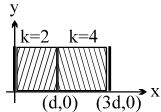
A parallel plate capacitor has two layers of dielectric as shown in figure. This capacitor is connected across a battery. The graph which shows the variation of electric field $(E)$ and distance $(x)$ from left plate.
$X$-rays of a particular wavelength are used to irradiate sodium and copper surfaces in two separate experiments and stopping potentials are determined. The stopping potentials are