Question
To increase the angular magnification of a simple microscope, one should increase:
  1. The focal length of the lens.
  2. The power of the lens.
  3. The aperture of the lens.
  4. The object size.

Answer

  1. The power of the lens.

Explanation:

For a simple microscope in normal adjustment, the object is placed at a distance equal to f (the ​focal length) from the lens, And the angular magnification is given by the relation

$\text{m}=\frac{\text{D}}{\text{f}}$

for $\text{u}<\text{f},\text{m}=\frac{\text{D}}{\text{f}}+1$

power of lens $=\frac{1}{\text{f}}$

Angular magnification depends on power.

Need a full question paper?

Generate a complete, print-ready paper with questions like this in minutes — across 16+ boards, with answer keys.

Start Generating Free

Similar questions

A motor-car tyre has a pressure of $2\, atm$ at $27\,^oC$. It suddenly burst's. If $\left( {\frac{{{C_p}}}{{{C_v}}}} \right) = 1.4$ for air, find the resulting temperatures (Given $4^{1/7} = 1.219$)
A mass of $100\, gm$ is tied to one end of a string $2 \,m$ long. The body is revolving in a horizontal circle making a maximum of $200$ revolutions per min. The other end of the string is fixed at the centre of the circle of revolution. The maximum tension that the string can bear is ..........  $N$. (approximately)
The X-ray beam emerging from an X-ray tube:
  1. Is monochromatic.
  2. Has all wavelengths smaller than a certain maximum wavelength.
  3. Has all wavelengths greater than a certain minimum wavelength.
  4. Has all wavelengths lying between a minimum and a maximum wavelength.
A air bubble rises from bottom of a lake to surface. If its radius increases by $200 \%$ and atmospheric pressure is equal to water coloumn of height $H$. then depth of lake is ..... $H$
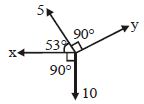
Find the magnitude of the unknown forces $X$ and $Y$ if sum of all forces is zero
A strap is passing over a wheel of radius $30\, cm.$ During the time the wheel moving with initial constant velocity of $2\, rev/sec.$ comes to rest the strap covers a distance of $25\, m.$ The deceleration of the wheel in $rad/s$$^2$ is
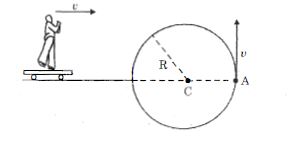
A boy is moving with a constant speed $v$ on a small trolley towards a distant circle as shown in the figure. A point mass is moving on the circle with a constant speed $v$, what is the frequency of change in magnitude of relative velocity of the point mass, as observed by the boy.
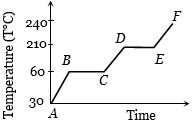
A solid substance is at $30°C$. To this substance heat energy is supplied at a constant rate. Then temperature versus time graph is as shown in the figure. The substance is in liquid state for the portion (of the graph)
The time period of a particle in simple harmonic motion is equal to the smallest time between the particle acquiring a particular velocity $\overrightarrow{\text{v}}.$ The value of v is
  1. vmax.
  2. 0
  3. between 0 and vmax.
  4. between 0 and - vmax
For a satellite if the time of revolution is $T$, then its $K.E.$ is proportional to