Question
To maintain a steady current through the conductor, some external device must do work. What does the external device provide?

Answer

  1. Electromotive force
Explanation:
To maintain steady current through the conductor, electromotive force must be provided by the external device to take positive charge from lower potential to higher potential i.e. in the direction opposite to that of the electric field.

Need a full question paper?

Generate a complete, print-ready paper with questions like this in minutes — across 16+ boards, with answer keys.
Start Generating Free

Similar questions

The apparent wavelength of the light from a star moving away from the earth is 0.01% more than its real wavelength. Then the velocity of star is(a) 60 km/sec(b) 15 km/sec(c) 150 km/sec(d) 30 km/sec
       
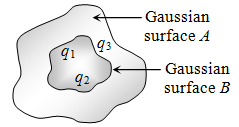
The electric flux for Gaussian surface $A$ that enclose the charged particles in free space is
$($given $q_1 = –14\ nC, q_2 = 78.85\ nC, q_3 = – 56\ nC)$ 
Hysterisis is the phenomenon of lagging of:
The magnitude of saturation photoelectric current depends upon(a) Frequency (b) Intensity(c) Work function(d) Stopping potential
       
The charge given to a hollow sphere of radius $10 \ cm$ is $3.2 \times 10^{–19}$ coulomb. At a distance of $4 \ cm$ from its centre, the electric potential will be
The relation between $a$ and $b$ parameters of current gains for a transistors is given by
The S.I. unit of electric flux is:
A long, straight wire carries a current i. The magnetizing field intensity H is measured at a point P close to the wire. A long, cylindrical iron rod is brought close to the wire so that the point P is at the centre the rod. The value of H at P will:
  1. Increase many times.
  2. Decrease many times
  3. Remain almost constant.
  4. Become zero.
Two lenses are placed in contact with each other and the focal length of combination is 80 cm. If the focal length of one is 20 cm, then the power of the other will be(a) 1.66 D(b) 4.00 D(c) –1.00 D(d) – 3.75 D
       
The Bohr radius of the fifth electron of phosphorus (atomic number = 15) acting as dopant in silicon (relative dielectric constant = 12) is(a) 10.6 Å(b) 0.53 Å(c) 21.2 Å                                           (d) None of these