MCQ
To maintain a steady current through the conductor, some external device must do work. What does the external device provide?
- AInductance
- BCapacitance
- CPotential difference
- DElectromotive force
Explanation:
To maintain steady current through the conductor, electromotive force must be provided by the external device to take positive charge from lower potential to higher potential i.e. in the direction opposite to that of the electric field.
Generate a complete, print-ready paper with questions like this in minutes — across 16+ boards, with answer keys.
64 drops of mercury each charged to a potential of 10V. They are combined to form one bigger drop. The potential of this drop will be (Assume all the drops to be spherical)
|
(a) 160 V |
(b) 80 V |
(c) 10 V |
(d) 640 V |
Assertion : If two long wires, hanging freely are connected to a battery in series, they come closer to each other.
Reason : Force of attraction acts between the two wires carrying current.
|
(a) If both assertion and reason are true and the reason is the correct explanation of the assertion. |
|
(b) If both assertion and reason are true but reason is not the correct explanation of the assertion. |
|
(c) If assertion is true but reason is false. |
|
(d) If the assertion and reason both are false. |
In a Young's double slit experiment, the central point on the screen is
|
(a) Bright |
(b) Dark |
|
(c) First bright and then dark |
(d) First dark and then bright |
The magnetic field to a small magnetic dipole of magnetic moment M, at distance r from the centre on the equatorial line is given by (in M.K.S. system)
|
(a) |
(b) |
(c) |
(d) |
Line spectrum contains information about
|
(a) The atoms of the prism |
|
(b) The atoms of the source |
|
(c) The molecules of the source |
|
(d) The atoms as well as molecules of the source |
The equivalent resistance of the following diagram A and B is
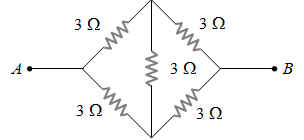
|
(a) |
(b) 9 W |
(c) 6 W |
(d) None of these |
In the interference pattern, energy is
|
(a) Created at the position of maxima |
(b) Destroyed at the position of minima |
|
(c) Conserved but is redistributed |
(d) None of the above |
A nuclear reaction given by  represents
|
(a) g-decay |
(b) Fusion |
(c) Fission |
(d) b-decay |
A galvanometer of 50 ohm resistance has 25 divisions. A current of 4 × 10⁻⁴ ampere gives a deflection of one division. To convert this galvanometer into a voltmeter having a range of 25 volts, it should be connected with a resistance of
|
(a) 2500 W as a shunt |
(b) 2450 W as a shunt |
|
(c) 2550 W in series |
(d) 2450 W in series |


