MCQ
To make a $PN$ junction conducting
  • The value of forward bias should be more than the barrier potential
  • B
    The value of forward bias should be less than the barrier potential
  • C
    The value of reverse bias should be more than the barrier potential
  • D
    The value of reverse bias should be less than the barrier potential

Answer

Correct option: A.
The value of forward bias should be more than the barrier potential
a
(a) To make a $p-n$ junction conducting, the value of forward bias should be more than the barrier potential.

Need a full question paper?

Generate a complete, print-ready paper with questions like this in minutes — across 16+ boards, with answer keys.

Start Generating Free

Similar questions

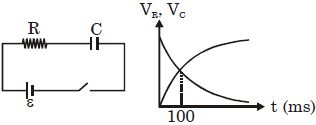
In the $RC$ circuit shown, switch is closed at $t = 0$ . Graphs showing variation of potential $(V_R)$ across resistor and potential $(V_C)$ across capacitor are given. Time constant of circuit is approximately equal to.....$ms$
If the measurement errors in all the independent quantities are known, then it is possible to determine the error in any dependent quantity. This is done by the use of series expansion and truncating the expansion at the first power of the error. For example, consider the relation $z=x / y$. If the errors in $x, y$ and $z$ are $\Delta x, \Delta y$ and $\Delta z$, respectively, then

$z \pm \Delta z=\frac{x \pm \Delta x}{y \pm \Delta y}=\frac{x}{y}\left(1 \pm \frac{\Delta x}{x}\right)\left(1 \pm \frac{\Delta y}{y}\right)^{-1} .$

The series expansion for $\left(1 \pm \frac{\Delta y}{y}\right)^{-1}$, to first power in $\Delta y / y$, is $1 \mp(\Delta y / y)$. The relative errors in independent variables are always added. So the error in $z$ will be $\Delta z=z\left(\frac{\Delta x}{x}+\frac{\Delta y}{y}\right)$.

The above derivation makes the assumption that $\Delta x / x \ll<1, \Delta y / y \ll<1$. Therefore, the higher powers of these quantities are neglected.

($1$) Consider the ratio $r =\frac{(1- a )}{(1+ a )}$ to be determined by measuring a dimensionless quantity a.

If the error in the measurement of $a$ is $\Delta a (\Delta a / a \ll<1)$, then what is the error $\Delta r$ in

$(A)$ $\frac{\Delta a }{(1+ a )^2}$  $(B)$ $\frac{2 \Delta a }{(1+ a )^2}$  $(C)$ $\frac{2 \Delta a}{\left(1-a^2\right)}$  $(D)$ $\frac{2 a \Delta a}{\left(1-a^2\right)}$

($2$) In an experiment the initial number of radioactive nuclei is $3000$ . It is found that $1000 \pm$ 40 nuclei decayed in the first $1.0 s$. For $|x|<1$, In $(1+x)=x$ up to first power in $x$. The error $\Delta \lambda$, in the determination of the decay constant $\lambda$, in $s ^{-1}$, is

$(A) 0.04$  $(B) 0.03$  $(C) 0.02$  $(D) 0.01$

Give the answer or quetion ($1$) and ($2$)
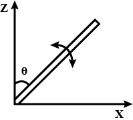
A slender uniform rod of mass $M$ and length $l$ is pivoted at one end so that it can rotate in a vertical plane (see figure). There is negligible friction at the pivot. The free end is held vertically above the pivot and then released. The angular acceleration of the rod when it makes an angle $\theta$ with the vertical is
A plane electromagnetic wave travelling along the $X$-direction has a wavelength of $3\ mm$ . The variation in the electric field occurs in the $Y$-direction with an amplitude $66\  Vm^{-1}$. The equations for the electric and magnetic fields as a function of $x$ and $t$ are respectively :-
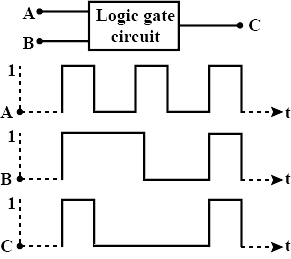
The following figure shows a logic gate circuit with two inputs $A$ and $B$ and the output $C.$ The voltage waveforms of $A, B$ and $C$ are as shown below. The logic circuit gate is
A cell of emf $90\,V$ is connected across series combination of two resistors each of $100\,\Omega$ resistance. A voltmeter of resistance $400\,\Omega$ is used to measure the potential difference across each resistor. The reading of the voltmeter will be $.........\,V$
The shortest wavelength of Lyman series of hydrogen atom is equal to the shortest  wavelength of Balmer series of an hydrogen like atom of atomic number $Z$. The value of $Z$ is equal to :-
What is the minimum coefficient of friction for a solid sphere to roll without slipping on an inclined plane of inclination $\theta$ ?
A car of weight $W$ is on an inclined road that rises by $100\,m$ over a distance of $1\,Km$ and applies a constant frictional force $\frac {W}{20}$ on the car. While moving uphill on the road at a speed of $10\,ms^{-1},$ the car needs power $P.$ If it needs power $\frac {P}{2}$ while moving down hill at speed $v$ then value of $v$ is $ .... ms^{-1}$
Two points $A$ and $B$ are situated at a distance $x$ and $2x$ respectively from the nearer pole of a magnet $2\,cm$ long. The ratio of magnetic field at $A$ and $B$ is