MCQ
To make the field radial in a moving coil galvanometer
  • A
    The number of turns in the coil is increased
  • B
    Magnet is taken in the form of horse-shoe
  • Poles are cylindrically cut
  • D
    Coil is wounded on aluminium frame

Answer

Correct option: C.
Poles are cylindrically cut
c
In order to obtain the radial magnetic field in a moving coil galvanometer, the poles of the magnet are cut cylindrical.

Need a full question paper?

Generate a complete, print-ready paper with questions like this in minutes — across 16+ boards, with answer keys.
Start Generating Free

Similar questions

At time $t = 0$, a simple harmonic oscillator is at its extreme position. If it covers half of  the amplitude distance in $1\, second$, then the time period of oscillation is ..... $s$
A hot and a cold body are kept in vacuum separated from each other. Which of the following cause decrease in temperature of the hot body
A point particle of mass $0.1\, kg$ is executing $S.H.M$. of amplitude of $0.1\, m$. When the particle passes through the mean position, its kinetic energy is $8\times10^{-3}$ Joule. Obtain the equation of motion of this particle if this initial phase of oscillation is $45^o$.
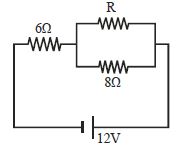
In the circuit shown in figure, the power which is dissipated as heat in the $6\,\Omega $ resistor is $6\,W$. What is the value of resistance $R$ in the circuit? ................ $\Omega$
The ratio of de-Broglie wavelengths of molecules of hydrogen and helium which are at temperature $27^oC$ and $127^oC$ respectively is
Orbits of a particle moving in a circle are such that the perimeter of the orbit equals an integer number of de-Broglie wavelengths of the particle. For a charged particle moving in a plane perpendicular to a magnetic field, the radius of the $n^{th}$ orbital will therefore be proportional to
If the buoyant force $F$ acting on an object depends on its volume $V$ immersed in a liquid, the density $\rho$ of the liquid and the acceleration due to gravity $g$. The correct expression for $F$ can be
Given below are two statements: one is labelled as Assertion $A$ and the other is labelled as Reason $R$.

Assertion $A$ : The photoelectric effect does not take place, if the energy of the incident radiation is less than the work function of a metal.

Reason $R$ : Kinetic energy of the photoelectrons is zero, if the energy of the incident radiation is equal to the work function of a metal.

In the light of the above statements, choose the most appropriate answer from the options given below

An electron revolves $6 × 10^{15}$ times/sec in circular loop. The current in the loop is
If in a experiment of photo electric effect wavelength of light is decreased by $60\%$ then $K_{max}$ change from $5\,eV$ to $17\,eV$ . The work function of metal is ............. $eV$