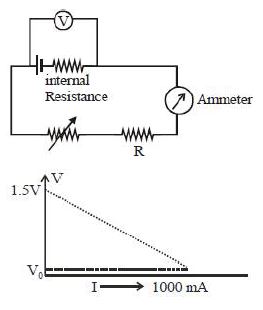
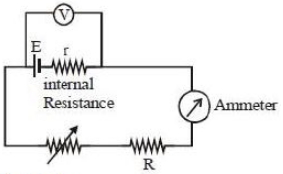
To verify Ohm's law, a student connects the voltmeter across the battery as, shown in the figure. The measured voltage is plotted as a function of the current, and the following graph is obtained If $V_0$ is almost zero, identify the correct statement
JEE MAIN 2019, Medium


Download our appand get started for free
Experience the future of education. Simply download our apps or reach out to us for more information. Let's shape the future of learning together!No signup needed.*
Similar Questions
- 1Two resistors of resistance $R_1$ and $R_2$ having $R_1 > R_2$ are connected in parallel. For equivalent resistance $R$, the correct statements isView Solution
- 2A battery of internal resistance one ohm and $emf$ $3\,volt$ sends a current through $1\,metre$ of uniform wire of resistance $5\,\Omega $. The pole of the cell of $emf$ $1.4\,volt$ are connected to two points on the wire so that no current passes through this cell. Then, the potential gradient of the wire isView Solution
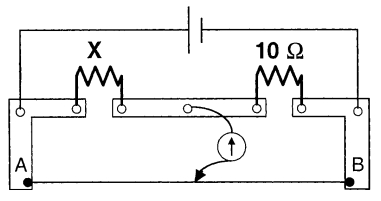
- 3A meter bridge is set-up as shown, to determine an unknown resistance ' $X$ ' using a standard $10$ ohm resistor. The galvanometer shows null point when tapping-key is at $52 \ cm$ mark. The end-corrections are $1 \ cm$ and $2 \ cm$ respectively for the ends $A$ and $B$. The determined value of ' $X$ ' isView Solution
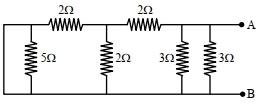
- 4The equivalent resistance of the given circuit between the terminals ${A}$ and ${B}$ is $....\Omega$View Solution
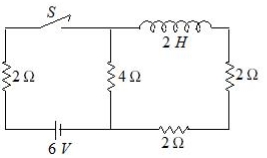
- 5For the given circuit the current through battery of $6\,V$ just after closing the switch ' $S$ ' will be$.......A$.View Solution
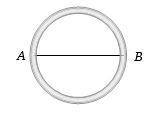
- 6A student has $10$ resistors of resistance ‘$r$’. The minimum resistance made by him from given resistors isView Solution
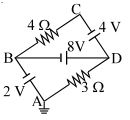
- 7The figure shows a network of resistances in which the point $A$ is earthed. The current through the $4\,\Omega$ resistor isView Solution
- 8What amount of heat will be generated in a coil of resistance $R$ due to a charge $q$ passing through it if the current in the coil decreases to zero uniformly during a time interval $\Delta t$View Solution
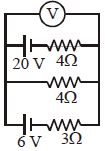
- 9What will be reading of voltmeter ................. $V$View Solution
- 10The resistance of a wire is ${10^{ - 6}}\,\Omega $ per meter. It is bend in the form of a circle of diameter $2\,m$. A wire of the same material is connected across its diameter. The total resistance across its diameter $AB$ will beView Solution