To Verify Ohm's law, a student is provided with a test resistor $\mathrm{R}_{\mathrm{T}}$, a high resistance $\mathrm{R}_1$, a small resistance $\mathrm{R}_2$, two identical galvanometers $\mathrm{G}_1$ and $\mathrm{G}_2$, and a variable voltage source $\mathrm{V}$. The correct circuit to carry out the experiment is
- A
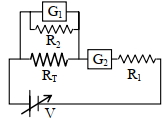
- B
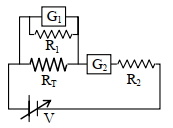
- C
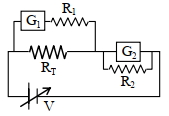
- D
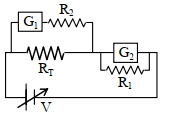
IIT 2010, Advanced


Download our appand get started for free
Experience the future of education. Simply download our apps or reach out to us for more information. Let's shape the future of learning together!No signup needed.*
Similar Questions
- 1When equal current is passed through two coils, equal magnetic field is produced at their centres. If the ratio of number of turns in the coils is $8: 15$, then the ratio of their radii will beView Solution
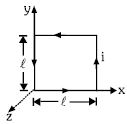
- 2The magnetic field existing in a region is given by $\vec B\, = \,{B_0}\,\left( {5 + \frac{x}{l}} \right)\,\hat K$ A square loop of edge $l$ and carrying a current $i$ is placed with its edges parallel to $x-y$ axes. Find the magnitude of the net magnetic force experienced by the loopView Solution
- 3A long solenoid is formed by winding $70$ turns $cm ^{-1}$. If $2.0\,A$ current flows, then the magnetic field produced inside the solenoid is $.......\times 10^{-4}\,T$ $\left(\mu_0=4 \pi \times 10^{-7}\,TmA ^{-1}\right)$View Solution
- 4View SolutionA particle is moving in a uniform magnetic field, then
- 5A voltmeter of resistance $1000\,\Omega $ gives full scale deflection when a current of $100\, mA$ flow through it. The shunt resistance required across it to enable it to be used as an ammeter reading $1\, A$ at full scale deflection is ............... $\Omega $View Solution
- 6One of the two small circular coils, (none of them having any self- inductance) is suspended with a $V-$ shaped copper wire, with plane horizontal. The other coil is placed just below the first one with plane horizontal. Both the coils are connected in series with a $dc$ supply. The coils are found to attract each other with a force. Which one of the following statements is incorrect ?View Solution
- 7The magnetic field at the origin due to a current element $i\,\overrightarrow {dl} $ placed at position $\vec r$ isView Solution
$(i)\,\,\left( {\frac{{{\mu _0}i}}{{4\pi }}} \right)\left( {\frac{{d\vec l\, \times \,\vec r}}{{{r^3}}}} \right)$
$(ii)\,\, - \left( {\frac{{{\mu _0}i}}{{4\pi }}} \right)\left( {\frac{{d\vec l\, \times \,\vec r}}{{{r^3}}}} \right)$
$(iii)\,\left( {\frac{{{\mu _0}i}}{{4\pi }}} \right)\left( {\frac{{\,\vec r \times d\vec l}}{{{r^3}}}} \right)$
$(iv)\, - \left( {\frac{{{\mu _0}i}}{{4\pi }}} \right)\left( {\frac{{\,\vec r \times d\vec l}}{{{r^3}}}} \right)$
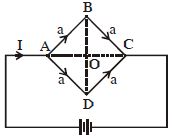
- 8Magnetic field at the centre $O$ of a square loop of side $'a'$ carrying current $I$ as shown in the figure isView Solution
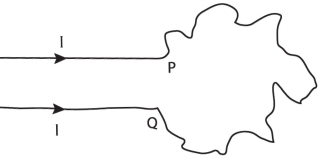
- 9Assertion $(A):$ A wire bent into an irregular shape with the points $P$ and $Q$ fixed. If a current $I$ passed through the wire, then the area enclosed by the irregular portion of the wire increases.View Solution
Reason $(R):$ Opposite currents carrying wires repel each other.
- 10A conductor (shown in the figure) carrying constant current $I$ is kept in the $x-y$ plane in a uniform magnetic field $\vec{B}$. If $F$ is the magnitude of the total magnetic force acting on the conductor, then the correct statement$(s)$ is(are) $Image$View Solution
$(A)$ If $\vec{B}$ is along $\hat{z}, F \propto(L+R)$
$(B)$ If $\overrightarrow{ B }$ is along $\hat{ x }, F =0$
$(C)$ If $\vec{B}$ is along $\hat{y}, F \propto(L+R)$
$(D)$ If $\overrightarrow{ B }$ is along $\hat{ z }, F =0$