Question
Total flux produced by a source of $1 cd$ is

Answer

(c) Luminous intensity $L = \frac{\phi }{{4\pi }}$$ \Rightarrow 1 = \frac{\phi }{{4\pi }} \Rightarrow \phi = 4\pi $.

Need a full question paper?

Generate a complete, print-ready paper with questions like this in minutes — across 16+ boards, with answer keys.

Start Generating Free

Similar questions

Which one of the following schematic graphs best represents the variation of $p V$ (in Joules) versus $T$ (in Kelvin) of one mole of an ideal gas? (The dotted line represents $p V=T$ )
If the position vector of a particle is

$\vec r =  - \cos \,t\hat i + \sin \,t\hat j - 18\,t\hat k$

then what is the magnitude of its acceleration ?

A distant hot air balloon subtends $0.25^o$ at the objective lens of an astronomical teleseope. The image subtends $1.5^o$ at  eyepiece when viewed with relaxed eye.The objective and eyepiece are in a $35\  cm$ long tube. Find the focal length of the eyepiece lens.....$cm$
A particle moves along a semicircle of radius $10\,m$ in $5$ seconds. The average velocity of the particle is...........$ms^{-1}$
Base catalysed aldol condensation occurs with
For a transverse wave travelling along a straight line, the distance between two peaks (crests) is $5 \,m ,$ while the distance between one crest and one trough is $1.5 \,m$ The possible wavelengths (in $m$ ) of the waves are
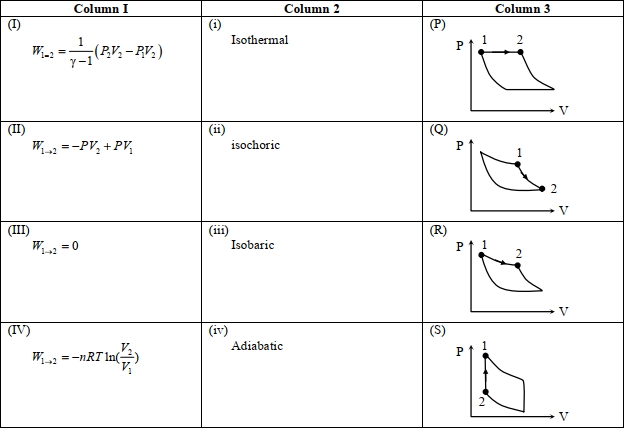
An ideal gas is undergoing a cyclic thermodynamic process in different ways as shown in the corresponding $P$ $V$ diagrams in column $3$ of the table. Consider only the path from state $1$ to $2 . W$ denotes the corresponding work done on the system. The equations and plots in the table have standard notations as used in thermodynamic processes. Here $\gamma$ is the ratio of heat capacities at constant pressure and constant volume. The number of moles in the gas is $n$.

(image)

($1$) Which of the following options is the only correct representation of a process in which $\Delta U=\Delta Q-P \Delta V$ ?

$[A] (II) (iv) (R)$    $[B] (II) (iii) (P)$    $[C] (II) (iii) (S)$   $[D] (III) (iii) (P)$

($2$)  Which one of the following options is the correct combination?

$[A] (III) (ii) (S)$    $[B] (II) (iv) (R)$   $[C] (II) (iv) (P)$   $[D] (IV) (ii) (S)$

($3$) Which one of the following options correctly represents a thermodynamic process that is used as a correction in the determination of the speed of sound in an ideal gas?

$[A] (III) (iv) (R)$  $[B] (I) (ii)$ $(\mathrm{Q})$   $[C] (IV) (ii) (R)$    $[D] (I) (iv) (Q)$

Identify the principal product of the following reaction?
There are $100$ divisions on the circular scale of a screw gauge of pitch $1 \mathrm{~mm}$. With no measuring quantity in between the jaws, the zero of the circular scale lies $5$ divisions below the reference line. The diameter of a wire is then measured using this screw gauge. It is found the $4$ linear scale divisions are clearly visible while $60$ divisions on circular scale coincide with the reference line. The diameter of the wire is :
In a young's double slit experiment, the fringe pattern is observed on a screen placed at a distance $D$. The slits are separated by $d$ and are illuminated by light of wavelength $\lambda$. Find the distance from the central point where the intensity falls  to half the maximum is