Question
Total internal reflection can take place only if:
  1. Light goes from optically rarer medium (smaller refractive index) to optically denser medium.
  2. Light goes from optically denser medium to rarer medium.
  3. The refractive indices of the two media are close to each other.
  4. The refractive indices of the two media are widely different.
Answer

  1. Light goes from optically denser medium to rarer medium.

Explanation:

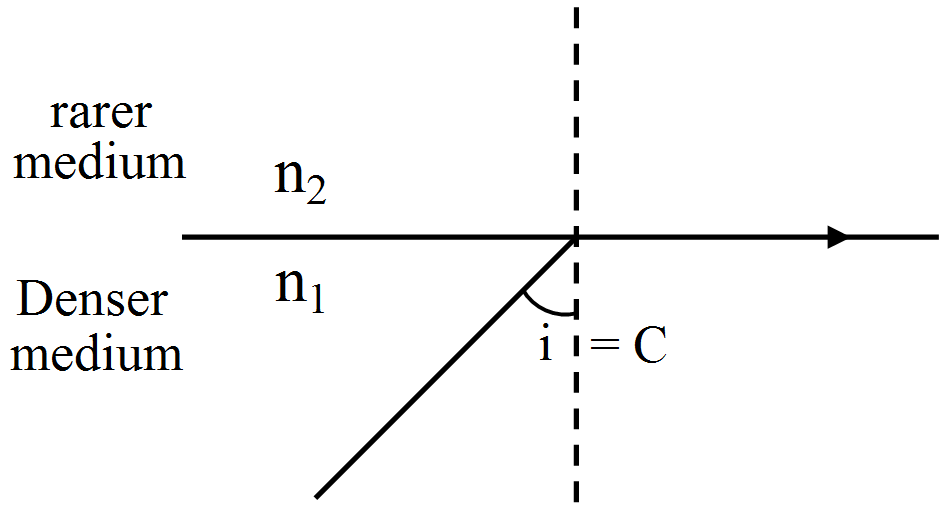
T.I.R. (Total Internal reflection)

i < C (condition for T.I.R.)

By Snell's Law

$\text{n}_1\sin\text{i}=\text{n}_2\sin90^{\circ}$

$\sin\text{i}=\frac{\text{n}_2}{\text{n}_1}=\sin\text{C}$

$\text{þ} \ \text{C}=\sin^{-1}$

$\because \ -1\leq\sin\text{i}\leq1$

n1 > n2 (so we can conclude that light goes from optically denser medium to rarer medium & incident angle is greater than the critical angle.)

Need a full question paper?

Generate a complete, print-ready paper with questions like this in minutes — across 16+ boards, with answer keys.

Start Generating Free

Similar questions

Assertio : Hydrogen atom consists of only one electron but its emission spectrum has many lines.  

Reason  : Only Lyman series is found in the absorption spectrum of hydrogen atom whereas in the emission spectrum, all the series are found.

(a) If both assertion and reason are true and the reason is the correct explanation of the assertion.

(b) If both assertion and reason are true but reason is not the correct explanation of the assertion.

(c) If assertion is true but reason is false.

(d) If the assertion and reason both are false.

What is the potential energy of the equal positive point charges of 1μC each held 1 m apart in air

(a) 9  

(b) 9  

(c) 2 eV/m

(d) Zero

Six charges, three positive and three negative of equal magnitude are to be placed at the vertices of a regular hexagon such that the electric field at O is double the electric field when only one positive charge of same magnitude is placed at R. Which of the following arrangements of charges is possible for P, Q, R, S, T and U respectively

(a) +, -, +, -, -, +

(b) +, -, +, -, +, -

(c) +, +, -, +, -, -

(d) -, +, +, -, +, -

Consider the diffraction patern for a small pinhole. As the size of the hole is increased:

The charge on a hole is equal to the charge of

(a) Zero

(b) Proton

(c) Neutron

(d) Electron

The focal length of a convex lens is 10 cm and its refractive index is 1.5.  If the radius of curvature of one surface is 7.5 cm, the radius of curvature of the second surface will be

(a) 7.5 cm

(b) 15.0 cm

(c) 75 cm

(d) 5.0 cm

During the nuclear fusion reaction

(a) A heavy nucleus breaks into two fragments by itself

(b) A light nucleus bombarded by thermal neutrons breaks up

(c) A heavy nucleus bombarded by thermal neutrons breaks up

(d) Two light nuclei combine to give a heavier nucleus and possibly other products

The electric potential V at any point O (x, y, z all in metres) in space is given by . The electric field at the point (1m,0, 2m)  in volt/metre  is

(a) 8 along negative X - axis

(b) 8 along positive X -  axis

(c) 16 along negative X -  axis

(d) 16 along positive Z - axis

A very thin film in reflected white light appears:

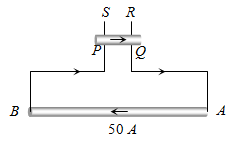
A long wire AB is placed on a table. Another wire PQ of mass 1.0 g and length 50 cm is set to slide on two rails PS and QR. A current of 50A is passed through the wires. At what distance above AB, will the wire PQ be in equilibrium

(a) 25 mm

(b) 50 mm

(c) 75 mm

(d) 100 mm