Question
Total internal reflection is the phenomenon of reflection of light into denser medium at the interface of denser medium with a rarer medium. For this phenomenon to occur necessary condition is that light must travel from denser to rarer and angle of incidence in denser medium must be greater than critical angle (C) for the pair of media in contact. Critical angle depends on nature of medium and wavelength of tight. We can show that $\mu=\frac{1}{\sin\text{C}}.$
  1. Critical angle for glass air interface, where ft of glass is $\frac{3}{2}$ is,
  1. 41.8
  2. 60º
  3. 30º
  4. 15º
  1. Critical angle for water air interface is 48.6º. What is the refractive index of water?
  1. $1$
  2. $\frac{3}{2}$
  3. $\frac{4}{3}$
  4. $\frac{3}{4}$
  1. Critical angle for air water interface for violet colour is 49º. Its value for red colour would be:
  1. 49º
  2. 50º
  3. 48º
  4. Cannot say.
  1. Which of the following is not due to total internal reflection?
  1. Working of optical fibre.
  2. Difference between apparent and real depth of a pond.
  3. Mirage on hot summer days.
  4. Brilliance of diamond.
  1. Critical angle of glass is $\theta_1$ and that of water is $\theta_2$The critical angle for water and glass surface would be $(\mu_\text{g}=\frac{3}{2},\ \mu_\text{w}=\frac{4}{3})$
  1. Less than $\theta_2$
  2. Between $\theta_1$ and $\theta_2$
  3. Greater than $\theta_2$
  4. Less than $\theta_1$

Answer

  1. (a) 41.8
Explanation:

$\sin\text{C}=\frac{1}{\mu}=\frac{1}{\frac{3}{2}}=\frac{2}{3}=0.6667$

$\text{C}=\sin^{-1}(0.6667)=41.8^{\circ}$
  1. (c) $\frac{4}{3}$
Explanation:

$\text{C}\mu=\frac{1}{\sin\text{C}}=\frac{1}{\sin48.6}=\frac{1}{0.75}=\frac{4}{3}$
  1. (c) 48º
Explanation:

From $\mu=\frac{1}{\sin\text{C}},\sin\text{C}=\frac{1}{\mu}$

As, $\mu_\text{v}>\mu_\text{r}\therefore\text{C}_\text{v}<\text{C}_\text{r}$

The correct alternative may be (c).
  1. (b) Difference between apparent and real depth of a pond.
Explanation:

Difference between apparent and real depth of a pond is due to refraction. Other three are due to total internal reflection.
  1. (c) Greater than $\theta_2$
Explanation:

As, $^\text{w}{\mu}_\text{g}<\ ^\text{a}\mu_\text{w}<\ ^\text{a}\mu_\text{g};\ \therefore\theta>\theta_2>\theta_1$

Need a full question paper?

Generate a complete, print-ready paper with questions like this in minutes — across 16+ boards, with answer keys.

Start Generating Free

Similar questions

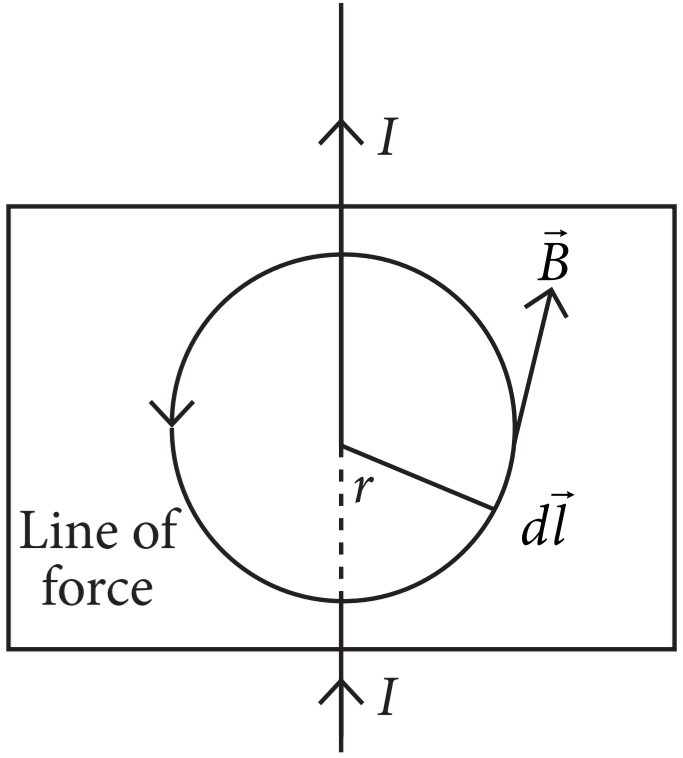
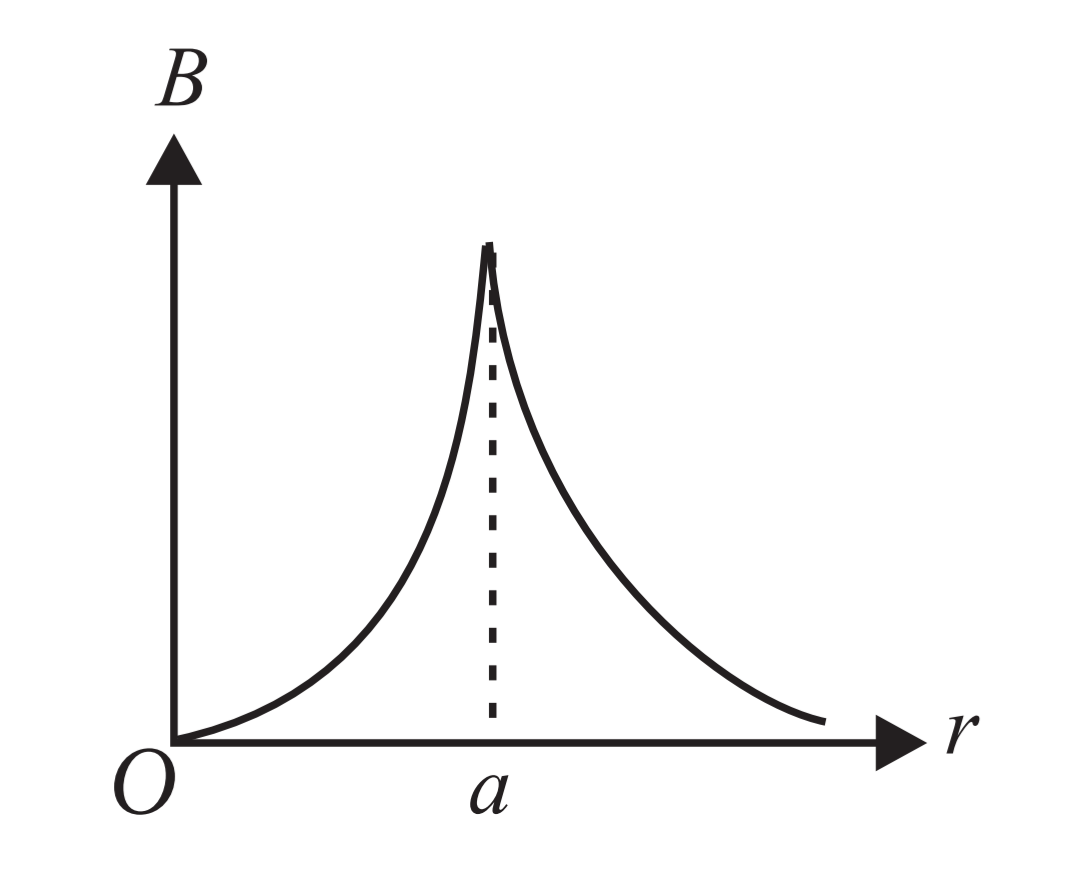
Ampere's law gives a method to calculate the magnetic field due to given current distribution. According to it, the circulation $\oint\vec{\text{B}}.\text{d}\vec{\text{l}}$ di of the resultant magnetic field along a closed plane curve is equal to $\mu_0$ times the total current crossing the area bounded by the closed curve provided the electric field inside the loop remains constant. Ampere's law is more useful under certain synunetrical conditions. Consider one such case of a long Straight wire with circular cross-section (radius R) carrying current f uniformly distributed across this cross-section.
  1. The magnetic field at a radial distance r from the centre of the wire in the region r > R, is:
  1. $\frac{\mu_0\text{I}}{2\pi\text{r}}$
  2. $\frac{\mu_0\text{I}}{2\pi\text{R}}$
  3. $\frac{\mu_0\text{IR}^2}{2\pi\text{r}}$
  4. $\frac{\mu_0\text{Ir}^2}{2\pi\text{R}}$
  1. The magnetic field at a distance r in the region r < R is:
  1. $\frac{\mu_0\text{I}}{2\text{r}}$
  2. $\frac{\mu_0\text{Ir}^2}{2\pi\text{R}^2}$
  3. $\frac{\mu_0\text{I}}{2\pi\text{r}}$
  4. $\frac{\mu_0\text{Ir}}{2\pi\text{R}^2}$
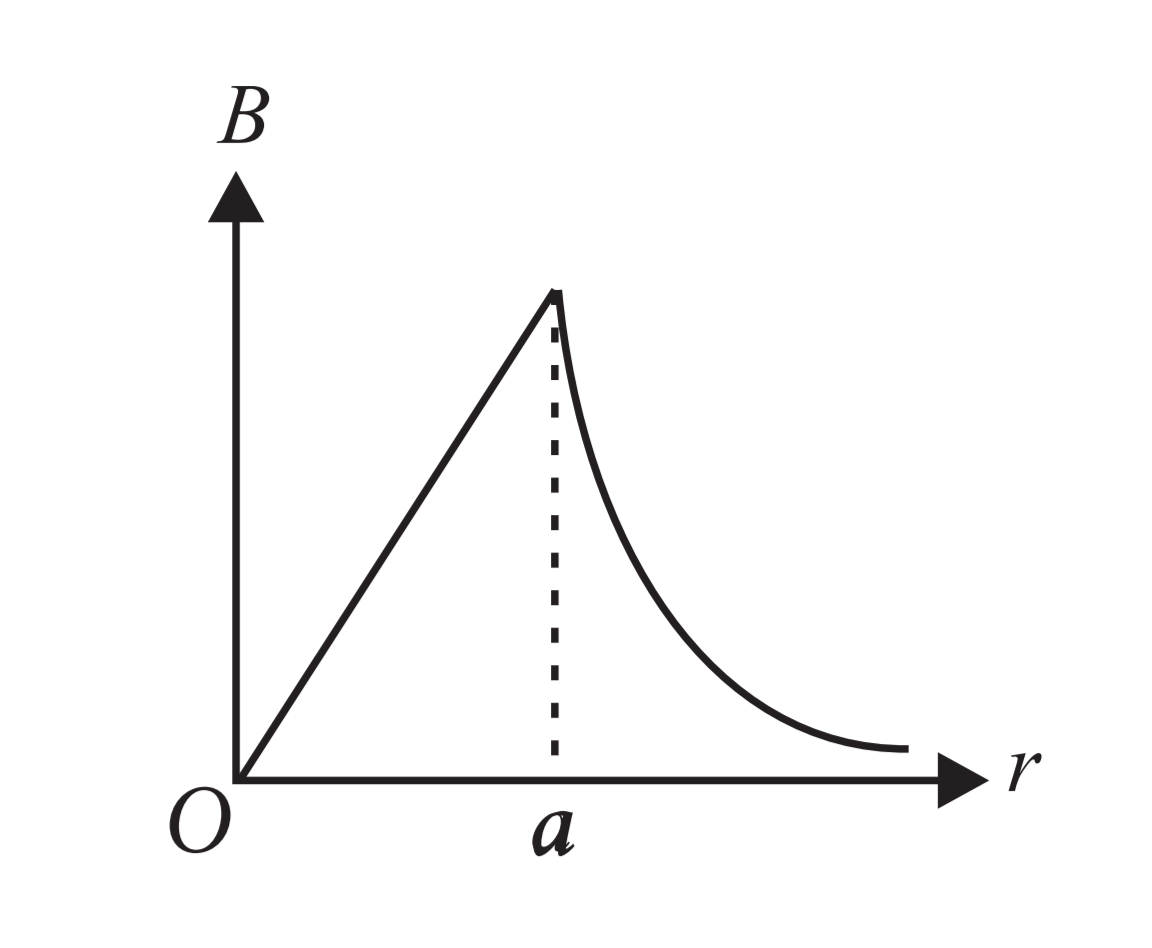
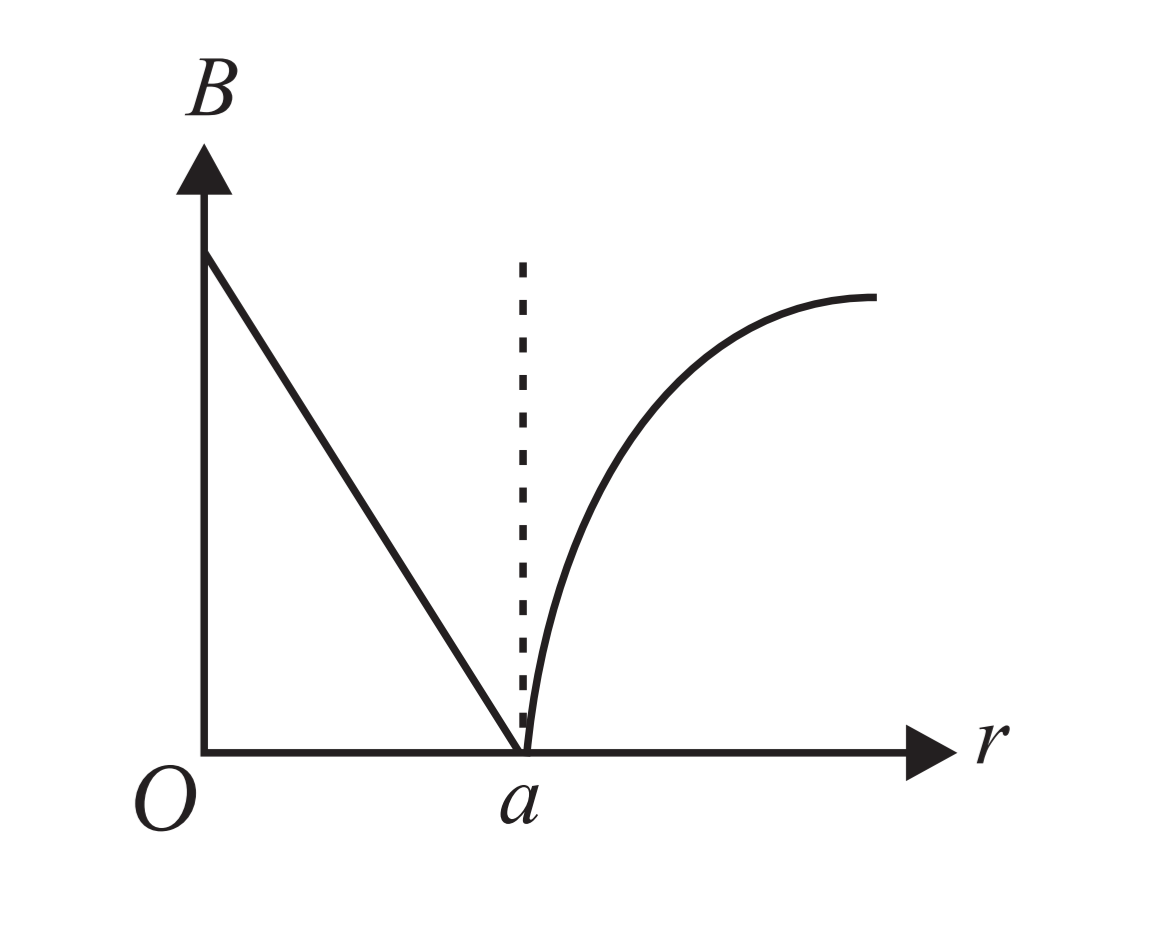
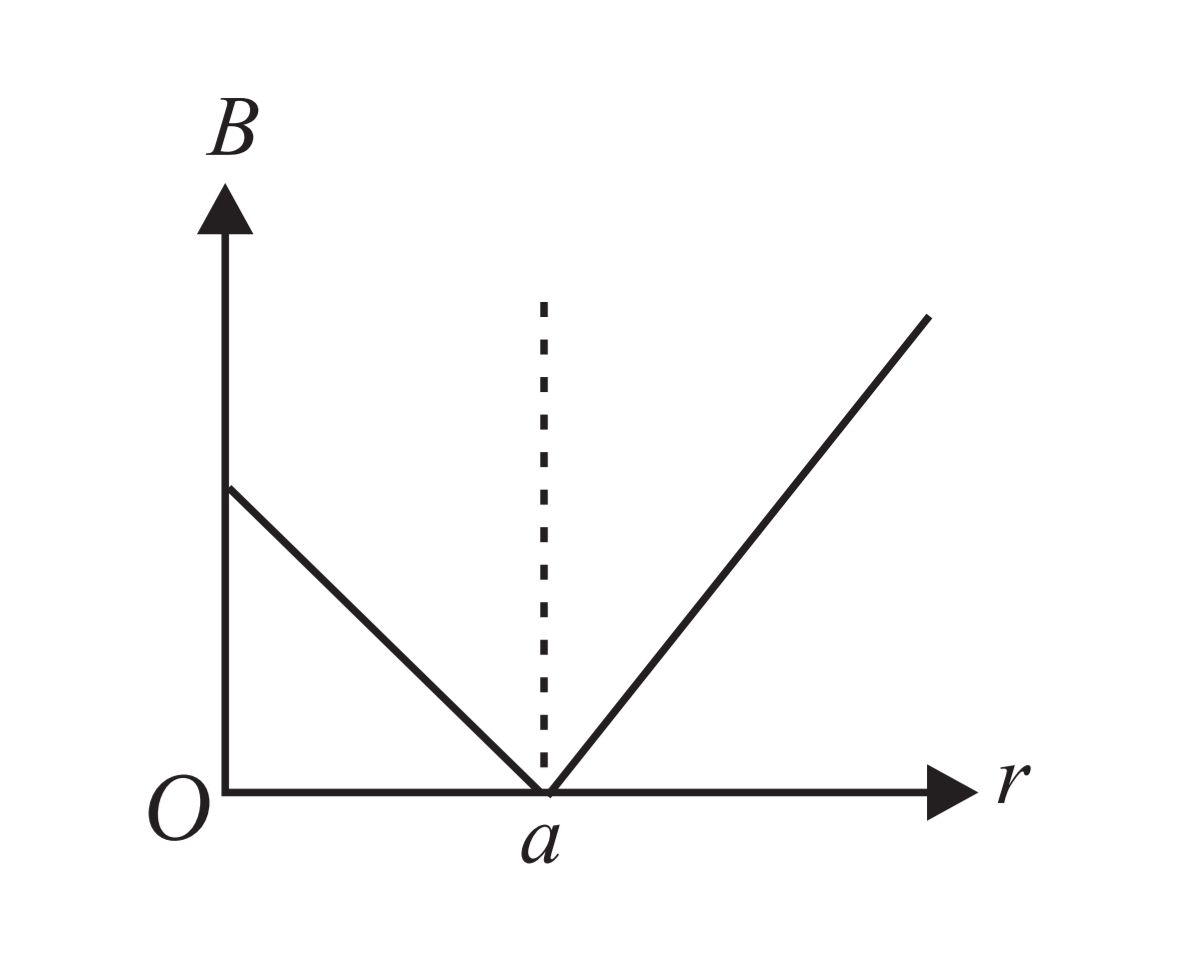
  1. A long straight wire of a circular cross section (radius a) carries a steady current I and the current I is uniformly distributed across this cross-section. Which of the following plots represents the variation of magnitude of magnetic field B with distance r from the centre of the wire?
  1.  
  1.  
  1.  
  1.  
  1. A long straight wire of radius R carries a steady current I. The current is uniformly distributed across its cross-section. The ratio of magnetic field at $\frac{\text{R}}{2}$ and 2R is:
  1. $\frac{\text{1}}{\text{2}}$
  2. $2$
  3. $\frac{\text{1}}{\text{4}}$
  4. $1$
  1. A direct current I flows along the length of an infinitely long straight thin walled pipe, then the magnetic field is:
  1. Uniform throughout the pipe but not zero.
  2. Zero only along the axis of the pipe.
  3. Zero at any point inside the pipe.
  4. Maximum at the centre and minimum at the edges.
Show that the magnetic field at a point due to a magnetic dipole is perpendicular to the magnetic axis if the line joining the point with the centre of the dipole makes an angle of $\tan^{-1}(\sqrt{2})$ with the magnetic axis.
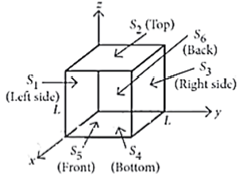
Net electric flux through a cube is the sum of fluxes through its six faces. Consider a cube as shown in figure, having sides of length $L =10.0 \ cm$. The electric field is uniform, has a magnitude $E =4.00 \times 10^3 NC ^{-1}$ and is parallel to the $xy$ plane at an angle of $37^{\circ}$ measured from the $+ x -$axis towards the $+ y -$axis.
Image
$(i)$ Electric flux passing through surface $S_6$ is
$(a) \ -24 \ Nm ^2 C ^{-1}$
$(b) \ 32 \ Nm ^2 C ^{-1}$
$(c) \ -32 \ Nm ^2 C ^{-1}$
$(d)\  24 \ Nm ^2 C ^{-1}$
$(ii)$ Electric flux passing through surface $S_1$ is
$(a)-32 \ Nm ^2 C ^{-1}$
$(b) -24 \ Nm ^2 C ^{-1}$
$(c)\ 32 \ Nm ^2 C ^{-1}$
$(d)\ 24 \ Nm ^2 C ^{-1}$
$(iii)$ The surfaces that have zero flux are
$(a) S _2$ and $S _4  \ (b)  S_3$ and $S_6  \ (c)  S _1$ and $S _2  \ (d)  S _1$ and $S _3$
$(iv)$ he total net electric flux through all faces of the cube is $a) 24 \ Nm^2 C-1 c)-8 \ Nm^2 C-1$
$(a) \ 24 \ Nm ^2 C ^{-1}  \ (b) \  8 \ Nm ^2 C ^{-1}  \ (c)  \ -8 \ Nm ^2 C ^{-1}  \ (d)$ zero
OR
The dimensional formula of surface integral $\oint \vec{E} \cdot d \vec{S}$ of an electric field is
$(a) \ \left[ M ^{-1} L^3 T^{-3} A\right]$
$(b)\  \left[ M L ^2 T^{-2} A^{-1}\right]$
$(c) \ \left[ ML ^3 T^{-3} A^{-1}\right]$
$(d) \ \left[ M L ^{-3} T^{-3} A^{-1}\right]$
Show that the magnetic field at a point due to a magnetic dipole is perpendicular to the magnetic axis if the line joining the point with the centre of the dipole makes an angle of $\tan^{-1}(\sqrt{2})$ with the magnetic axis.
Suppose the density of air at Madras is $P_0$ and atomospheric pressure is $P_0$. If we go up, the density and the pressure both decrease. Suppose we wish to calculate the pressure at a height 10km above Madras. If we use the equation $P_0- P =$ pogz, will we get a pressure more than the actual or less than the actual? Neglect the variation in g. Does your answer change if you also consider the variation in g?
Neutrons and protons are identical particle in the sense that their masses are nearly the same and the force, called nuclear force, does into distinguish them. Nuclear force is the strongest force. Stability of nucleus is determined by the neutron proton ratio or mass defect or packing fraction. Shape of nucleus is calculated by quadrupole moment and spin of nucleus depends on even or odd mass number. Volume of nucleus depends on the mass number. Whole mass of the atom (nearly 99%) is centered at the nucleus.
  1. The correct statements about the nuclear force is/ are.
  1. Change independent.
  2. Short range force.
  3. Non-conservative force.
  4. All of these.
  1. The range of nuclear force is the order of.
  1. $2 \times 10^{-10}m$
  2. $1.5 \times 10^{-20}m$
  3. $1.2.\times ^10^{-4}m$
  4. $1.4 \times 10^{-15}m$
  1. A force between two protons is same as the force between proton and neutron. The nature of the force is.
  1. Electrical force.
  2. Weak nuclear force.
  3. Gravitational force.
  4. Strong nuclear force.
  1. Two protons are kept at a separation of 40 A. $F_n$ is the nuclear force and $F_e$ is the electrostatic force between them. Then.
  1. $F_n << F_e$
  2. $F_n= F_e$
  3. $F_n >> F_e$
  4. $F_n = F_e$
  1. AD the nucleons in an atom are held by.
  1. Nuclear forces
  2. Van der Waal's forces
  3. Tensor forces
  4. Coulomb forces
To convert two atoms into ions, 2 electrons have been removed from each of them. When these ions are placed in a vacuum, they repel each other with a force of $3.7 \times 10^{-9}$ Newton. Find the distance between them.
The needle of a dip circle shows an apparent dip of 45° in a particular position and 53° when the circle is rotated through 90°. Find the true dip.
A charge of $1.6 \times 10^{-7} C$ is uniformly distributed on the surface of a spherical conductor of radius 12 cm . What will be the electric field?(a) Inside the sphere(b) Just outside the sphere(c) At any point located 18 cm from the centre of the sphere.
Calculate the intensity of the electric field due to the helium nucleus at a distance of $1Å$ from it.