MCQ
Total number of electron present in $\left(\pi^*\right)$ molecular orbitals of $\mathrm{O}_2, \mathrm{O}_2^{+}$and $\mathrm{O}_2^{-}$is ............
- ✓$6$
- B$7$
- C$9$
- D$10$
$ \left(\sigma_{2 \mathrm{p}}\right)^2\left[\left(\pi_{2 \mathrm{p}}\right)^2=\left(\pi_{2 \mathrm{p}}\right)^2\right],\left[\left(\pi_{2 \mathrm{p}}^*\right)^1=\left(\pi_{2 \mathrm{p}}^*\right)^1\right]$
Number of $\mathrm{e}^{-}$present in $\left(\pi^*\right)$ of $\mathrm{O}_2=2$
Number of $\mathrm{e}^{-}$present in $\left(\pi^*\right)$ of $\mathrm{O}_2^{+}=1$
Number of $\mathrm{e}^{-}$present in $\left(\pi^*\right)$ of $\mathrm{O}_2^{-}=3$
So total $\mathrm{e}^{-}$in $\left(\pi^*\right)=2+1+3=6$
Generate a complete, print-ready paper with questions like this in minutes — across 16+ boards, with answer keys.
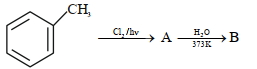
$A$ in the above reaction is:

$SO_3(g) \rightleftharpoons SO_2(g)+ \frac{1}{2} O_2(g)$
is $K_c= 4.9 \times 10^{-2}.$ The value of $K_c$ for the reaction
$2SO_2(g) + O_2(g) \rightleftharpoons 2SO_3(g)$
will be