MCQ
Total number of electrons in $“Cu”$ atom having $m_l = 0$
  • A
    $9$
  • $13$
  • C
    $10$
  • D
    $6$

Answer

Correct option: B.
$13$
b
Electronic configuration of $Cu(29) = 1s^2\ 2s^2\ 2p^6\ 3s^2\ 3p^6\ 4s^1\ 3d^{10}$

$\therefore m_l = 0$ will be $= 2 + 2 + 2 + 2 + 2 + 1 + 2 = 13$

Need a full question paper?

Generate a complete, print-ready paper with questions like this in minutes — across 16+ boards, with answer keys.

Start Generating Free

Similar questions

A reaction of $0.1$ mole of Benzylamine with bromomethane gave $23\, g$ of Benzyl trimethyl ammonium bromide. The number of moles of bromomethane consumed in this reaction are $n \times 10^{-1},$ when $n =\ldots...$ (Round off to the Nearest Integer).

(Given : Atomic masses: $C$ : $12.0\, u$, $H : 1.0\, u , N : 14.0\, u , Br : 80.0\, u ]$

A weak acid of dissociation constant $10^{-5}$ is being titrated with aqueous $NaOH$ solution. The $pH$ at the point of one-third neutralization of the acid will be:-
What amount of bromine will be required to convert 2 g of phenol into 2, 4, 6-tribromophenol ? (Given molar mass in $g mol ^{-1}$ of $C , H , O , Br$ are $12,1,16,80$ respectively)
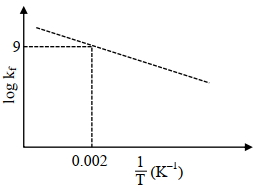
The plot of $\log \mathrm{k}_f$ versus $1 / \mathrm{T}$ for a reversible reaction $\mathrm{A}(\mathrm{g}) \rightleftharpoons \mathrm{P}(\mathrm{g})$ is shown.

(Image)

Pre-exponential factors for the forward and backward reactions are $10^{15} \mathrm{~s}^{-1}$ and $10^{11} \mathrm{~s}^{-1}$, respectively. If the value of $\log \mathrm{K}$ for the reaction at $500 \mathrm{~K}$ is $6$ , the value of $\left|\log \mathrm{k}_{\mathrm{b}}\right|$ at $250 \mathrm{~K}$ is $\qquad$

$[\mathrm{K}=$ equilibrium constant of the reaction

$\mathrm{k}_{\mathrm{f}}=$ rate constant of forward reaction

$\mathrm{k}_{\mathrm{b}}=$ rate constant of backward reaction]
Arrange the following in the order of their decreasing electrode potential $Mg, K, Ba, Ca$
Number of bonds in benzene
The $pH$ of an acidic buffer mixture is
Action of hydrogen chloride on $\mathop {\mathop {C{H_3} - C = C{H_2}}\limits_| }\limits_{\,\,\,\,\,C{H_3}} $ and on $CH \equiv CH$ will predominantly give the compounds, respectively
Which of the following reactions will yield $2, 2-$dibromopropane
A proton and a $Li ^{3+}$ nucleus are accelerated by the same potential. If $\lambda_{L i}$ and $\lambda_{P}$ denote the de Broglie wavelengths of $Li ^{3+}$ and proton respectively, then the value of $\frac{\lambda_{ Li }}{\lambda_{ P }}$ is $x \times 10^{-1}$.The value of $x$ is ............

(Rounded off to the nearest integer)

(Mass of $Li ^{3+}=8.3$ mass of proton)