MCQ
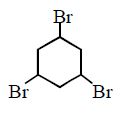
Total number of stereo isomers possible by given compound is
  • $2$
  • B
    $3$
  • C
    $4$
  • D
    $8$

Answer

Correct option: A.
$2$
a

Need a full question paper?

Generate a complete, print-ready paper with questions like this in minutes — across 16+ boards, with answer keys.

Start Generating Free

Similar questions

A quantum will have more energy if :
Ligand in a complex salt are
Identify correct statements from below:

$A$. The chromate ion is square planar.

$B$. Dichromates are generally prepared from chromates.

$C$. The green manganate ion is diamagnetic.

$D$. Dark green coloured $\mathrm{K}_2 \mathrm{MnO}_4$ disproportionates in a neutral or acidic medium to give permanganate.

$E$. With increasing oxidation number of transition metal, ionic character of the oxides decreases.

Choose the correct answer from the options given below:

In the following the most stable conformation of $n-$ butane is
Highest value of $pK_b$ will be of :
The photoelectric current from Na (work function, $\left. w _{0}=2.3\, eV \right)$ is stopped by the output voltage of the cell 

$Pt ( s )\left| H _{2}( g , 1 bar )\right| HCl ( aq \cdot, pH =1)| AgCl ( s )| Ag ( s )$

The $pH$ of aq. HCl required to stop the photoelectric current from $K \left( w _{0}=2.25 eV \right),$ all other conditions remaining the same, is..........$\times 10^{-2}$ (to the nearest integer).

Given, $2.303 \frac{ RT }{ F }=0.06 V ; E _{ AgC1|Ag|C ^{-}}^{0}=0.22\, V$

Liquids $A$ and $B$ form and ideal solution in the entire composition range. At $350\, K$, the vapour pressures of pure $A$ and pure $B$ are $7 \times 10^3\, Pa$ and $12 \times 10^3\, Pa$, respectively. The composition of the vapour in equilibrium with a solution containing $40\, mole$ percent of $A$ at this temperature is
Which one does not exist ?
If for ${H_2}_{(g)} + \frac{1}{2}{S_{2(S)}}$ $\rightleftharpoons$ ${H_2}{S_{(g)}}$ and ${H_{2(g)}} + B{r_{2(g)}}$ $\rightleftharpoons$ $2HB{r_{(g)}}$The equilibrium constants are $K_1$ and $K_2$ respectively, the reaction$B{r_2}_{(g)} + {H_2}{S_{(g)}}$ $\rightleftharpoons$ $2HB{r_{(g)}} + \frac{1}{2}{S_{2(S)}}$ would have equilibrium constant
The osmotic pressure of equimolar solutions of urea, $BaCl_2$ and $AlCl_3$ will be in the order