MCQ
Transition element makes complex compound due to
  • presence of $d-$ orbital
  • B
    large size
  • C
    variable valency
  • D
    presence of $2e^-$

Answer

Correct option: A.
presence of $d-$ orbital
a

Need a full question paper?

Generate a complete, print-ready paper with questions like this in minutes — across 16+ boards, with answer keys.
Start Generating Free

Similar questions

The product obtained by heating ${(N{H_4})_2}S{O_4}$ and $KCNO$ is
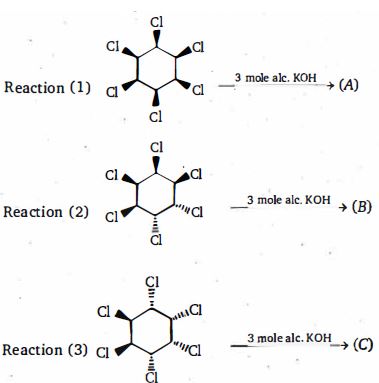
Product obtained in above reactions $(1), (2)$ & $(3)$ is
_______________ is responsible for development of secondary male characteristic like deep voice and facial hair
Which of the following complexes exhibit the highest paramagnetic behaviour ? Where gly $=$ glycine, en $=$ ethylenediamine and bpy $=$ bipyridyl moities) (At. nos. $Ti =22,\, V = 23,\, Fe = 26, \,Co= 27$)
The boiling point of benzene is $353.23\,\, K$. When $1.80\,gm$ of a nonvolatile solute was dissolved in $90\,gm$ of benzene, the boiling point is raised to $354.11\,K$. the molar mass of the solute is ........ $g\,mo{l^{ - 1}}$ . $[{K_b}$ for benzene $= 2.53 \,K\,mol^{-1}$]
Isobutene in the presence of dil. $H_2SO_4,$ forms an alcohol major product is
How many minutes are required to deliver $3.21 \times 10^6$ Columbs using a current of $500\, A$ used in the commercial production of chlorine?
Which statement is correct for product $‘X’$ ?

$\begin{array}{*{20}{c}}
  {O\,\,\,\,\,\,\,\,\,\,\,\,\,\,\,\,\,\,\,\,\,\,\,\,\,\,C \equiv CH\,\,\,\,\,\,\,\,\,\,\,\,\,\,\,\,\,\,\,\,\,\,\,\,\,\,\,\,\,O\,\,\,} \\ 
  {\,\,\,\,\,\,\,\,\,\,\,\,\,\,\,||\,\,\,\,\,\,\,\,\,\,\,\,\,\,\,\,\,\,\,\,\,\,\,\,\,\,\,\,|\,\,\,\,\,\,\,\,\,\,\,\,\,\,\,\,\,\,\,\,\,\,\,\,\,\,\,\,\,\,\,\,\,\,\,\,\,\,\,\,\,\,\,\,\,\,\,||\,\,\,\,\,\,\,\,\,\,\,\,\,\,\,\,\,\,\,} \\ 
  {Cl - C - C{H_2} - C - C{H_2} - C{H_2} - C - C{H_3}} \\ 
  {|\,\,\,\,\,\,\,\,\,\,\,\,\,\,\,\,\,\,\,\,\,\,\,\,} \\ 
  {C{H_2}\,\,\,\,\,\,\,\,\,\,\,\,\,\,\,\,\,\,} \\ 
  {|\,\,\,\,\,\,\,\,\,\,\,\,\,\,\,\,\,\,\,\,\,\,\,\,\,} \\ 
  {C \equiv N\,\,\,\,\,\,\,\,\,\,\,\,\,\,\,} 
\end{array}$ $\xrightarrow[{BaS{O_4}}]{{{H_2}/Pd}}\,'X'$

$P{H_4}I + NaOH$ forms
The hydrolysis of ethyl acetate is a reaction of ......... order

$C{{H}_{3}}COOEt+{{H}_{2}}O\xrightarrow{{{H}^{+}}}C{{H}_{3}}COOH+EtOH$