MCQ
Transition elements are coloured
- ADue to small size
- BDue to metallic nature
- ✓Due to unpaired $d -$ electrons
- DAll of these
Generate a complete, print-ready paper with questions like this in minutes — across 16+ boards, with answer keys.
Compound $(A)$ exist in geometrical isomers and $(B)$ gives cannizaro reaction $(A)$ will be
A solution $\mathrm{M}$ is prepared by mixing ethanol and water. The mole fraction of ethanol in the mixture is $0.9$ .
Given: Freezing point depression constant of water $\left(\mathrm{K}_{\mathrm{f}}^{\text {rate }}\right)=1.86 \mathrm{~K} \mathrm{~kg} \mathrm{~mol}^{-1}$
Freezing point depression constant of ethanol $\left(\mathrm{K}_{\mathrm{f}}^{\text {ethunol }}\right)=2.0 \mathrm{~K} \mathrm{~kg} \mathrm{~mol}^{-1}$
Boiling point elevation constant of water $\left(\mathrm{K}_{\mathrm{b}}^{\text {nate }}\right)=0.52 \mathrm{~K} \mathrm{~kg} \mathrm{~mol}^{-1}$
Boiling point elevation constant of ethanol $\left(\mathrm{K}_{\mathrm{b}}^{\text {ethanol }}\right)=1.2 \mathrm{~K} \mathrm{~kg} \mathrm{~mol}^{-1}$
Standard freezing point of water $=273 \mathrm{~K}$
Standard freezing point of ethanol $=155.7 \mathrm{~K}$
Standard boiling point of water $=373 \mathrm{~K}$
Standard boiling point of ethanol $=351.5 \mathrm{~K}$
Vapour pressure of pure water $=32.8 \mathrm{~mm} \mathrm{Hg}$
Vapour pressure of pure ethanol $=40 \mathrm{~mm} \mathrm{Hg}$
Molecular weight of water $=18 \mathrm{~g} \mathrm{~mol}^{-1}$
Molecular weight of ethanol $=46 \mathrm{~g} \mathrm{~mol}^{-1}$
In answering the following questions, consider the solutions to be ideal dilute solutions and solutes to be non-volatile and nondissociative.
$1.$ The freezing point of the solution ${M}$ is
$(A)$ $268.7 \mathrm{~K}$ $(B)$ $268.5 \mathrm{~K}$
$(C)$ $234.2 \mathrm{~K}$ $(D)$ $150.9 \mathrm{~K}$
$2.$ The vapour pressure of the solution ${M}$ is
$(A)$ $39.3 \mathrm{~mm} \mathrm{Hg}$ $(B)$ $36.0 \mathrm{~mm} \mathrm{Hg}$
$(C)$ $29.5 \mathrm{~mm} \mathrm{Hg}$ $(D)$ $28.8 \mathrm{~mm} \mathrm{Hg}$
$3.$ Water is added to the solution ${M}$ such that the fraction of water in the solution becomes $0.9$ . The boiling point of this solution is
$(A)$ $380.4 \mathrm{~K}$ $(B)$ $376.2 \mathrm{~K}$
$(C)$ $375.5 \mathrm{~K}$ $(D)$ $354.7 \mathrm{~K}$
Give the answer question $1,2$ and $3.$
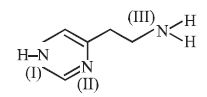
structure of $(A)$ is
[Given : Molar mass of water $=18 \mathrm{~g} \mathrm{~mol}^{-1}$, acetic acid $=60 \mathrm{~g} \mathrm{~mol}^{-1}$ ]
${ }^{\mathrm{K}_{\mathrm{f}}} \mathrm{H}_2 \mathrm{O}: 1.86 \mathrm{~K} \mathrm{~kg} \mathrm{~mol}^{-1}$
$\mathrm{K}_{\mathrm{r}}$ acetic acid : $3.90 \mathrm{~K} \mathrm{~kg} \mathrm{~mol}^{-1}$
freezing point: $\mathrm{H}_2 \mathrm{O}=273 \mathrm{~K}$, acetic acid $=290 \mathrm{~K}$ ]
$\left[\mathrm{CoCl}\left(\mathrm{NH}_3\right)_5\right]^{2+}, \quad\left[\mathrm{Co}(\mathrm{CN})_6\right]^{3-} \text {, }$
$(A)$ $(B)$
$\left[\mathrm{Co}\left(\mathrm{NH}_3\right)_5\left(\mathrm{H}_2 \mathrm{O}\right)\right]^{3+}, \quad\left[\mathrm{Cu}\left(\mathrm{H}_2 \mathrm{O}\right)_4\right]^{2+}$
$(C)$ $(D)$
The correct order of $A$, $B$, $C$ and $D$ in terms of wavenumber of light absorbed is :