MCQ
Transition elements form complexes readily because:
  • A
    Small size of cation
  • B
    Large ionic Charge
  • C
    Vacant d orbitals
  • D
    All the above

Answer

  1. All the above

Explanation:

Transition elements form complexes readily because

Due to lower size and higher charge, they have high charge density.

They have vacant d orbital in which a ligand can donate its electron and form complex.

Need a full question paper?

Generate a complete, print-ready paper with questions like this in minutes — across 16+ boards, with answer keys.

Start Generating Free

Similar questions

The rise in the boiling point of a solution containing $1.8\,gram$ of glucose in $100\,g$ of a solvent in ${0.1\,^o}C$. The molal elevation constant of the liquid is ..........  $K/m$.
$A.$ Phenyl methanamine

$B.$ $N , N$ -Dimethylaniline

$C.$ N-Methyl aniline

$D.$ Benzenamine

Choose the correct order of basic nature of the above amines.

The latent heat of vapourisation of water is $9700\,Cal/mole$ and if the b.p. is ${100\,^o}C$, ebullioscopic constant of water is  .......... $^oC$.
The reaction $2FeC{l_3} + SnC{l_2} \to 2FeC{l_2} + SnC{l_4}$ is an example of
Match List$-I$ with List$-II :$

List$-I$ List$-II$
$(a)$ $\left[ Co \left( NH _{3}\right)_{6}\right]\left[ Cr ( CN )_{6}\right]$

$(i)$ Linkage isomerism

$(b)$ $\left[ Co \left( NH _{3}\right)_{3}\left( NO _{2}\right)_{3}\right]$

$(ii)$Solvate isomerism

$(c)$ $\left[ Cr \left( H _{2} O \right)_{6}\right] Cl _{3}$

$(iii)$ Co-ordination isomerism

$(c)$ $cis-[CrCl$ $\left._{2}(\text { ox })_{2}\right]^{3-}$ $(iv)$ Optical isomerism

Choose the correct answer from the options given below:
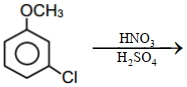
(see figure) Major Product, product will be :
The number of $S-S$ bonds in $SO_3, S_2O_3^{-2}, S_2O_6^{-2}$ and $S_2O_8^{-2}$ respectively are
The conversion of propan$-1-$ol to $n-$butylamine involves the sequential addition of reagents. The correct sequential order of reagents is.
The $[Fe(CN)_6]^{3-}$ complex ion
Two beakers of capacity 500mL were taken. One of these beakers, labelled as “A”, was filled with 400mL water whereas the beaker labelled “B” was filled with 400mL of 2M solution of NaCl. At the same temperature both the beakers were placed in closed containers of same material and same capacity as shown in. At a given temperature, which of the following statement is correct about the vapour pressure of pure water and that of NaCl solution.